This month’s work was mostly bodywork, specifically coming to the realization that I really am going to have to extend the rear coachwork. This awareness was finalized as a plan once I had enough constructed to lessen the degree of guesswork about where the power-train goes, which determines where the axles go, leading to the understanding of where the wheels and tires will be and thus the rear fender flares. Initially I’d thought that I could just do a speed-hump (no…not at my age I can’t) and cover the rear of the transaxle where it protrudes beyond the body. I added a bit of .040″ (1.016mm) bracing so that the bodywork would be dimensionally stable:

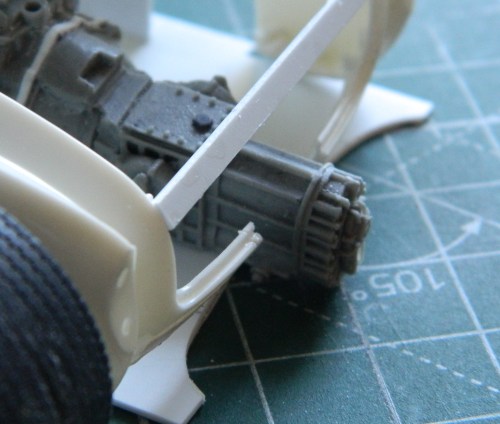
But once I estimated the location of the rear wheels, and subsequently the fender flares, I realized that the rear of the flares extended well past the rear of the body and would end up removing the sense of “Karman-Ghia” that I’m trying not to obliterate:
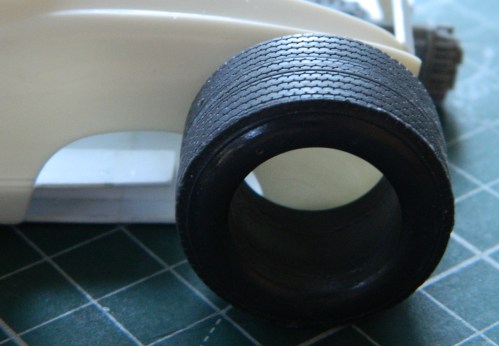
The brace was removed and the section of body that I’d removed was glued back into place.
I had initially considered making the cut much further forward, and I’d also considered making a couple (or more) cuts to blend the compound curves. I decided that I was, once again, overcomplicating things. Since I just need the back of the bodywork to extend past the end of the transaxle, I decided I’d just cut the end of the body off. I glued the stock engine cover in place for structural stability, only gluing the part that would be removed with the body (because as this point I still have the notion of having the former engine cover hinged separately from the rest of the hinged rear body to have a small load-carrying space that could be accessed without having to open the whole back of the car to get to it). I laid out the line and made the cut:

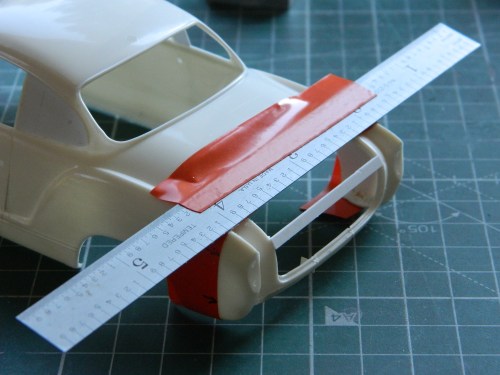

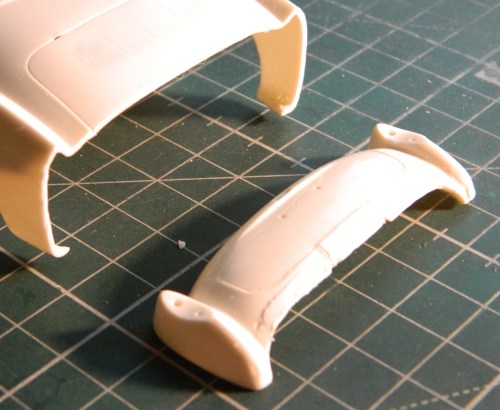
Not only did I move the section that was cut off back 5/8″ (15.88mm), I also moved it down in order to maintain the arc of the upper curves of the rear fenders. Once I figured out where I wanted it, I added .040″ (1.016mm) braces to hold it there (and managed to superglue my thumb to the rear of the fender, as you can see in the photos):
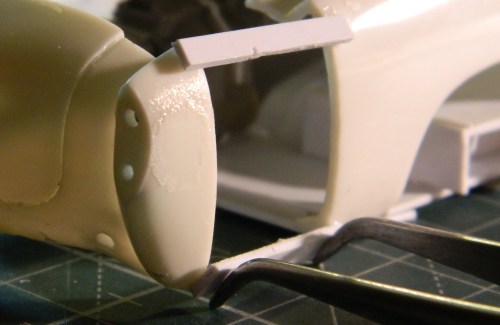
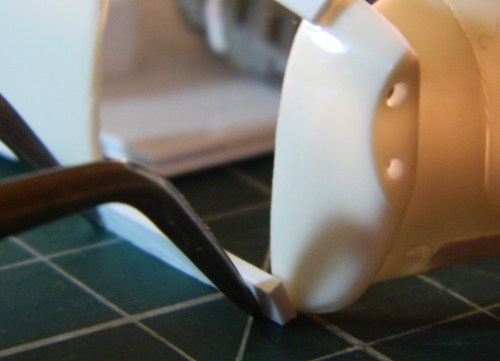
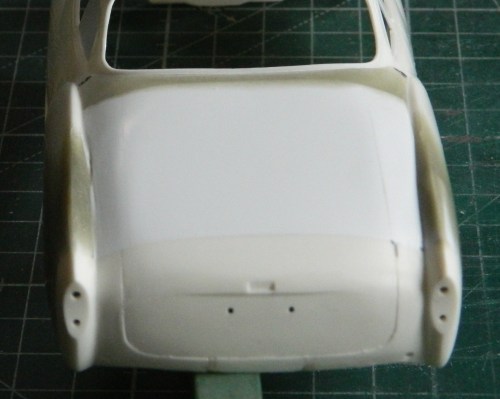
Having positioned the rear of the body, I checked to see if I could just add a piece of flat styrene sheet for the upper body. Looks like I can:
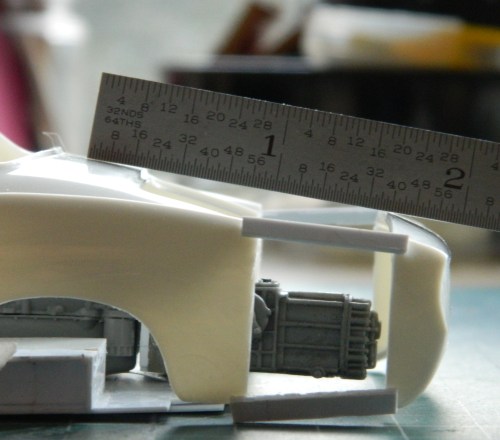
That obviously left large areas that need to be filled. Rather than drive myself crazy(er) by trying to make a single-piece fill section, I opted to use more .040″ (1.016mm) strips as structural filler as well as gluing a flat piece of the same thickness styrene on top. For the ridge at the top of the fenders, I filled the odd shaped gap with .080″ (2.032mm) scrap:

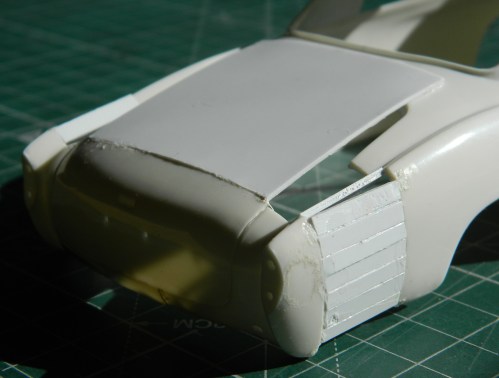
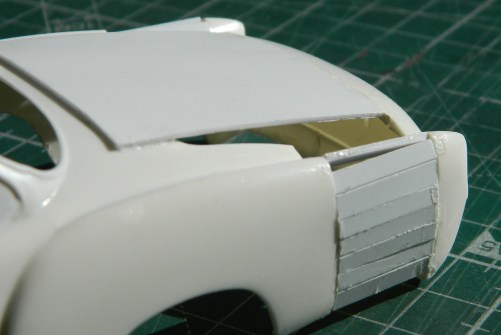

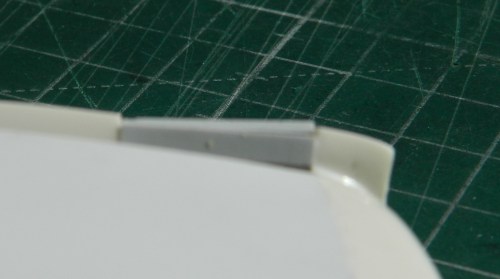
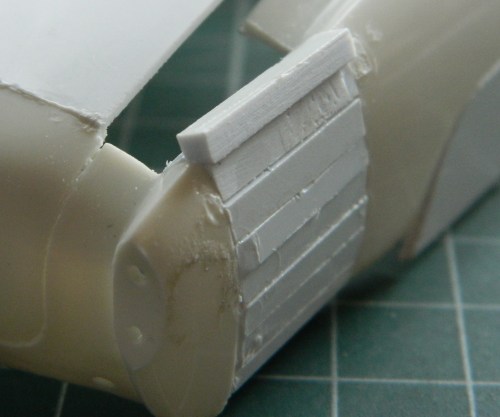
l used more .040″ (1.016mm) to fill the gaps on either side of the top addition and then roughly sanded the additions to shape as well as filling the stock wheel openings using .020″ (.508mm):
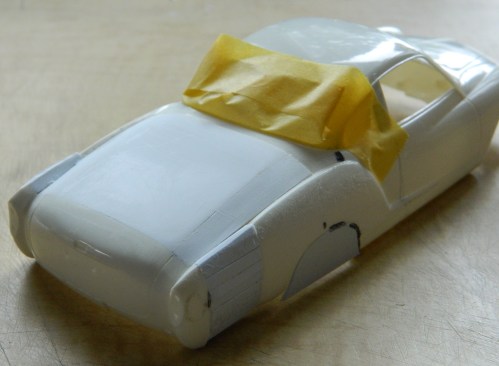
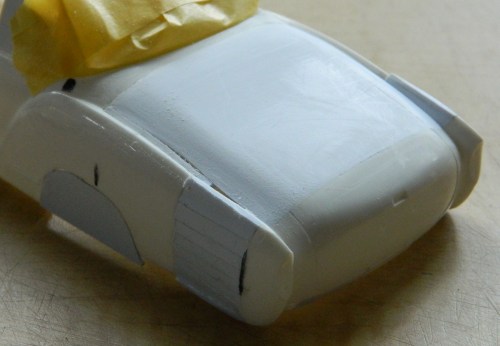
Much putty was needed to smooth the surfaces. Rather than lay down several layers of putty putty, I opted instead to use Aves Apoxie Sculpt (great stuff if you ever need a structural filler!) and waited overnight for it to harden. The join of the top of the rear deck and the side sections started to show gaps after minimal sanding so I added the Apoxie Sculpt there as well:
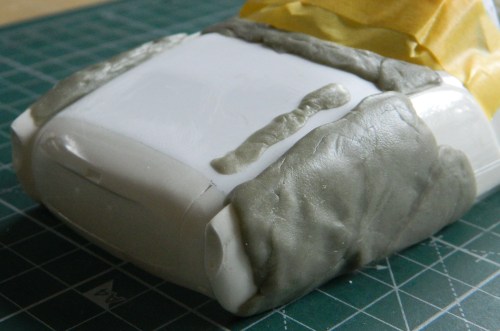
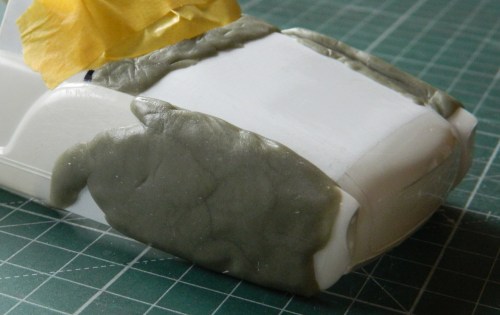
Since the rear of the body will be hinged, I needed to add Apoxie Sculpt inside as well:

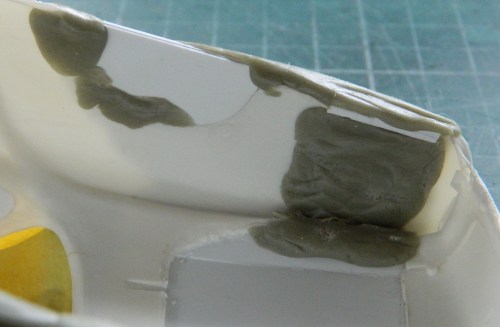
After letting the putty cure overnight, I used my Dremel to roughly shape the putty (and created a metric TON of dust):
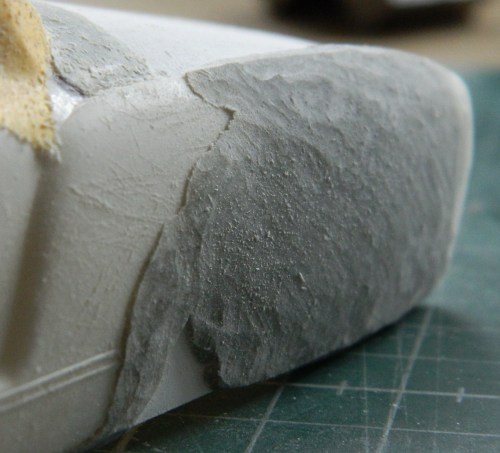
The first shaping was done with a file:
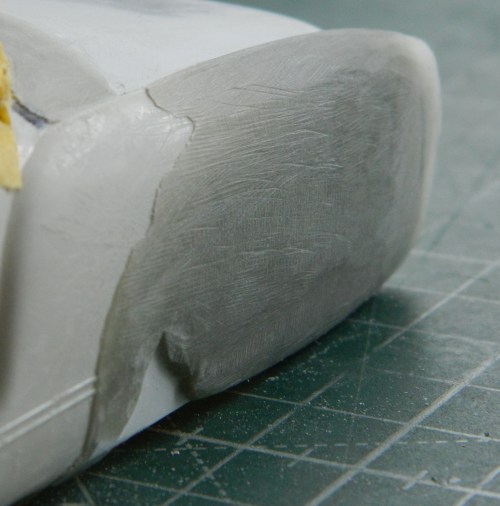
Then it was all sanded. I started with 220 grit and went through the grades up to 2000 grit:
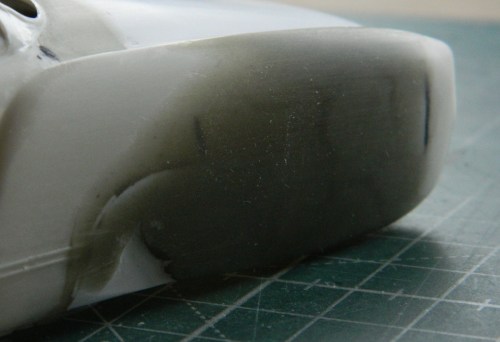
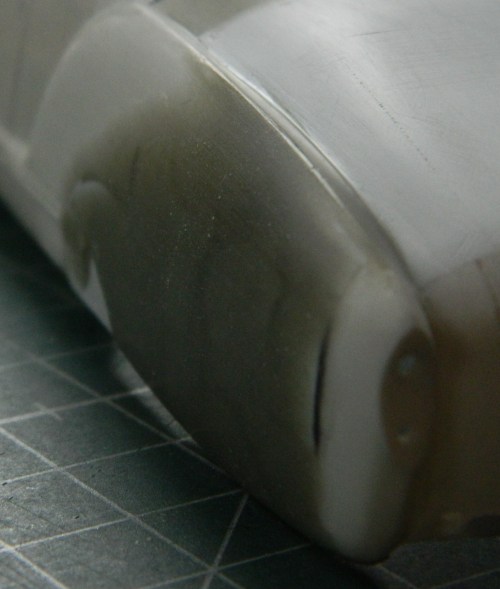
My goal of creating a gradual curve on top of the fenders worked well:
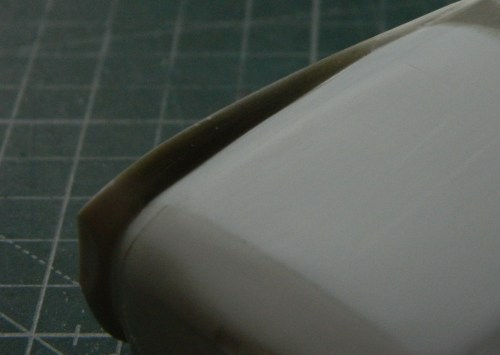
I knew as I was doing all of this that a large area would be cut away on both sides to accommodate the wheels/tires. I also knew that I was going to have to fit the fender flares to the body so I wanted the surfaces to be properly shaped before I started that.
Though it looked odd at first, I rather like the extended body:
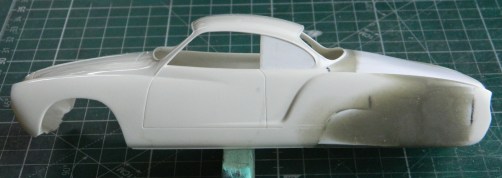
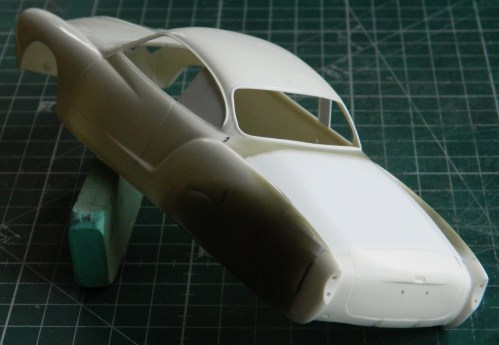
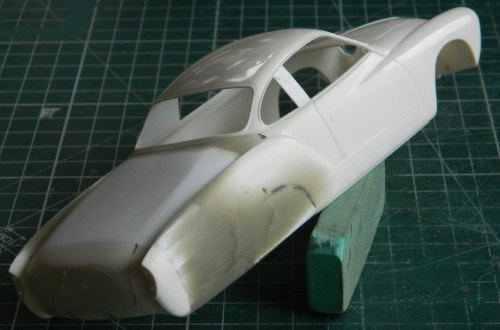
To know where the openings need to be cut out, I needed to know where the wheels/tires would be more accurately. Since it’s the engine/transaxle that determine where the rear wheels/tires will be, I needed something better than tape or white glue to determine where the engine will sit. The next task was to build the engine mounts so that I could dry-fit the engine/transaxle to where it will be attached. I knew that not only were these parts need to be sturdy enough to handle being moved around a lot, using .020″ (.508mm) styrene wouldn’t provide much gluing surface, so I reinforced the joins with Evergreen’s L-shaped extrusions:
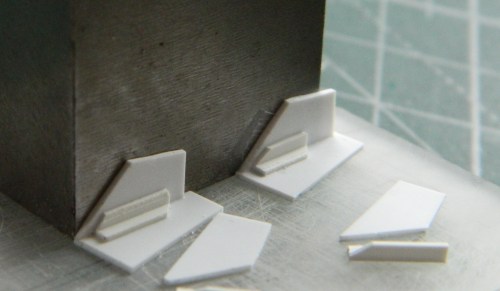
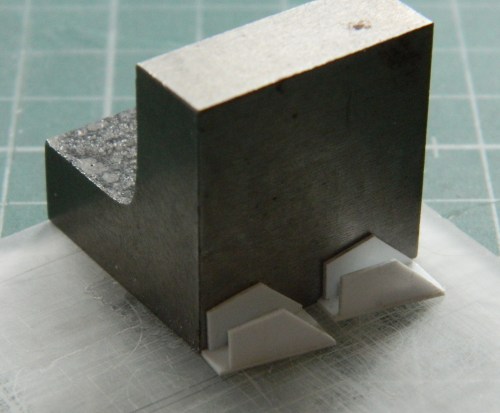
These parts did what I want them to, locate the engine, but they’re too clunky. I’ll make another set of them later:
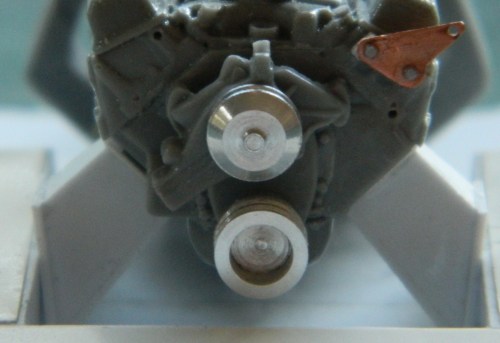
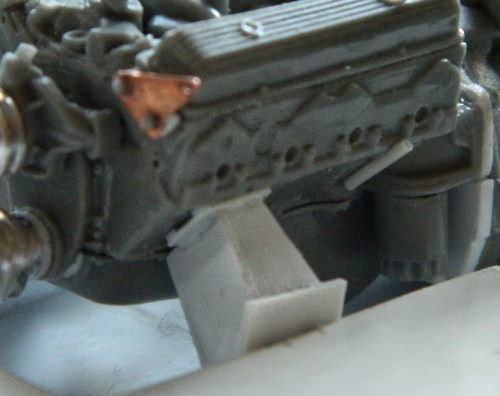
I also needed to fit the rear engine and suspension mount so that I have the angles for the driveshafts at the correct height. While that part is still free and the surface of it easily accessed, there was something I needed to fix first. For whatever reason, the resin copy has these two depressions that shouldn’t be there :

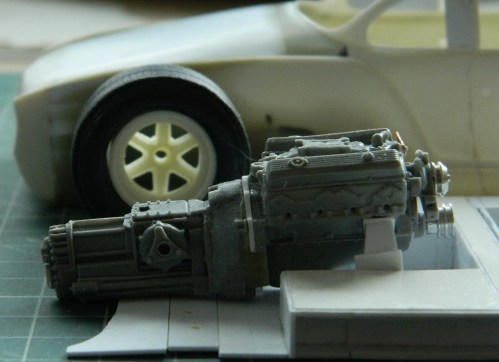
Once I added the putty (deciding to finish the surface later), I was able to put the engine where it will end up being (the plastic underneath the transaxle is just there as a spacer to maintain the correct height):
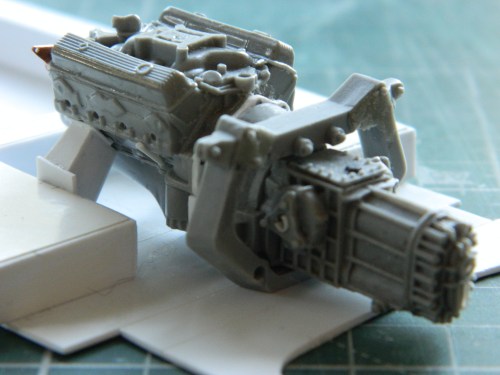
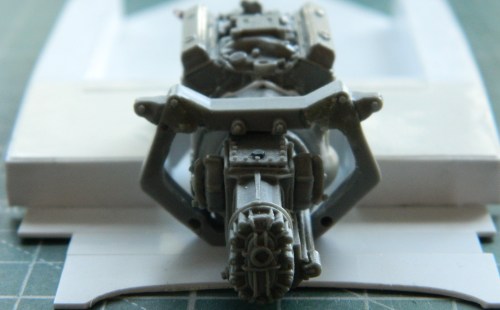
I wanted to determine the ride height of the car. Seeing as it’s a street car, it couldn’t be as low as a custom or race car. The streets are much rougher on a car than a track (or trailer), having things like potholes, speed-bumps, driveways with steep approaches, and all the other wonderful things that street cars have to cope with. I wanted to shim the car and monocoque at a ride height I thought to be realistic. For that I used quarters and now I call this my “seventy-five cent clearance” because three quarters gave me just what I wanted, or about 6″ (152.4mm) scale inches:
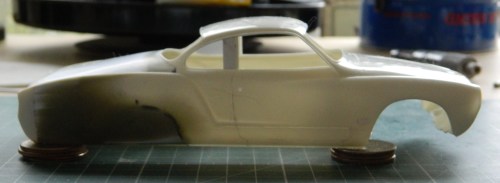
With ride height figured out, I dry-fit the engine, aligned things, and traced around the tire to determine the size, shape, and placement of the rear wheel openings. I did this while both the body and the monocoque were sitting flat on the bench instead of at ride height to allow for suspension compression:
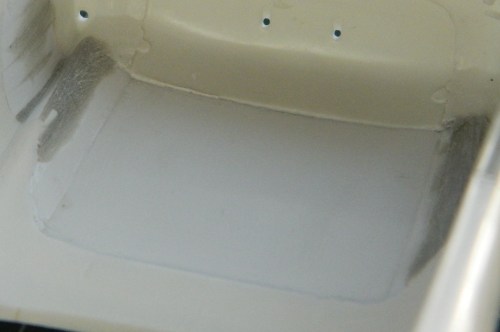
Once the putty had cured, I sanded down the putty inside the bodywork:

At this point there has been a lot of sanding of plastic that wasn’t too thick to start with. I wanted to check how thick or thin it was, especially where the seams are. I held the body up to a bright light (the sun) to see where it was getting too thin:

Answer…where the plastic lets the most light through. I knew that I was going to have to thicken this entire area a bit and decided that there was no point to waiting. I laid down strips of .020″ (.508mm) scrap styrene and then another coat of putty:
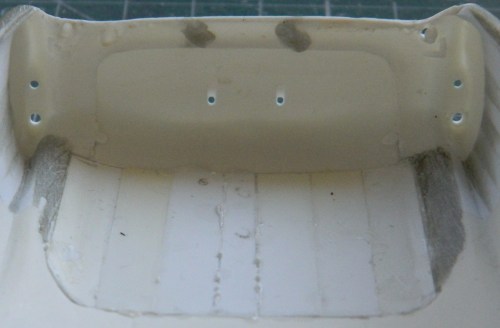

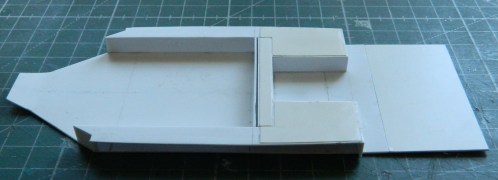
While that was curing, I did a little work on the monocoque which gave me more room for fuel tanks. I haven’t done the numbers yet but I estimate that I’m probably at the 25 gallon (94.6L) target, perhaps more, and now that I have a better idea of how long the chassis needs to be, I added an extension to the rear and made a less-clunky set of engine mounts:

Having ascertained where things go, it’s time to put some things there. The rear fender flares. If I could design a body for an inveterate modeler, I’d design someone with variable-magnification eyes and four arms so that I could have four hands. I think the second pair of hands would be really small for handling really small parts. Since my body doesn’t have those features (or many other ones lost over the decades), I figure out how to make do with what’s left after the Sands of Time have scoured thoroughly.
I need to hold the Bug fenders in place while holding the body in place while outlining where I (possibly) need to cut the Bug fenders. Lacking the genetic and physical modifications that I so ardently desire (hmm…buying shirts could pose another challenge), I used a lump of Plasticine to hold the fender in place so that I could mark it:

Once marked (sorta), the cutting, filing, sanding, and fitting began (double-sided tape stuck the flare to the body to allow me to step back and look at how it went):
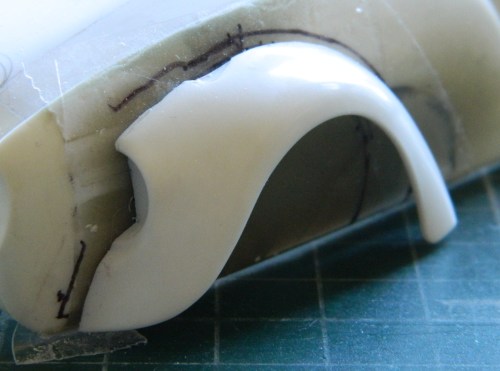
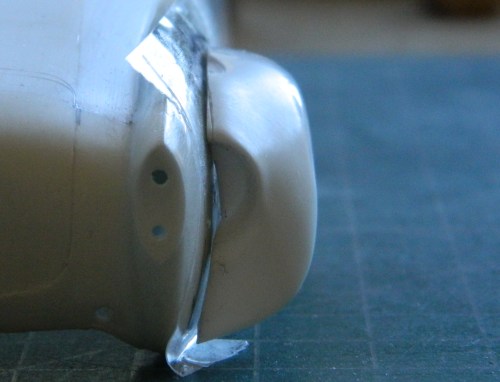
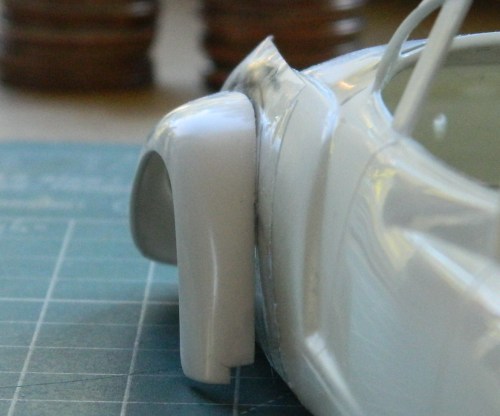
Well, it didn’t go as I’d hoped (but expected) and some plastic had to be added back and I used various thicknesses of scrap to do that:

This was followed by more sanding, scraping, and filing. Eventually I got things close enough so that I was confident that the Apoxie Sculpt could bring it home:
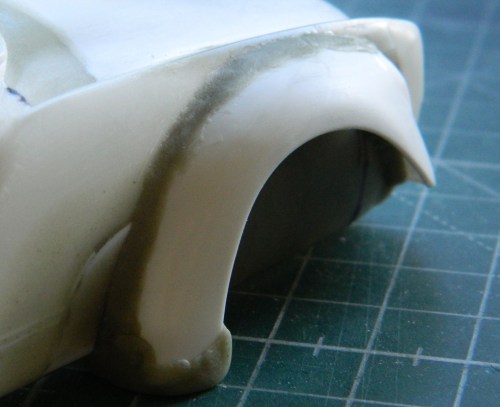
The I got to do it again on the other side, hopefully (more on that shortly) matching what I had just done. This process was repeated on the other side and all of the putty was filed and sanded:
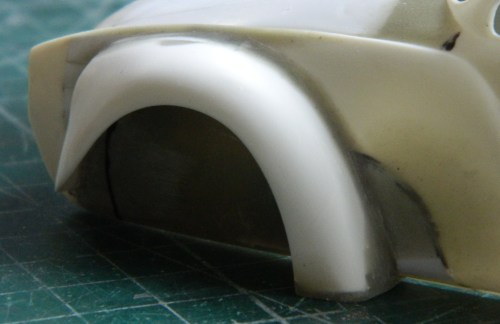
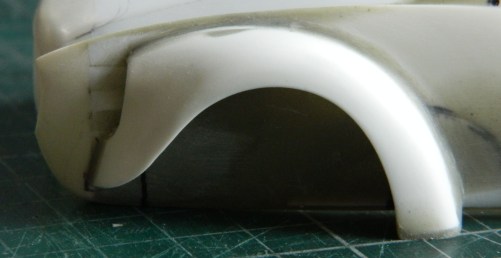
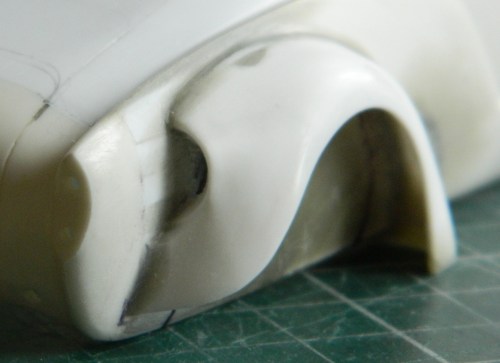
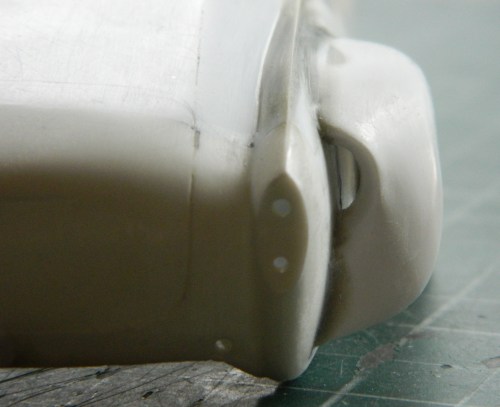
And…no. I didn’t get both sides identical. I also didn’t notice the difference immediately (the second flare was a bit wider than the first). I worked (snapped, more accurately) the forward half of the second flare loose, figured out how much I had to remove, and started cutting:
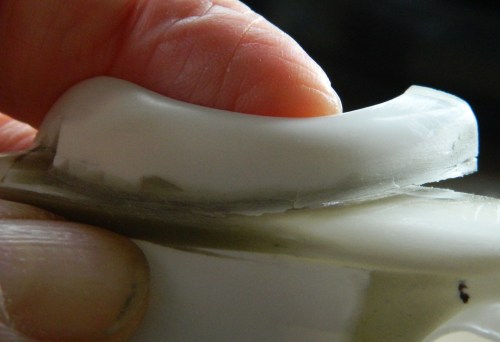
I thought it would be easier if I took a little bit more off than I needed because in this manner I could adjust the width easier (and this time I was correct…I’m not getting accustomed to that and neither should you):
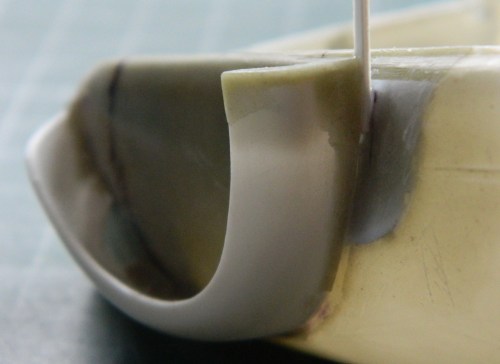
That almost did it. Once the front of the flare was narrowed, it showed that the rear of it was also too wide (go figure) and I took care of that in the same manner. Finally satisfied that the flares were as close to identical as I could make them, more epoxy putty was applied. Then the putty was ground, filed, and sanded:

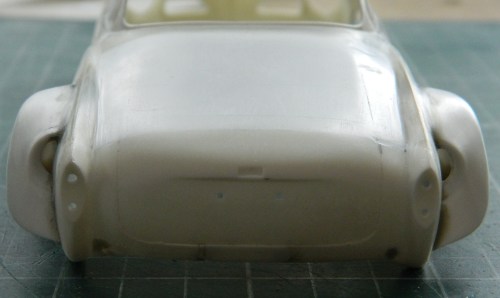
My original intent was to be able to use what had been the headlight sockets as brake lights and the original brake light locations used as backup lights instead. Since lengthening the body meant that the rears of the fender flares wouldn’t match up with the rear of the car’s body, that notion got tossed. Instead I’ll be using what’s left of the headlight sockets as vents to allow air that gets pulled into the engine bay to have an easy exit.
I’m stopping (briefly, I hope) at this point because though I know what I have to do, I’ve less than no idea as to what the build sequence should (and will) be. I think what I’ll do instead is to add the front fender flares while the BitB work on it and hopefully come up with a workable plan because right now I am utterly bereft of having one.
 Scale Modeling Mania
This one is so cool! Thanks for all the photos!
LikeLike
Yeah…just may have bitten off more than can easily be swallowed with this one. But thanks! And thanks for your interest!
LikeLike