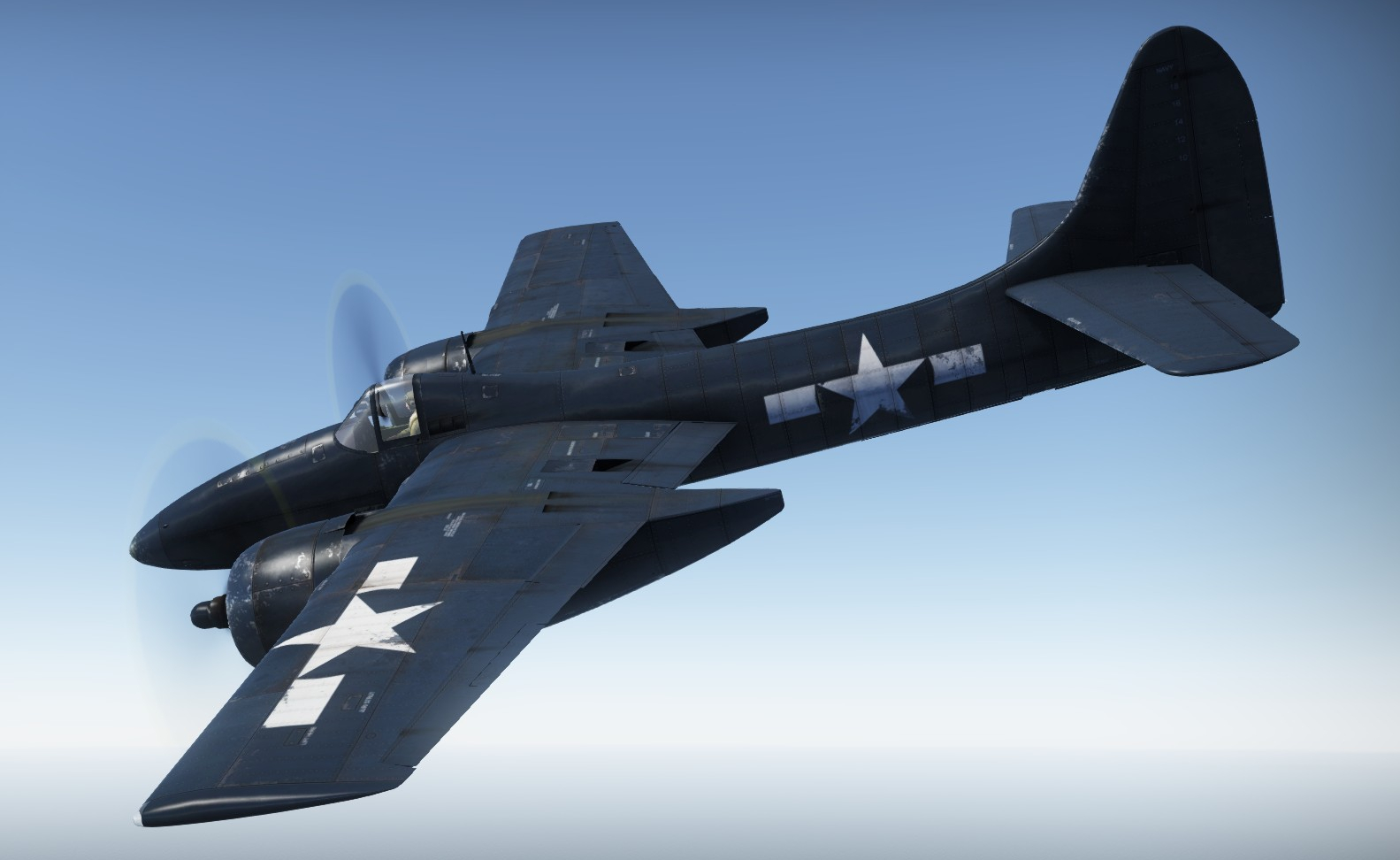
The F7F-3 Tigercat was the Navy’s first twin-engine fighter as well as being its first tricycle landing gear aircraft. Design and development time (the prototype didn’t fly until November 3, 1943) kept it from seeing duty during WWII and most of the -3’s 364 airframes that were built at the end of production in 1946 were given to the Marines. Most of the -3s were converted to either a photo-recon variant, the -3P, or a night fighter, the -3N with the remainder of the -3s being used for training purposes.
Initial problems were pretty much designed in. The first problem was that the Tigercat was too big and heavy for any carrier class smaller than the Midway class. (Its undercarriage, airframe, and tailhook needed to beefed up.) That restricted where and when it could be deployed. It seems its major flaw was that it didn’t spin well. Ah…yeah…maybe it spun TOO well, because it was discovered that after four spins there was no recovery possible. VJ day also meant that the Tigercat was a tool for a job that didn’t need it anymore. It was still big, really fast (70mph faster than the F6F Hellcat), had a range of 1300 miles, and being armed with four fifty caliber machine guns and four twenty millimeter cannons, as well as carrying two 1000lb bombs underwing or a Mk13 aerial torpedo under the fuselage meant that it would smite with a big hammer…but smite what?
Then there was the lousy timing (from the Tigercat’s position) of its introduction. About this time, air arms and aircraft designers were invested in a new bit of kit that is also called “jet engines.” (Things like the Grumman F9F Panther.)
That all meant that once the final peace treaty of WWII was signed, there wasn’t much will expended on (and probably less money) spent on the F7F.
When the Korean War kicked off, we had a lot of propeller driven aircraft that had made their bones in WWII on hand. P-51 Mustangs, F4FU Corsairs , AD-1 Skyraiders, all of which were pressed into immediate service in the Korean skies. No need for F7Fs…
However.
The F7F-3N night-fighter variant carried the SCR-720 radar with a protruding fairing under the nose and this time the second crewman had a job! He operated the radar and his location was in a second cockpit behind the pilot.
The -3N was ferried arrived aboard the carrier Cape Esperance to Japan and VMF (M)-542 Marine night fighters which brought them to Inchon. During the opening weeks of that war, the North Korean pilots flew harassment missions at night in biplanes, the PO2. Tigercats of Marine Night-Fighter Squadrons VMF(N)-542 and -513 were credited with two kills. The F7F’s combat role was brief as the turbojet F3D Skynight soon replaced it in the land-based night-fighter role, though through 1952, F7F-3P and -3N were used in support of B-29s (which were flying night missions because of the high loss rate of daytime bombing operations).
The F7F-3P was the photo-recon variant and carried five cameras. It also had a second cockpit for the camera “operator.” But since the pilot aimed and triggered the cameras, the camera operator was unneeded and his position saw the canopy over it removed and fared over with sheet metal.
Any pilot accounts I’ve read are favorable. Pilots liked that it was comfortable, robust, smooth, and powerful.
 Scale Modeling Mania