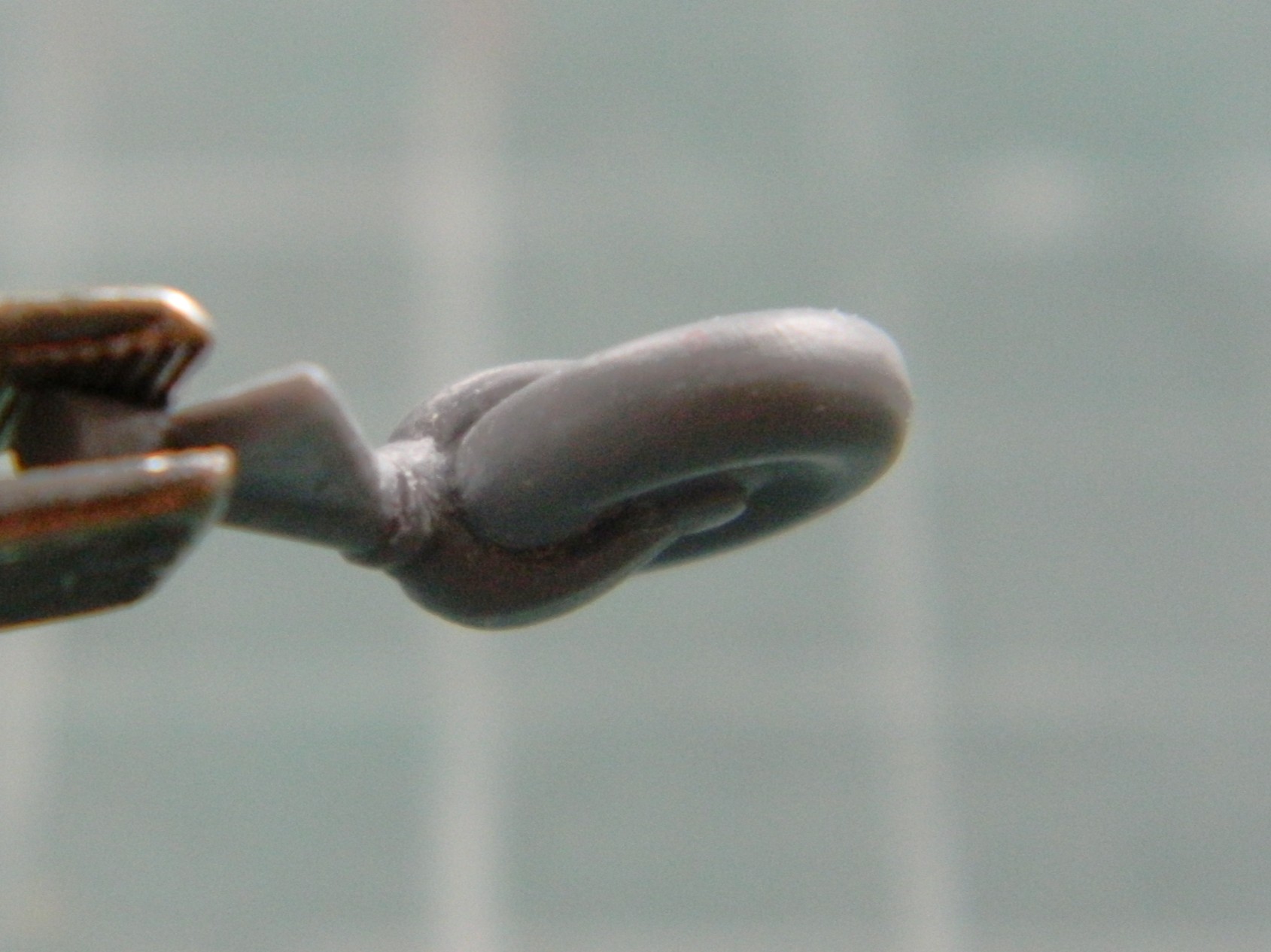
I picked up where I left off last month by working the landing lights. It’s one thing “knowing” that the plastic of this kit is rather thick. And then I get the socket for the landing light cut out and see this…it’s 2mm (okay, 1.96mm) thick here:
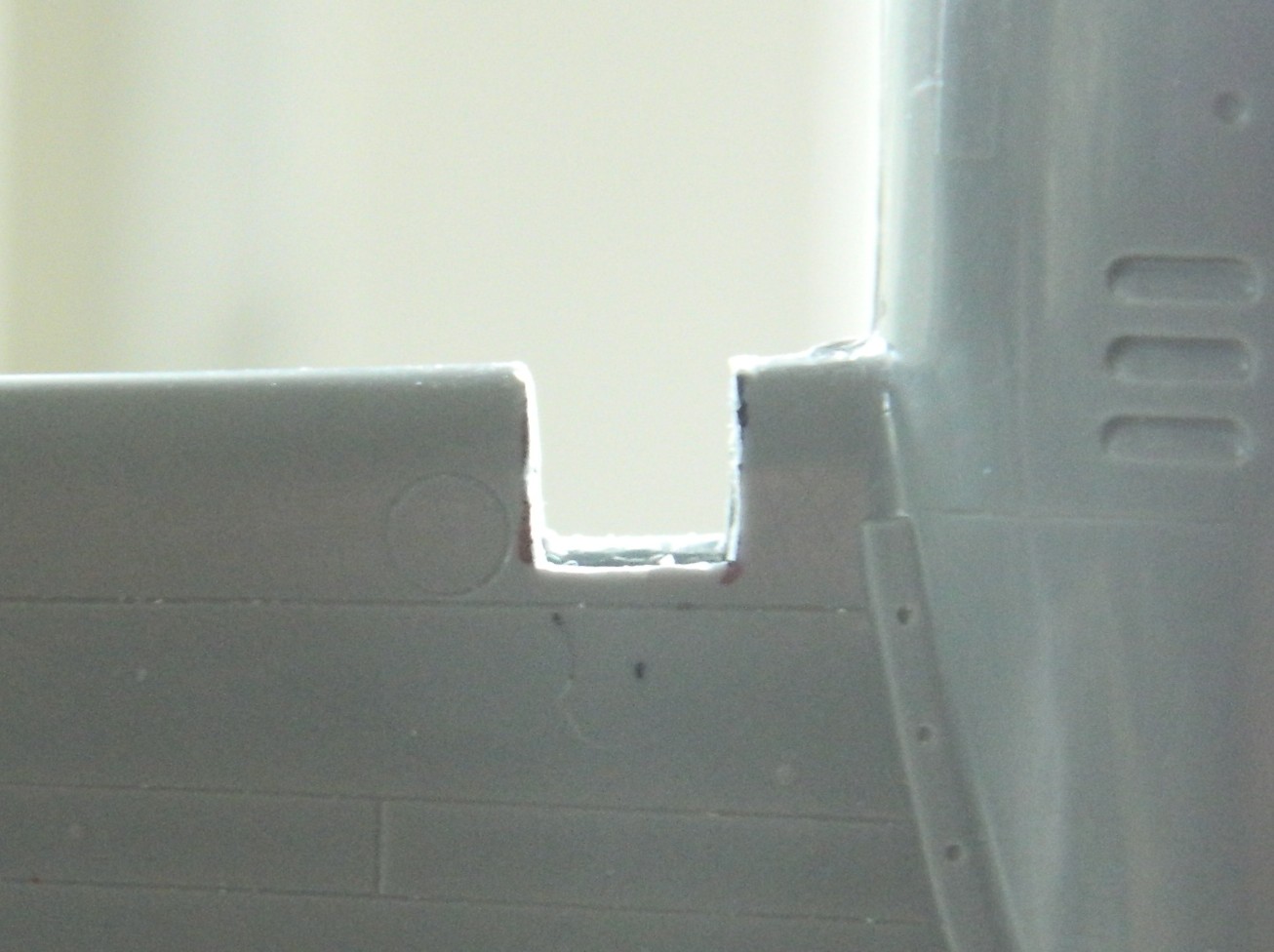

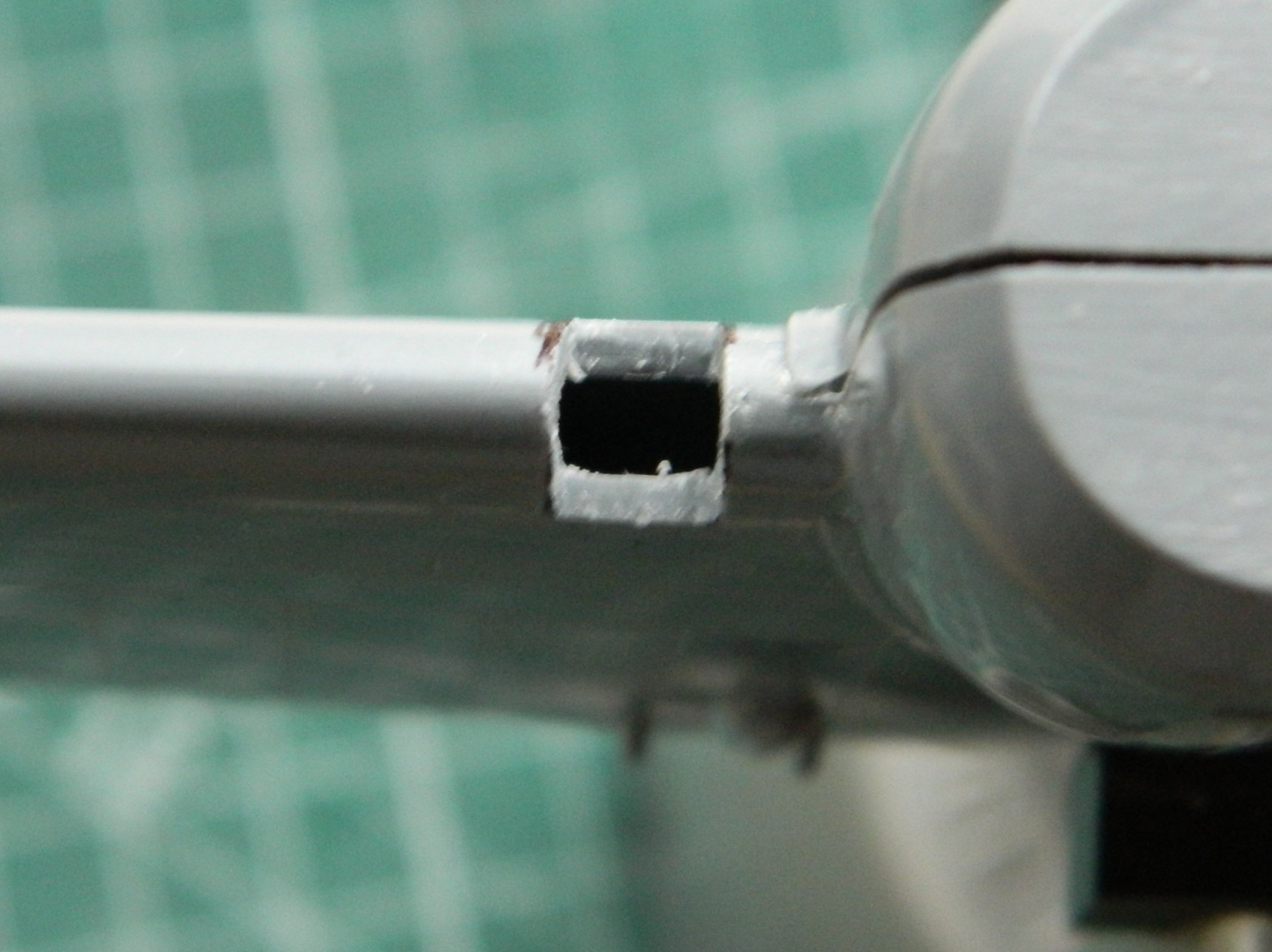
And making these cuts only cost me one bent saw blade.
With the acrylic rod cut, I needed to fit it to its socket to mark where the leading edge of the wing is so that I can drill out the “light”:
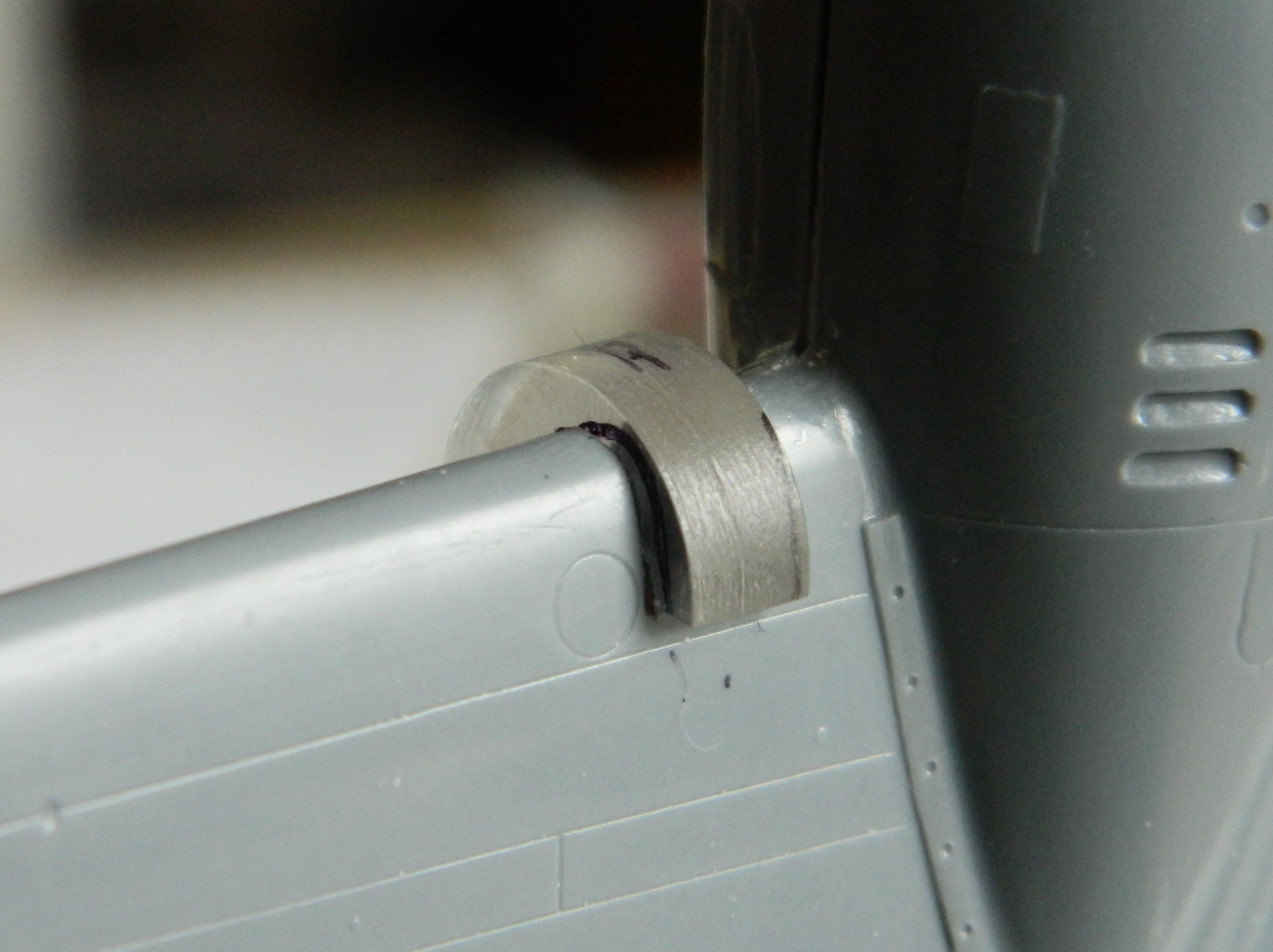
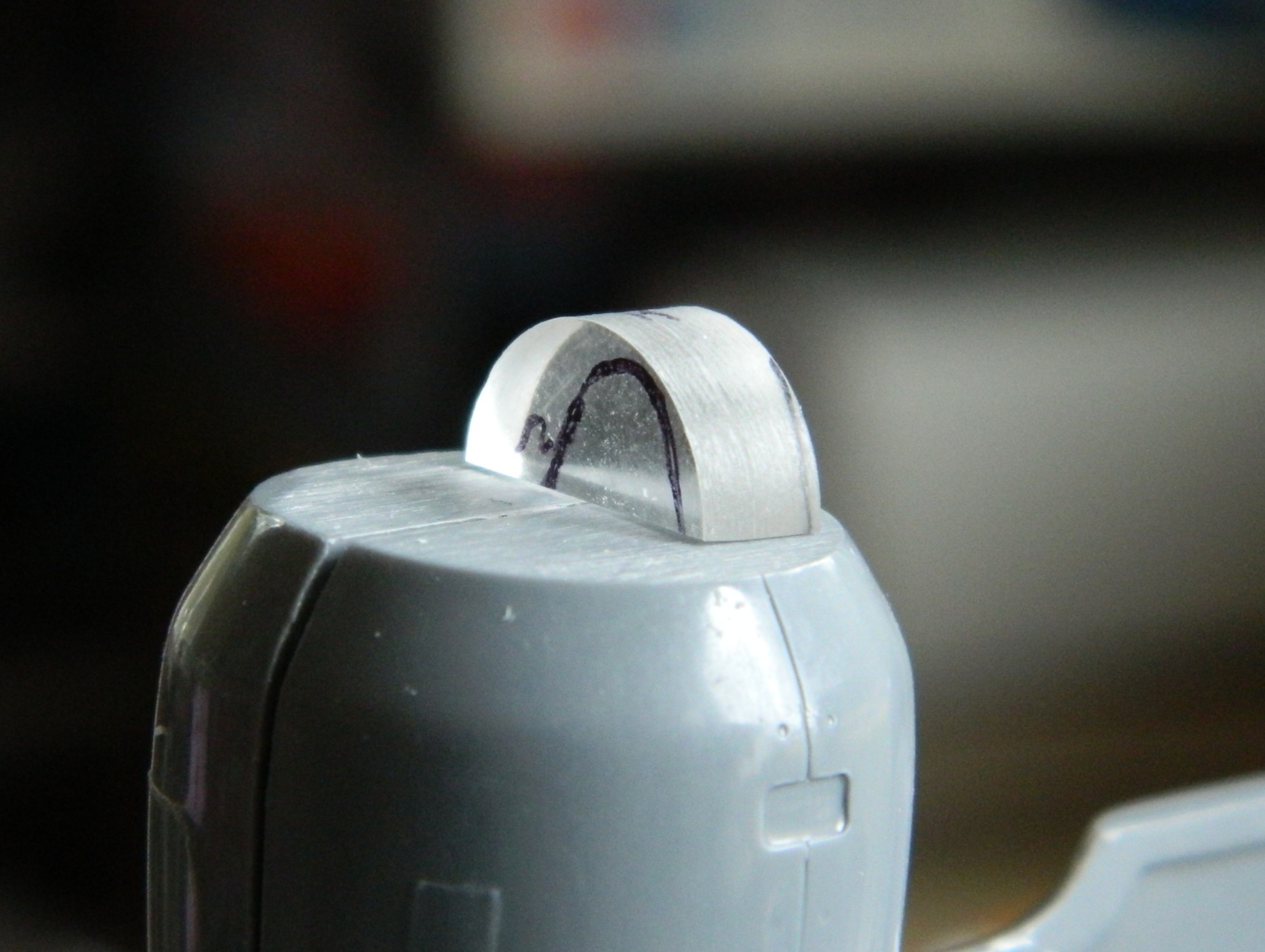
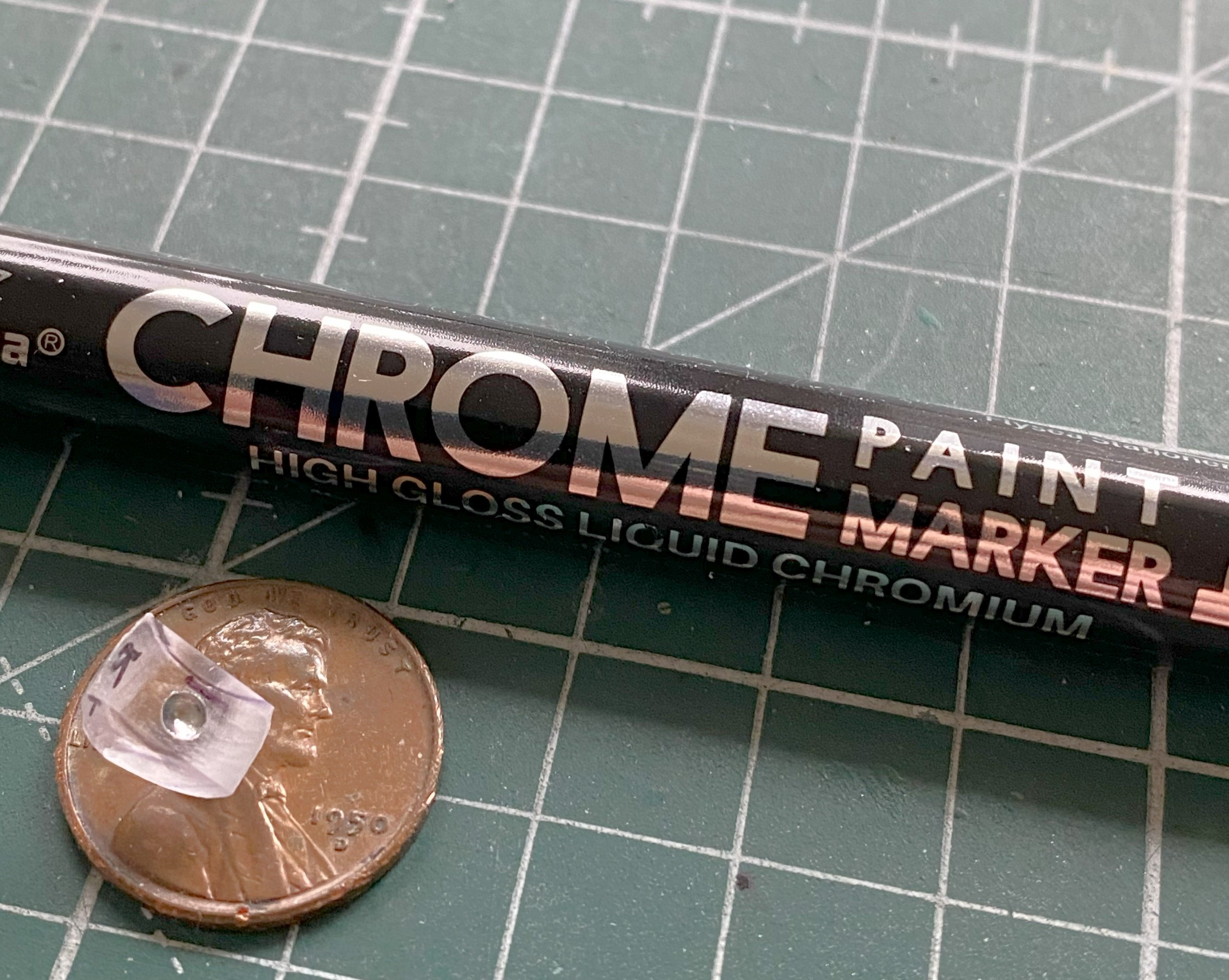
With the “light” drilled and a tiny drop of black paint to replicate the bulb, the whole depression is hit with chrome:
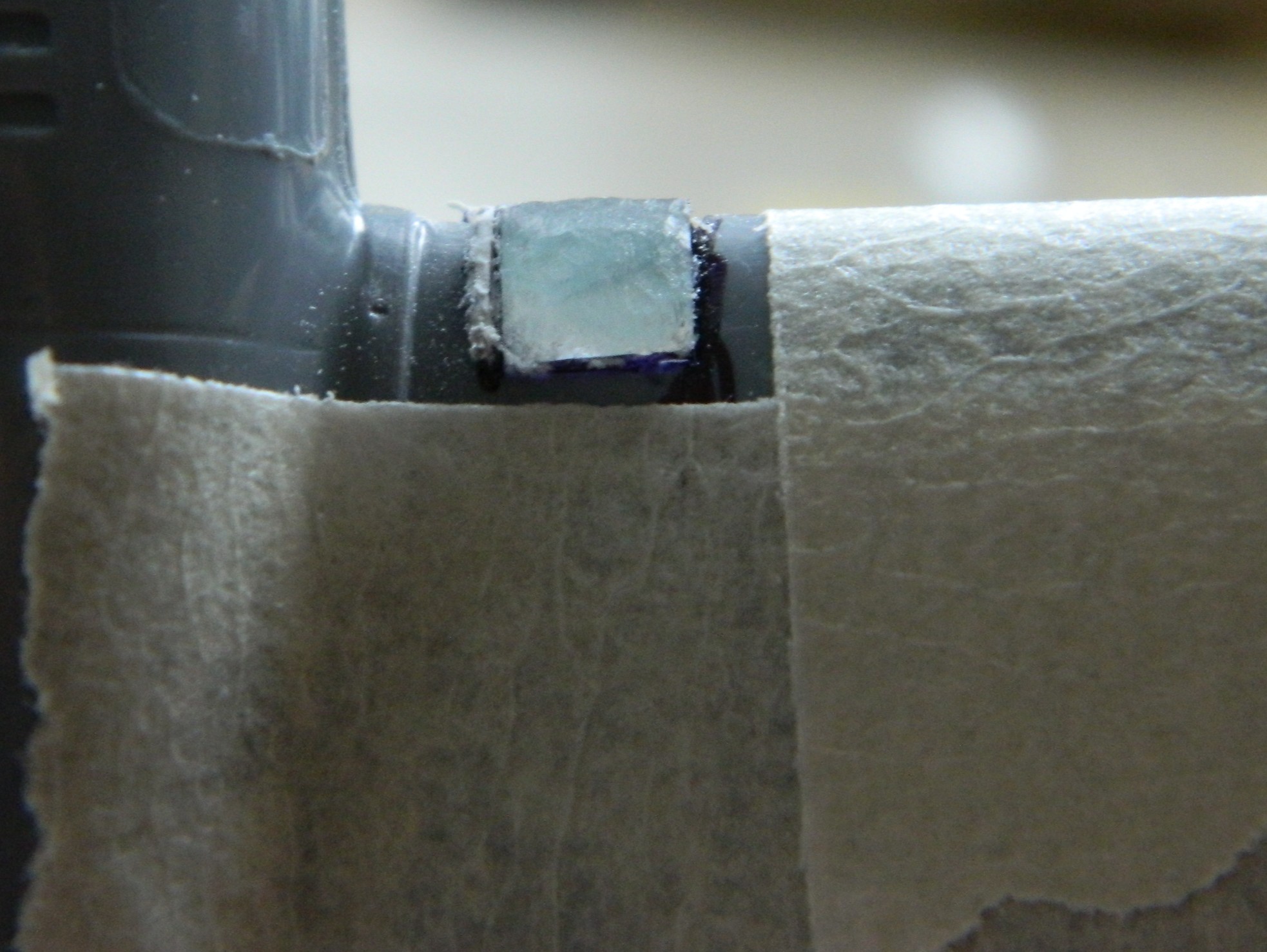
Then it gets glued in place and shaping begins, starting with a motor-tool, then files, leading to sandpaper(s), and then polishing (Novus Plastic Polish #2):

Some of the choices Czech Models made don’t make sense to me…though I guess it’s got to be easier to produce raised details than recessed details just due to the physical requirements of cutting dies. Dies are negatives of the parts so if the kit has very fine recessed details, that means those very fine details have to be positives, as in not recessed, in the dies. In other words, if it’s recessed in plastic, the dies have to be cut away from the intended line leaving just the fine rib in the die(s). It’s probably MUCH easier to recess the die for raised details…which I don’t want so I decided to sand down the mistaken raised details and scribe that detail instead (because of how much I LOVE scribing lines).
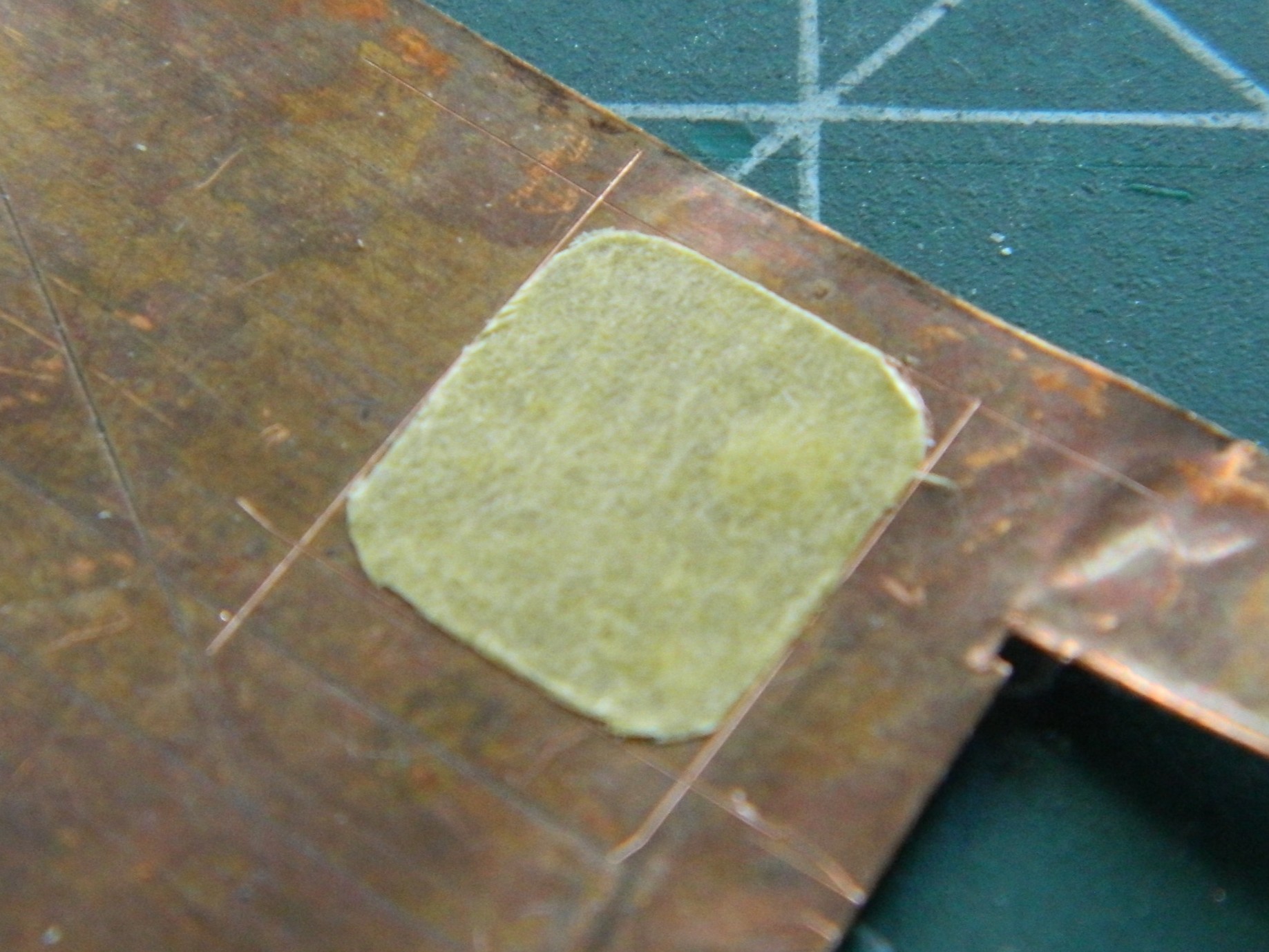
What all that means is that I have a few areas that need scribing. Four of them (of ten) have radiused corners and because I’m SO good at scribing (::giggles::), I decided to make a template. I used .005″ (.127mm) copper shim stock and pressed masking tape over the shape I’m replacing to act as something that I can trace onto the copper. Here’s the progression:
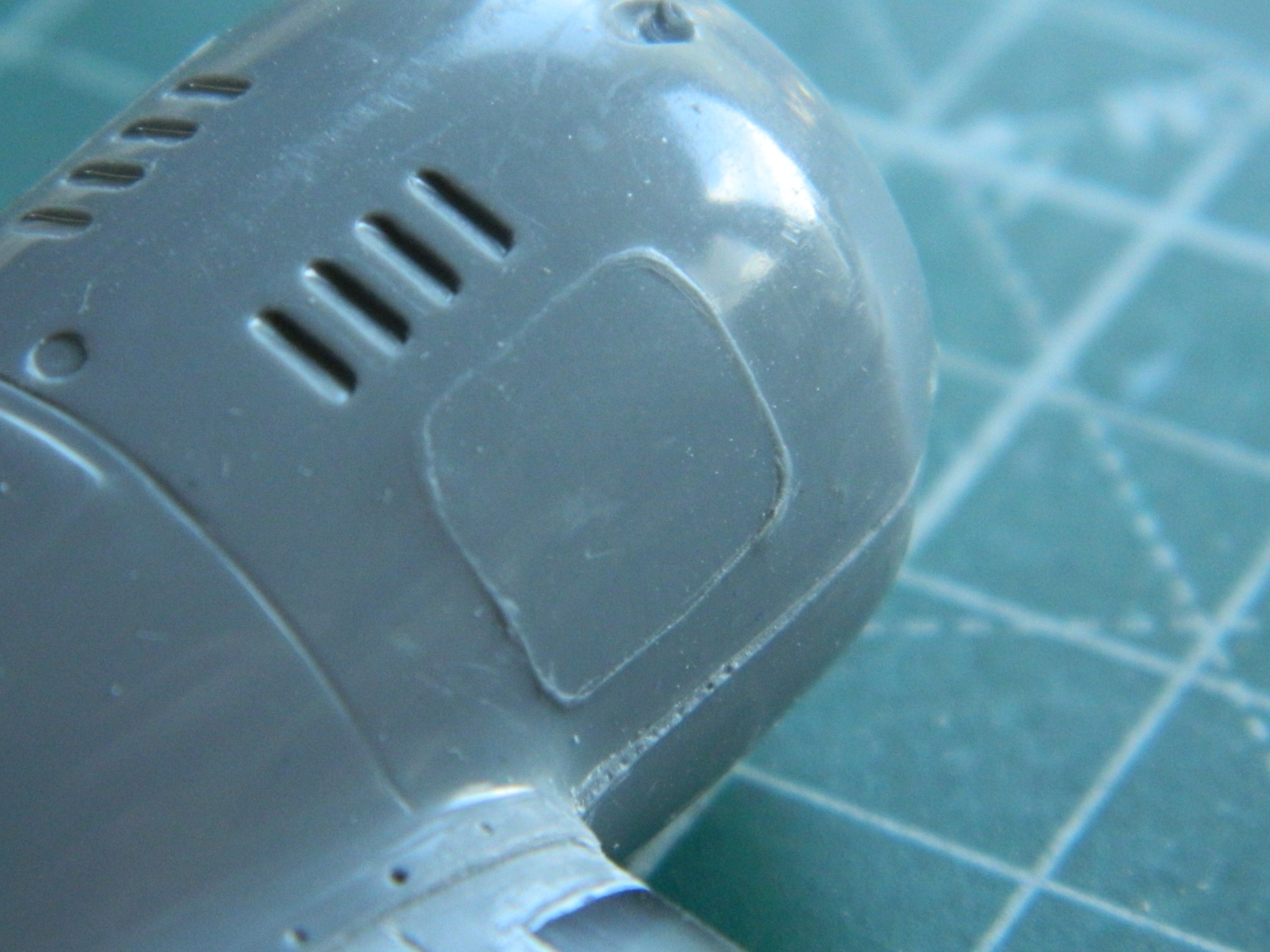
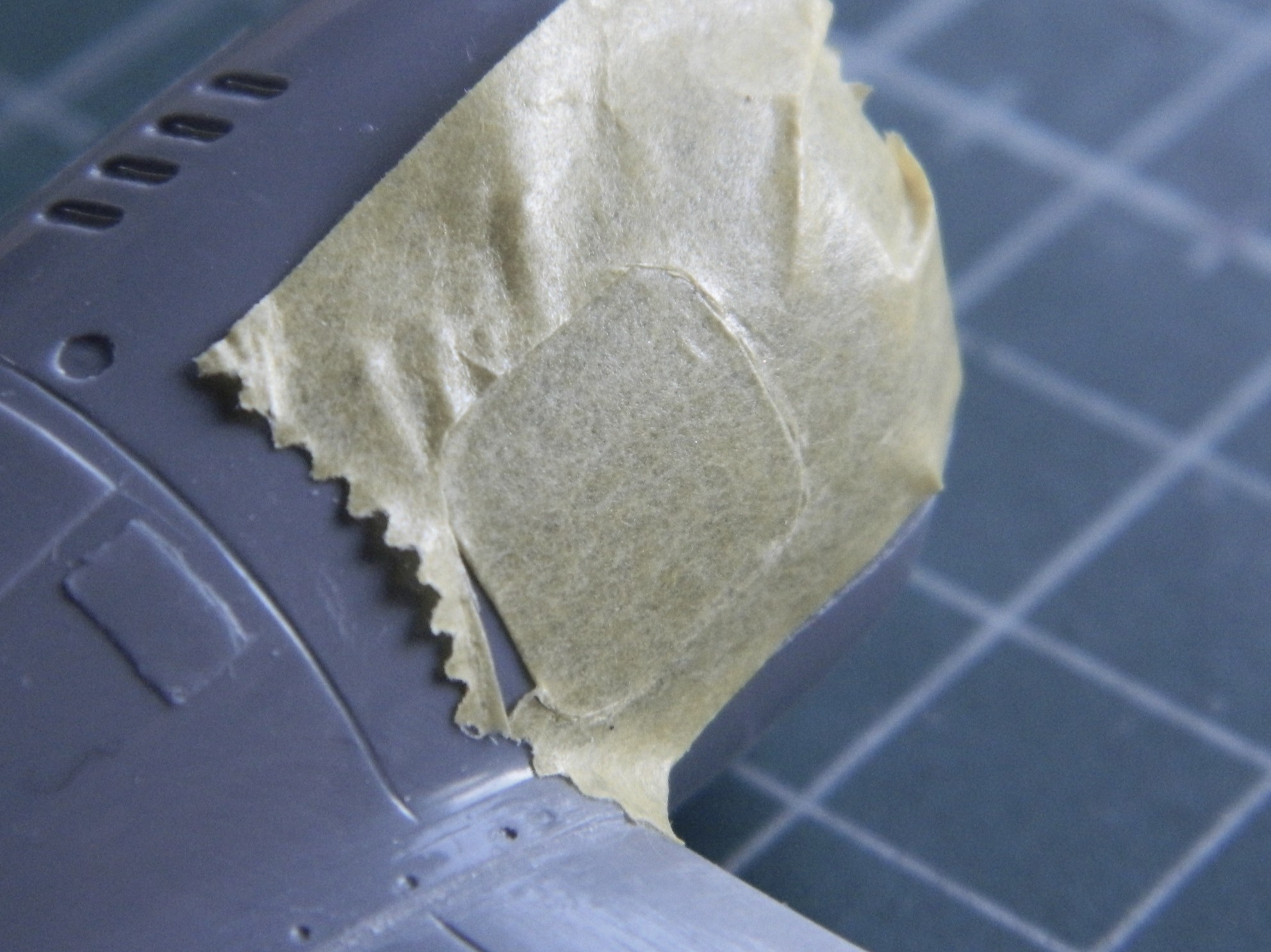

The results were better than I could have done freehand (this access panel has a piano hinge at its top so I replicated that with stretched sprue, which I also used on the nacelle to fill in the HORRIBLE recessed panel line…on both nacelles…and behind the added sprue, you can see other panels that had been raised panels also but easier shapes to rescribe):
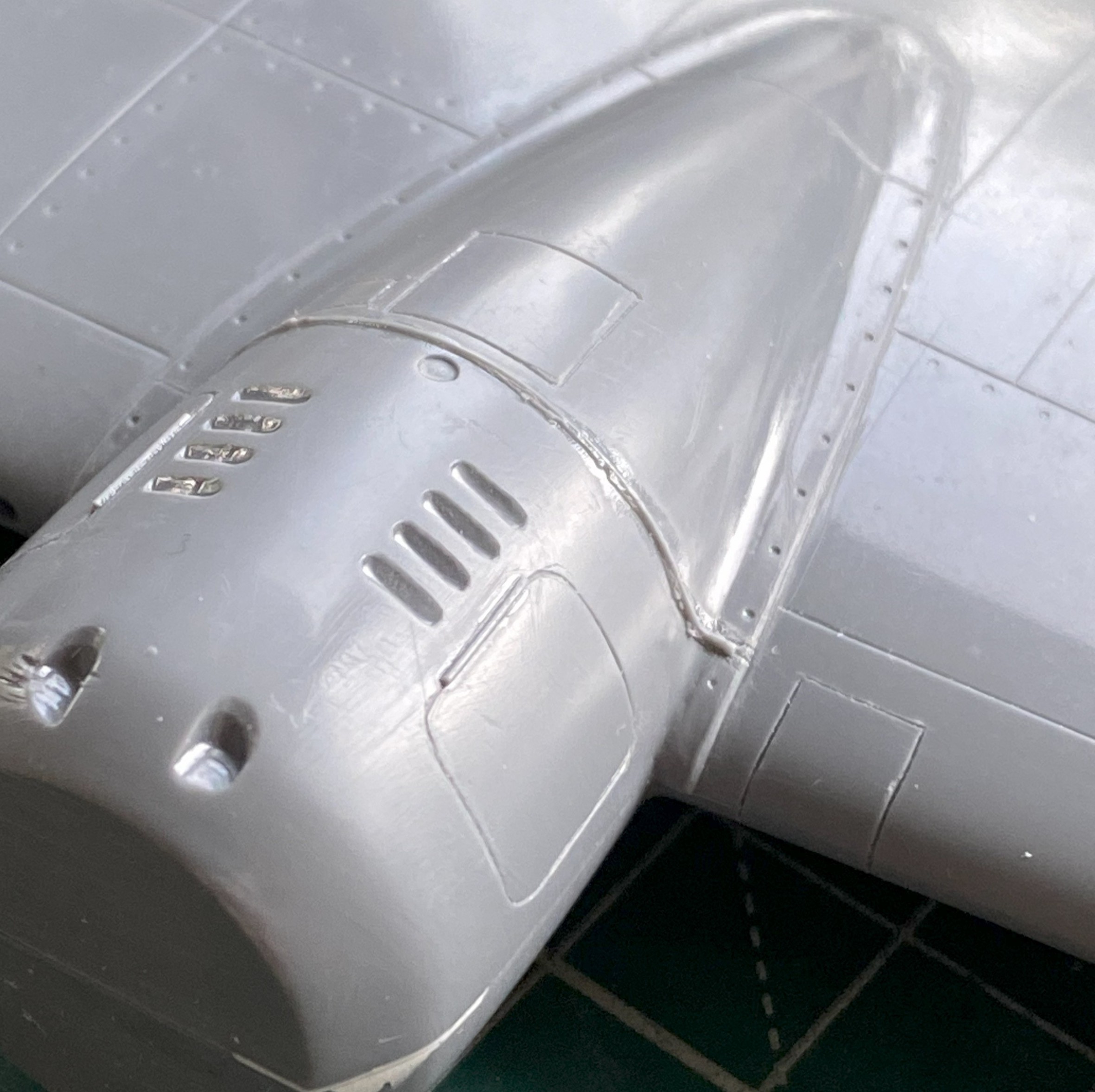
And now the surface behind the louvers is ready to be scribed:

There are several gaps like these (and note the nicely polished landing light to the left):
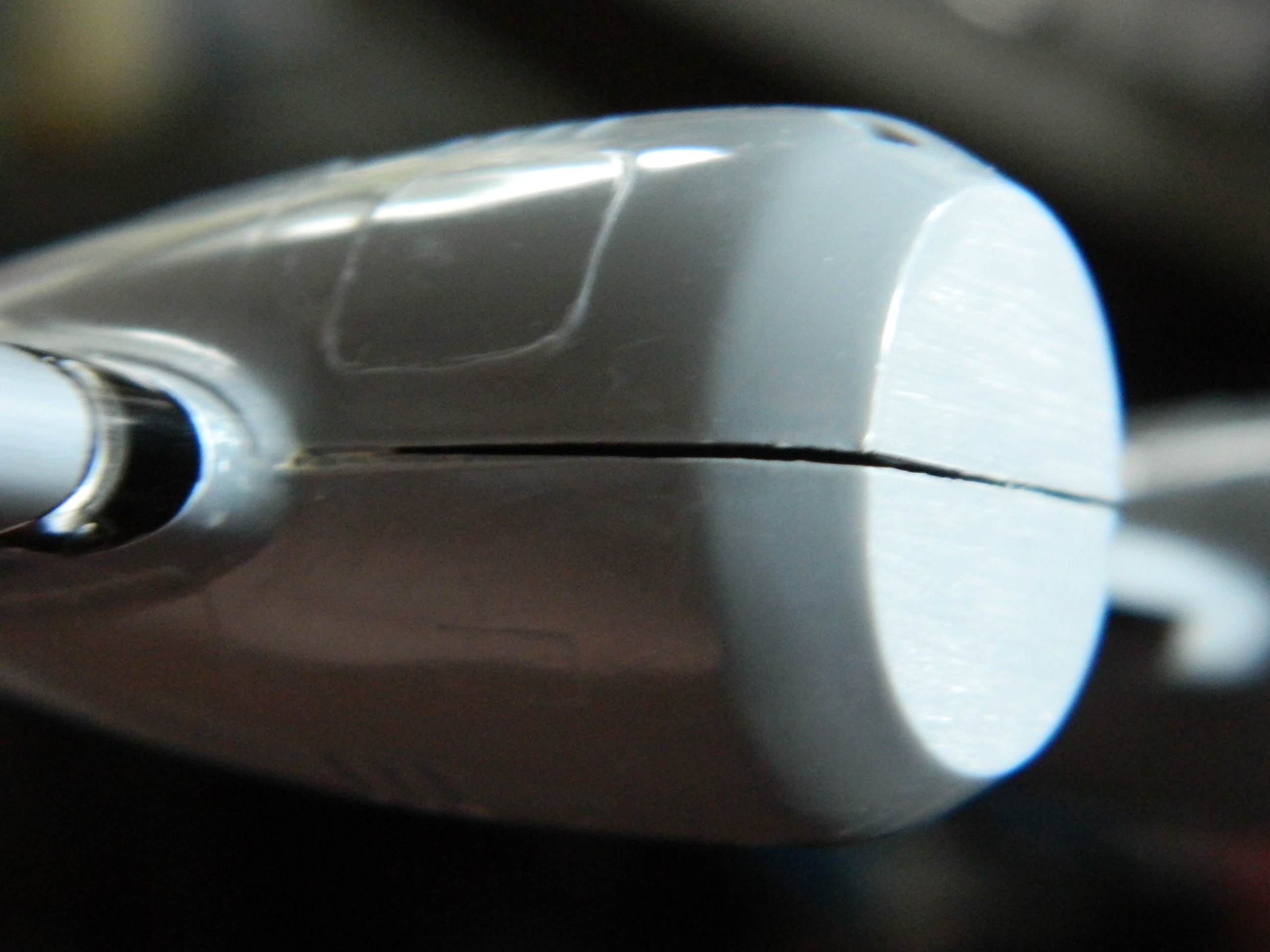
My preferred method of closing large gaps is to start by stuffing them with scrap styrene:
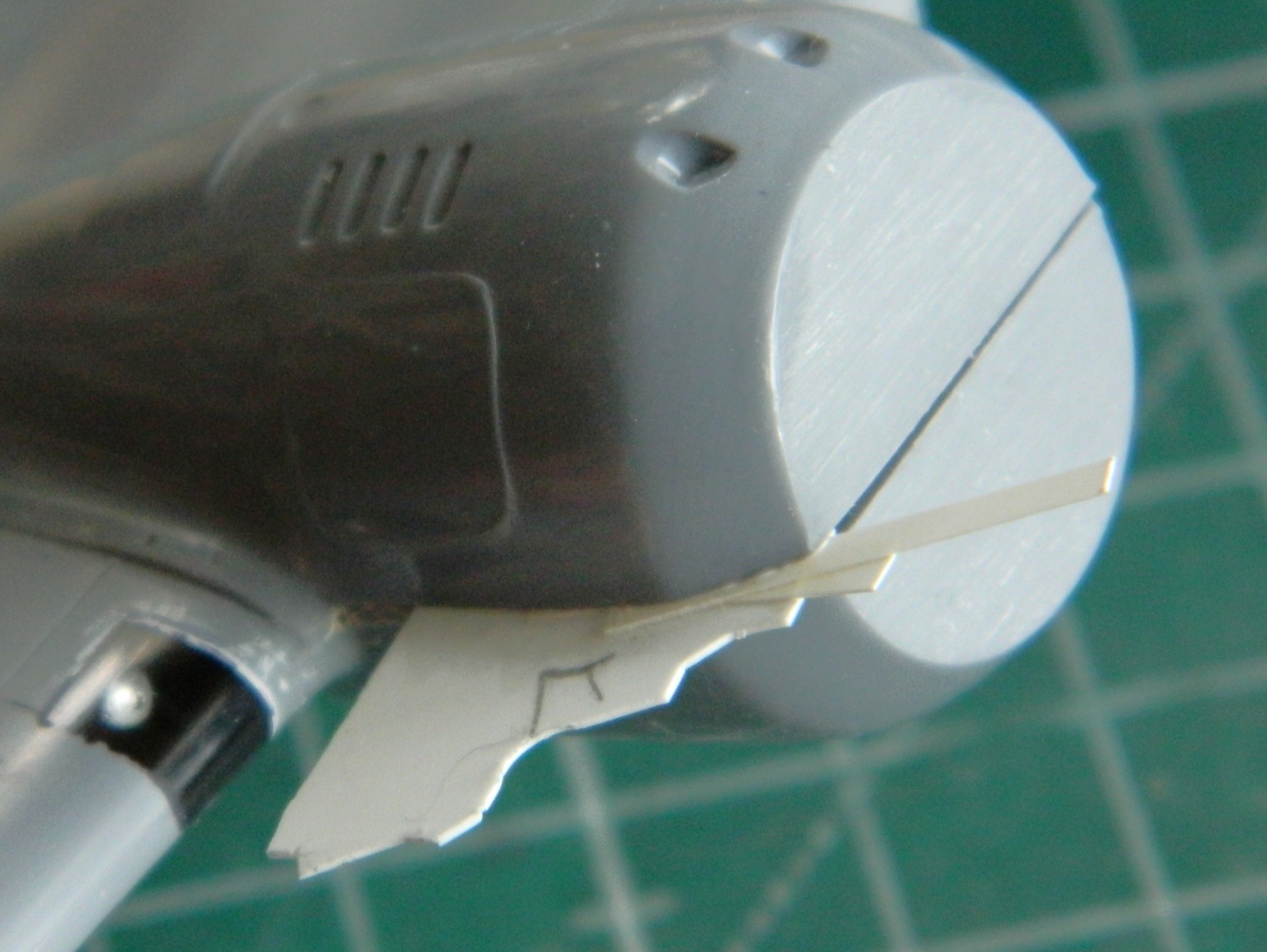
This aircraft has formation lights (if I’ve guessed correctly on the nomenclature) at the leading edges of the wingtips. There are zero indicators of those with this kit. I consulted visual references and played internal logic games and decided that this is pretty much where they go:

Then it was cut out on one side (just in case I somehow got it wrong, it’s half the work to fix one instead of two):

And yes…I marked each wingtip with the color of the formation light because what I have for a memory looks like a sieve.
With the notch cut, I used a small strip of masking tape as a gauge so that the two sides match:

Having cut the notch, I took a section of clear sprue and stretched it. I measured its diameter and cut the appropriate hole on the inner vertical face because that’s how it looks in reference photos. The tip of the stretched sprue was dipped in its appropriate color (red/left, green/right) and glued into place(s):

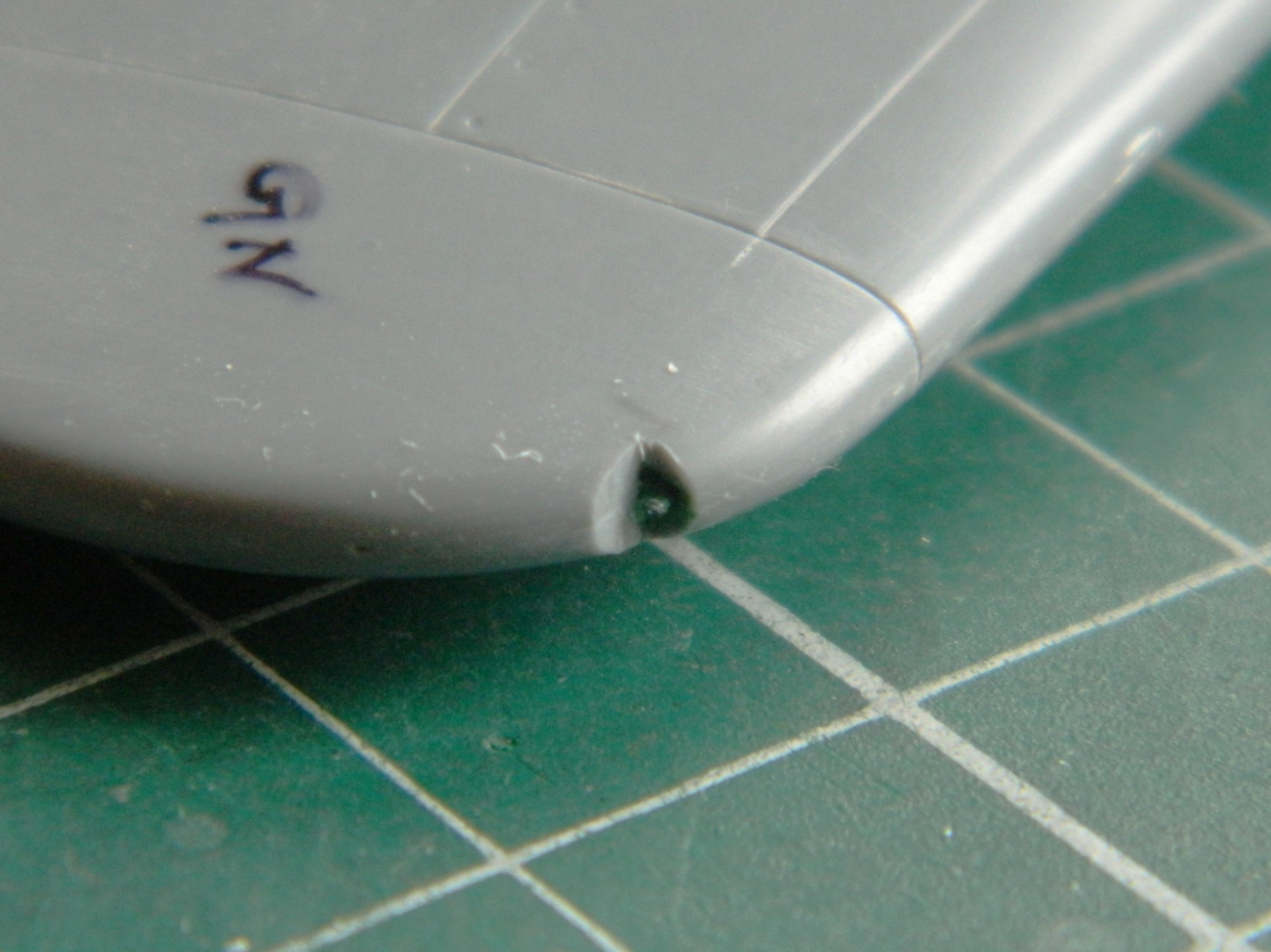
Many of the recessed panel lines were VERY shallow. So with the explanation of what a recessed panel line is in the die, what I think I’m looking at with these shallow panel lines is someone (or several) got sloppy polishing the dies. While I was working on the wing, I was reminded (like I needed it) of how dissatisfied I was with the paint job on the F7F-3 Tigercat because of too many surface imperfections found too late (because I really, REALLY, didn’t want to strip the paint off of it and start over), I decided that even though self-inflicted wounds are wounds, sometimes I can manage a modicum of control over the Self (always a joyous surprise) and this was one of those times.
This specific kit has obviously been sitting around for a long time. All the parts that are not clear parts were stuffed into the same plastic bag. So for a long time, these parts have rubbed against each other which leaves scuff marks of varying sizes. Doing the Tigercat, I’d mistakenly assumed that those surface imperfections wouldn’t show after painting. As I found out, I was definitely mistaken. I worked the wing, applying 3M Acrylic Glazing Putty to the small scratches and gouges left in the surface after my far from perfect scribing. Once those had been sanded down with 2000 grit, I sanded most of the wing the same way. Once that was all done, I polished the wing, top and bottom, to get a uniform, scratch-free, surface:
Evidence of how well I don’t scribe:


Box wear on the surface before polishing:

And with the box wear polished away (aka, After…the long form):

With construction (hopefully) done on the wing, I turned my attention to the fuselage to check fit. Essentially, there isn’t any.
All these surfaces are supposed to be in contact with each other:

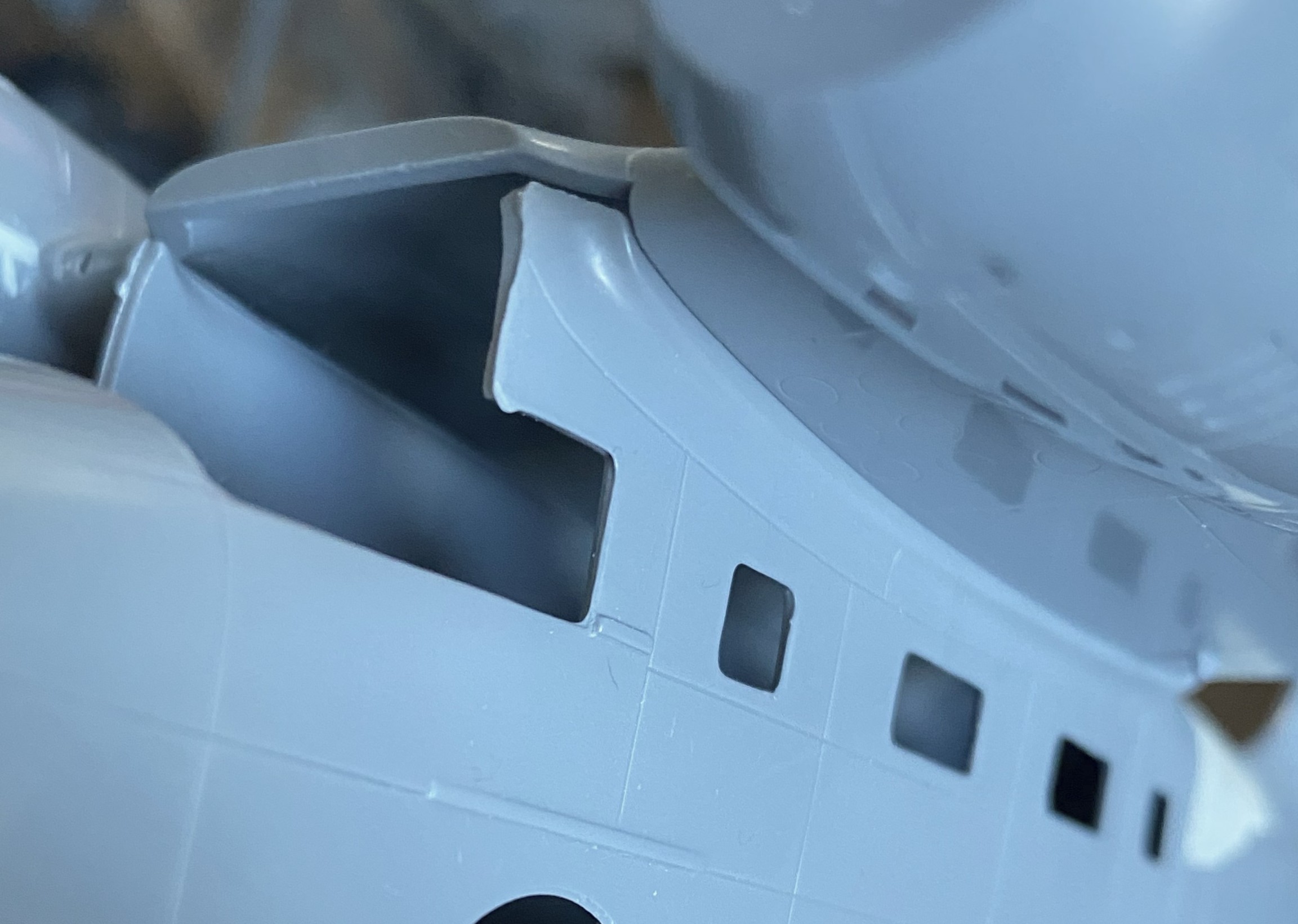
Obviously, not only is the gap between wing and fuselage not supposed to be there, the curve of the lower wing is supposed to match with the curve of the wing root on the fuselage, neither of which are happening here:


Fit is minimally “better” (aka, not as bad) at the rear where the wing blends into the upper fuselage:

If you look closely at the above photo, there is a recessed (sort of) panel line below the fuselage seam. This is what happens when someone polishes away the ridge in the die. There’s a lot of that with this kit.
I can see my stock of scrap styrene dwindling soon.
And if I thought that was bad, I checked the (absent) fit of the canopy. It was cast as two pieces (something I think will be a benefit for me when I start making the overhead console), so those pieces were taped together and I tried fitting it. This is the best I managed:
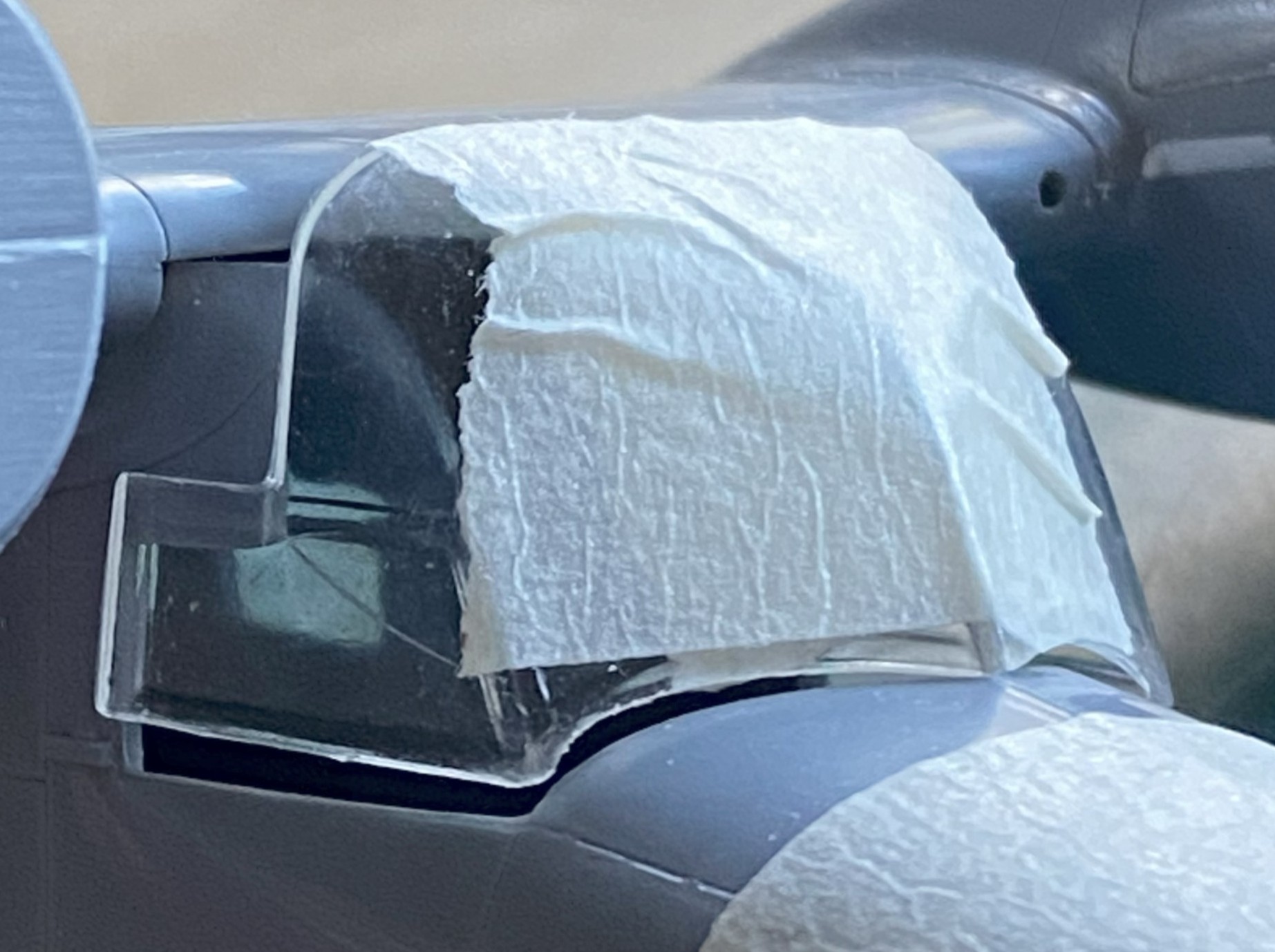
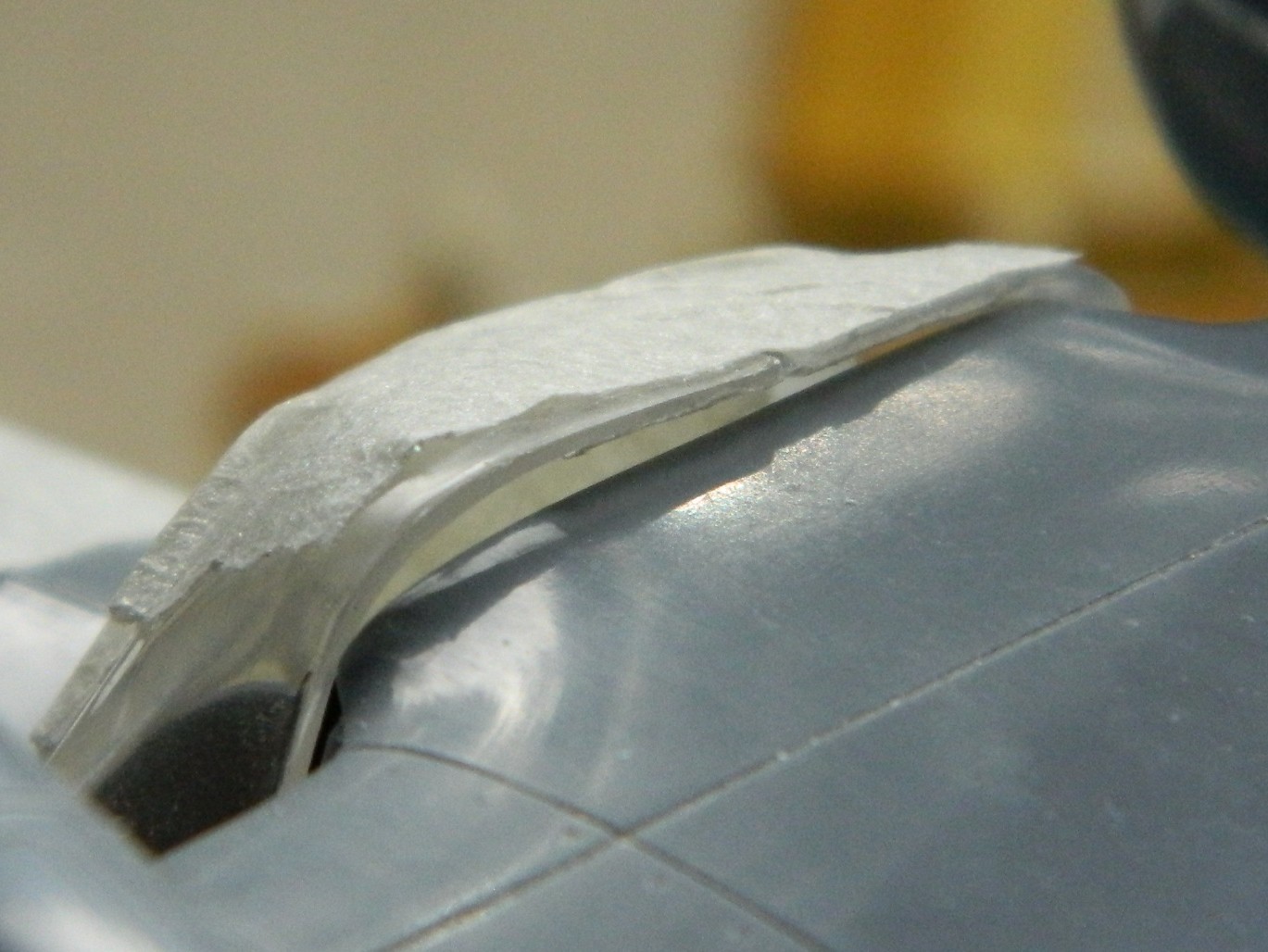
And I figured out why. Look for the blue arrow in the photo below. That shows the overhang of the upper wing. Not only are all these parts supposed to be in contact with each other, the overhang (because that’s what it is, it’s not a parallax view) shouldn’t be there AT ALL:

I won’t know until that overhang is removed but I wouldn’t be surprised if its absence goes some distance to allowing the clear parts to fit (all terms being relative).
And speaking of clever engineering (in the most sarcastic manner I can), would it have broken someone’s back to put the ejector pin mark on the side without any detail…like the flip side of this part? No…it’s not the most labor intensive part of this build…it’s just unnecessary:

And there was one of each of these on both inside the passenger compartment walls. No…none of them stick out in the view, but how many of you have seen someone look at your build(s) without getting just as close as you’ll let them? I know SOMEbody will crank their head around to look through the windows (a row on both sides) and look in there. If I left these as-is, they’re clearly visible:
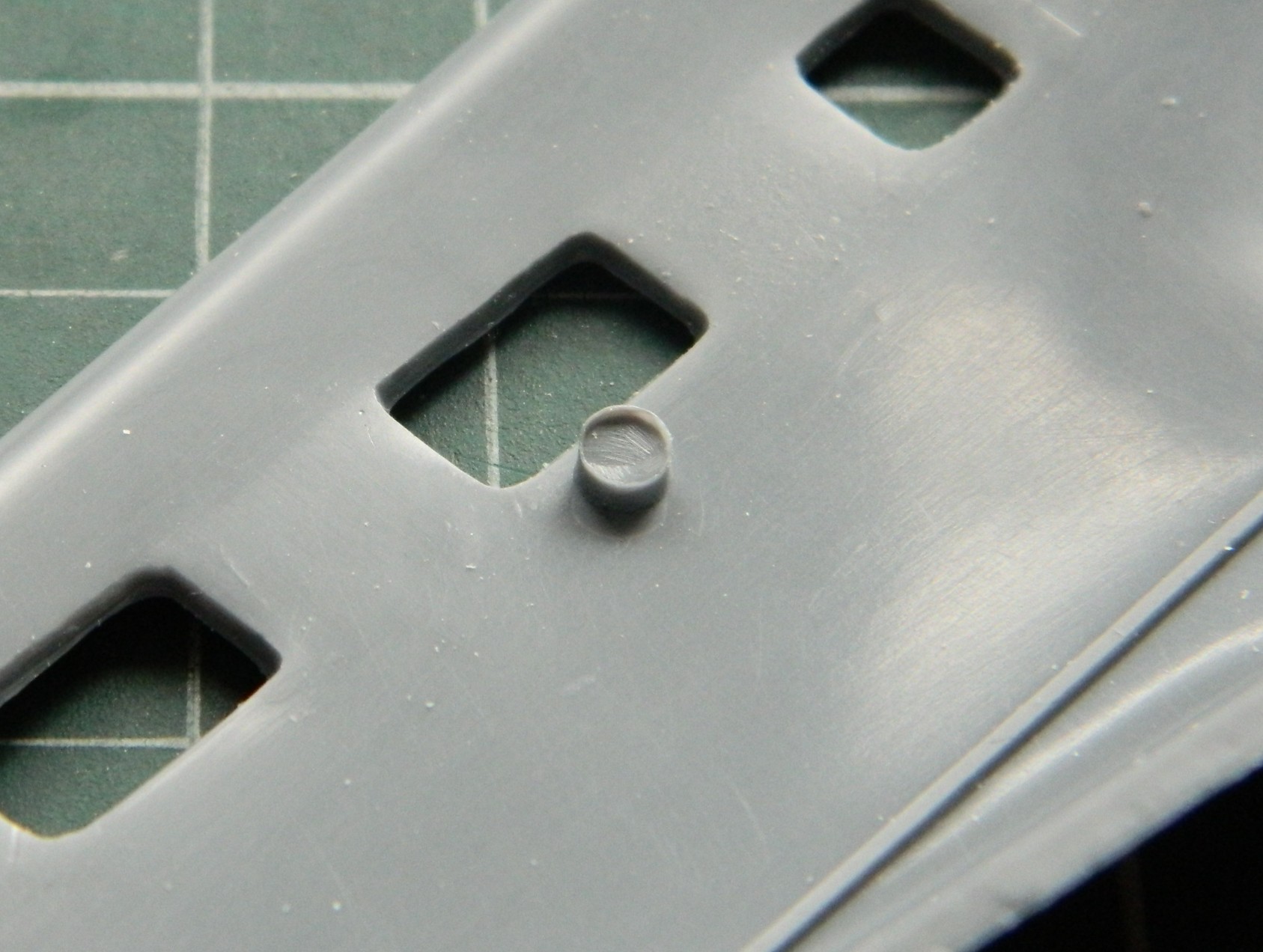
::facepalm::
And speaking of fit (which I had shortly after the first time I saw this), these two parts are supposed to MEET. The part on the left is the fuselage just in front of where the windscreen mounts, and the part on the right is the back of the instrument panel. Both have convex meeting surfaces! Gosh…I wonder why there’s a gap!:

The landing gear bays were molded as separate parts so they had to be, well, fit. Yeah. [INSERT REOCCURRING WHINING ABOUT FIT HERE] I got them as good as needed to get them mounted and glued on, figuring whatever tweaking was needed would get done later (and later I will let you know how that went).
The resin parts, with the exceptions of the engines that I used, not the resin engines that came with the kit, were supplied by True Details. I am not a fan of that company. I’ve only ordered something from them three times. Each time I was disappointed when the goods arrived. I can’t recall, though I’m sure there must be, times that I didn’t have to rework their detail parts (and their “bulged” tires? They usually look about half deflated). This time was not an exception.
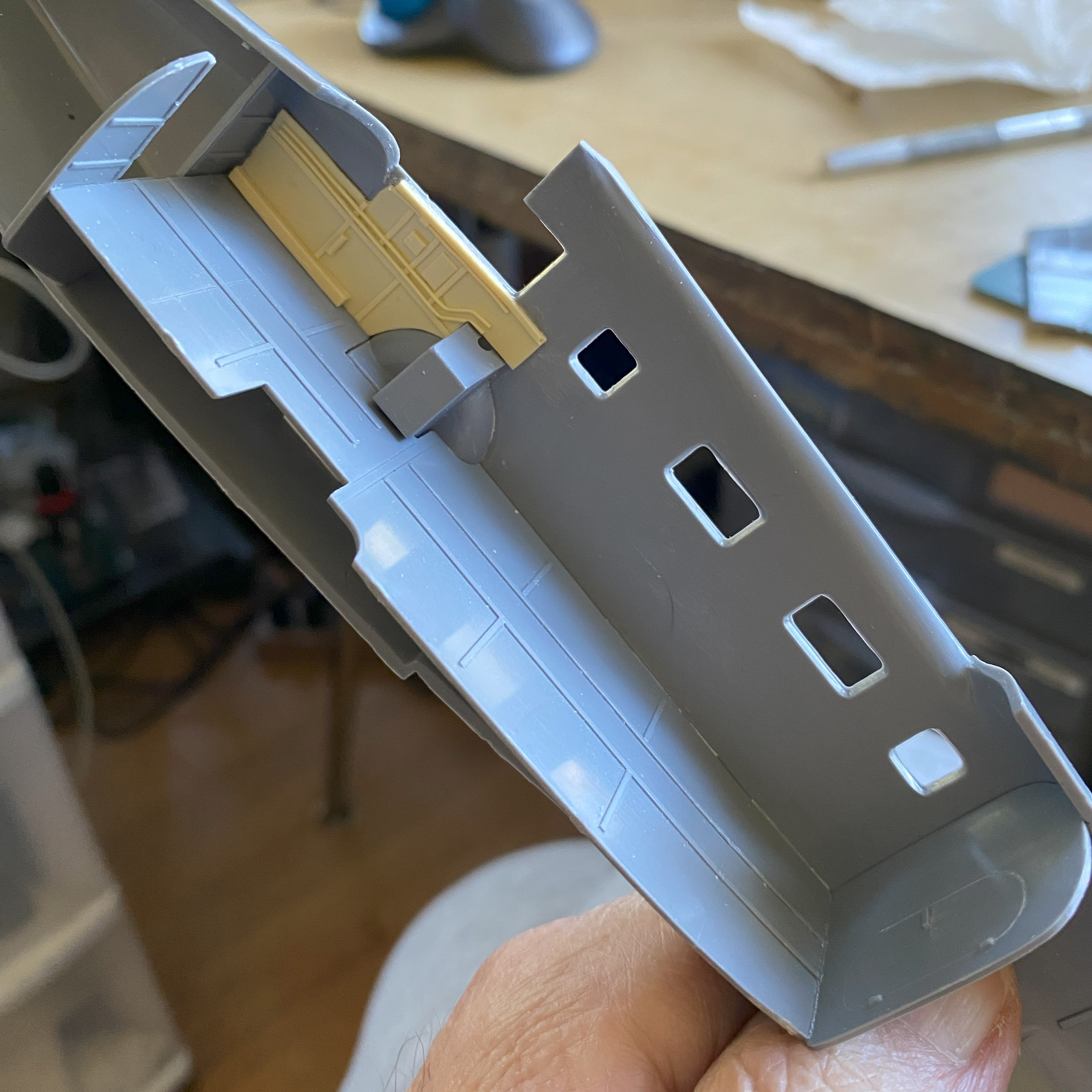
These are the side cockpit details. The thickness that would result if I’d just glued them in like that is even thicker than the armor on a Sturmovik…which this is not:
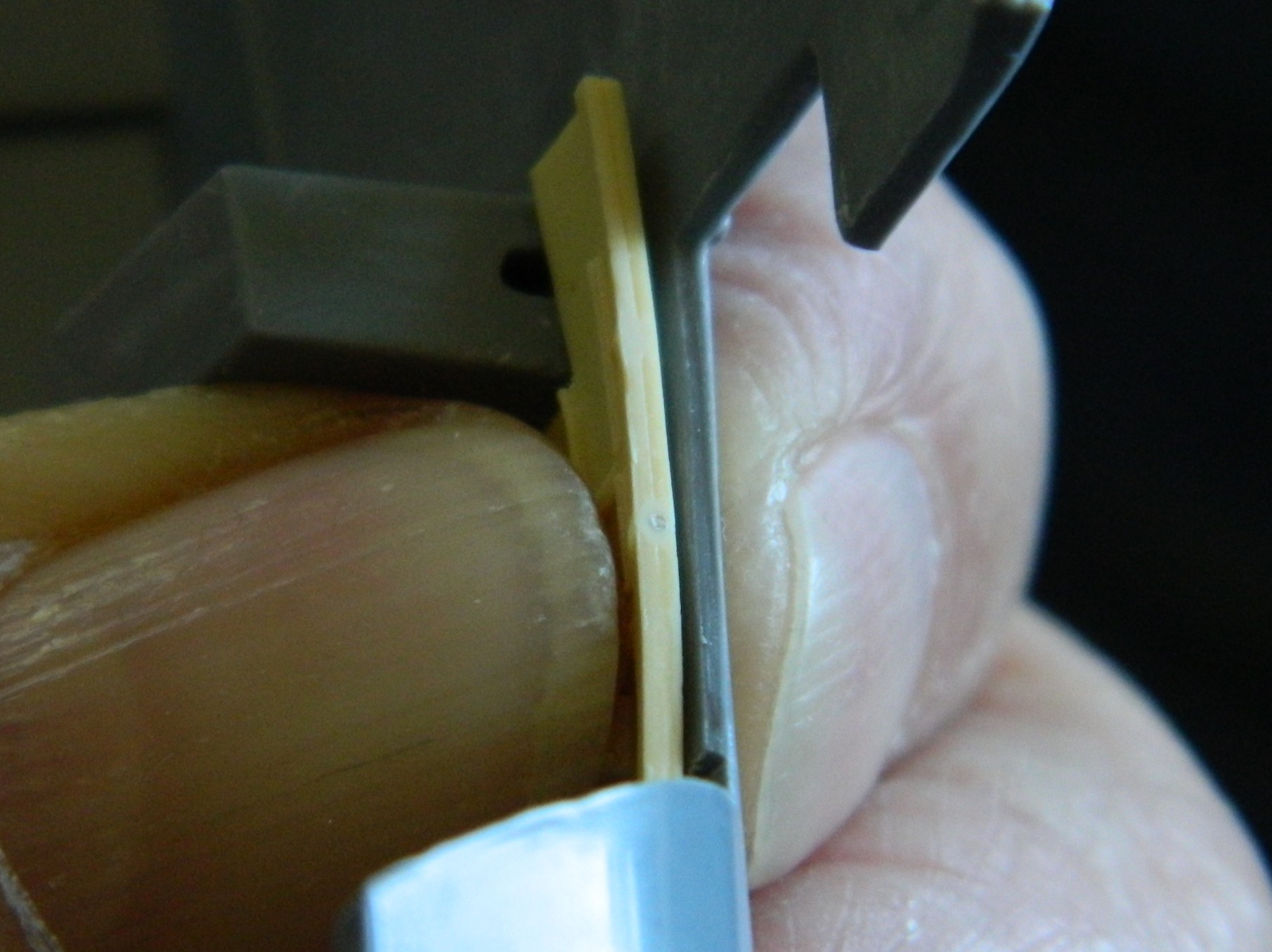
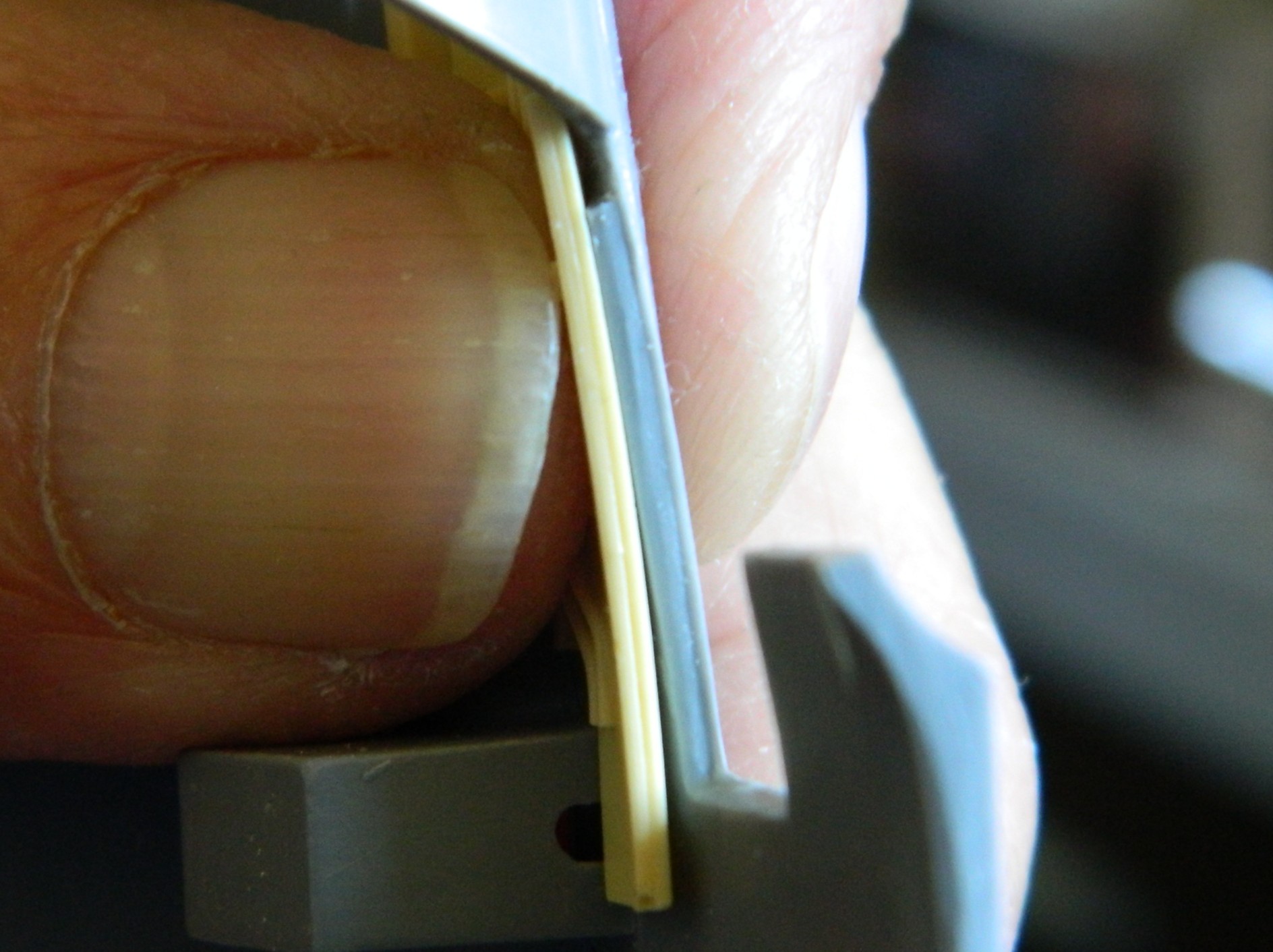
With such thick plastic in the kit, it made more sense to thin the sidewalls of the kit instead of trying to thin the resin part; I had more to work with. It’s still a bit thick but will have to suffice.
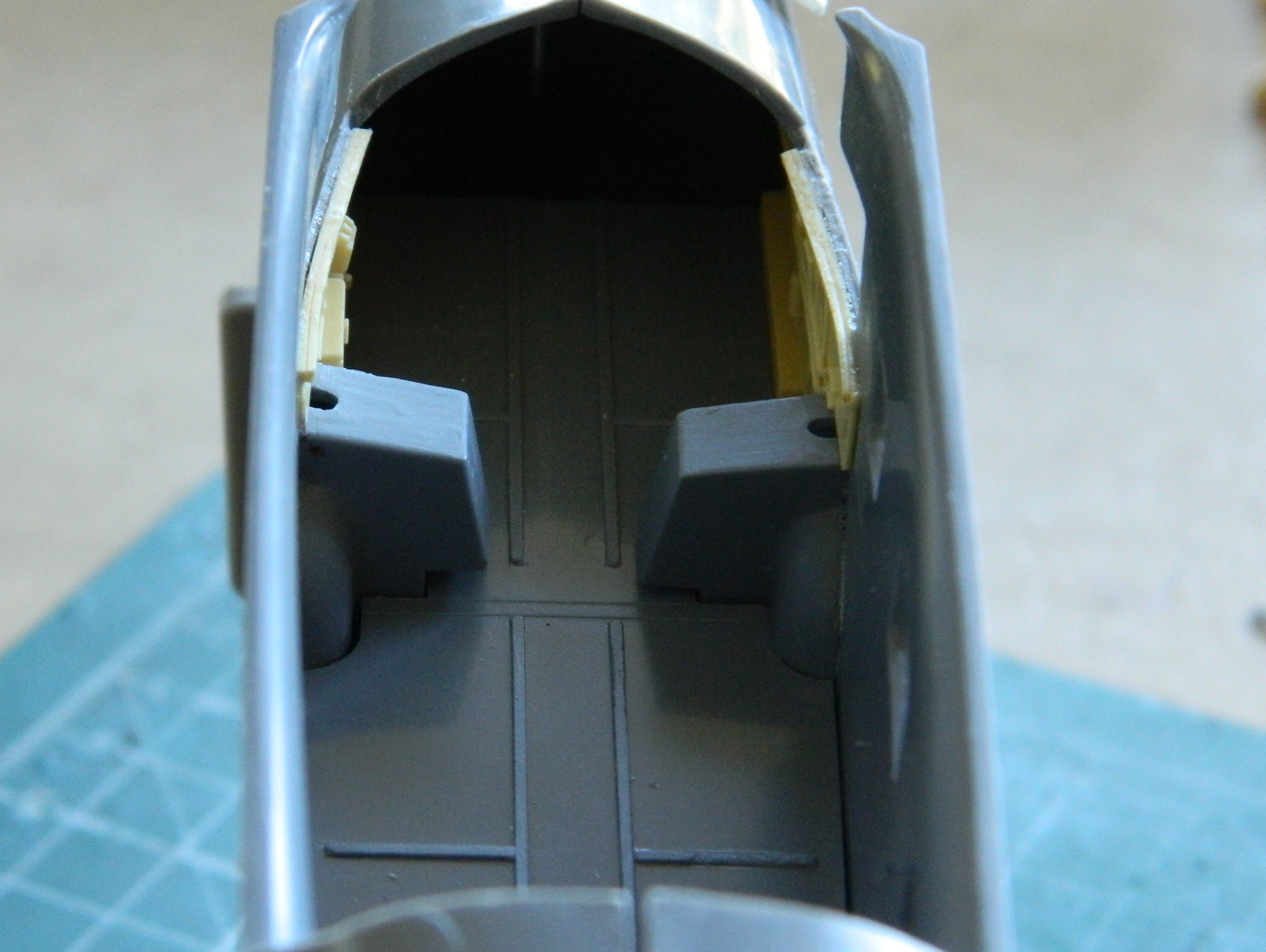
Also note the right end of that resin panel. Where the panel ends is where the bulkhead at the rear of the crew compartment fits. Look closer and you’ll see that the molded-in wiring conduits end well before they should. In fitting the other resin panel in wasn’t much better. See where the box and wheel well arch meet? True Details didn’t mold that box the way you see it. They’d molded it square…which kept it from fitting. That it fits isn’t because of their work:
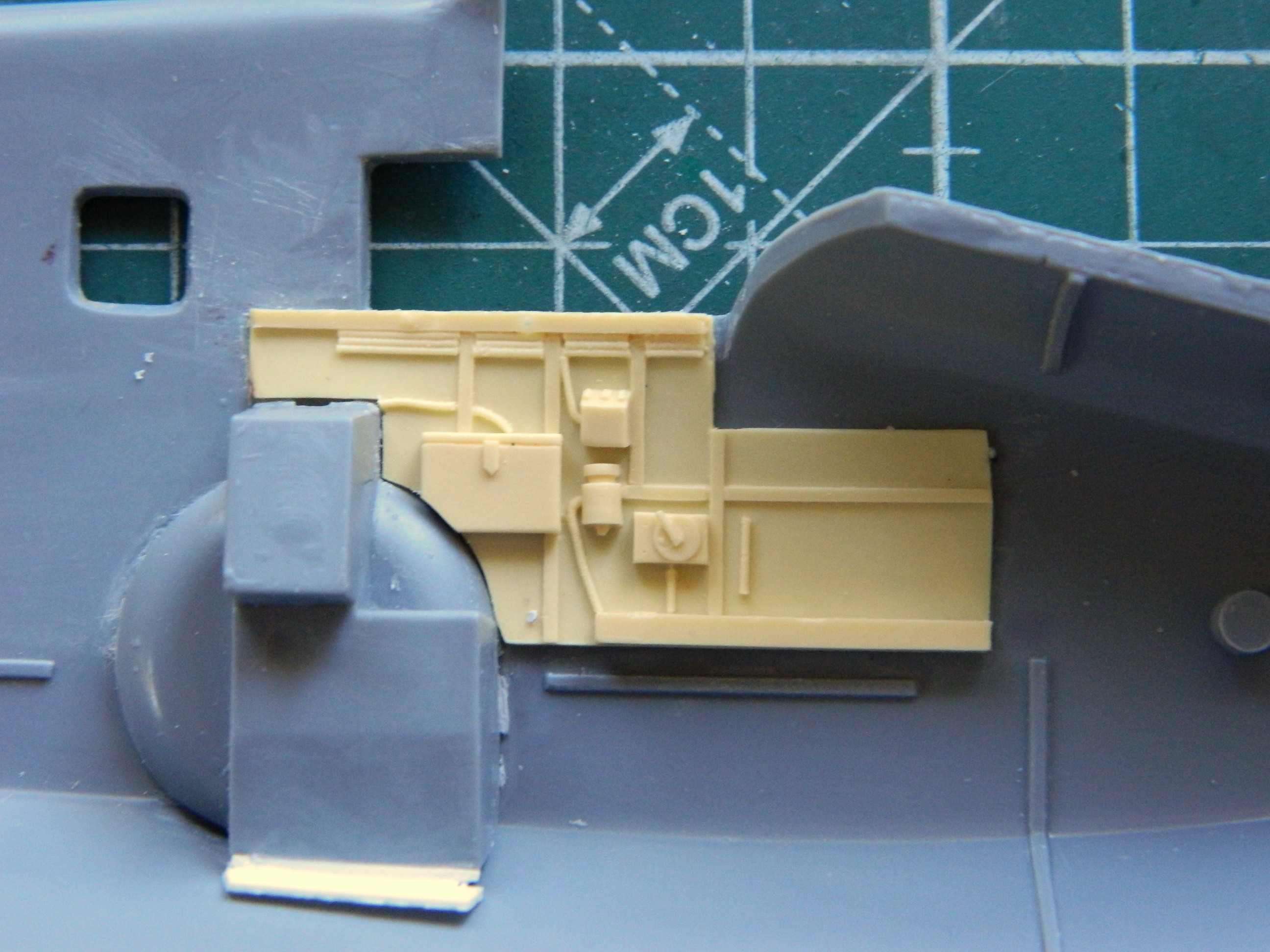
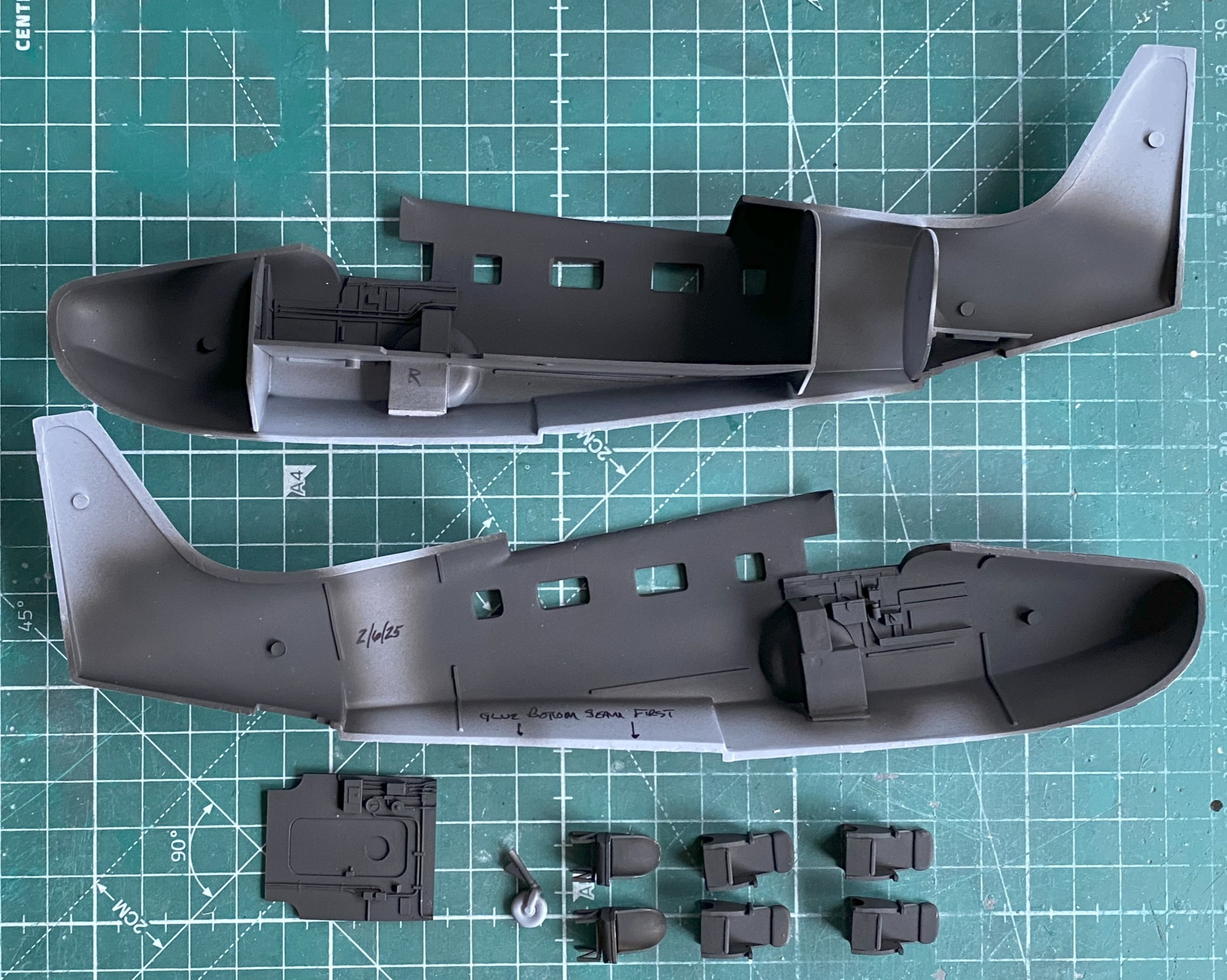
After much scraping, sanding (100 grit!), more scraping and more sanding, they’re now in there permanently. Next task was to fit the floor, which included the forward bulkhead and the rearmost bulkhead (with the ejection pin gone and the door’s panel line scribed):
True Details also supplied four seats for the passenger compartment as well as the crew’s seats. The passenger seats:

The crew’s seats were molded separately from their mounts. Once all cleaned up and attached to their mounts, I ended up with these:

The tail wheel has its own bulkhead with mount:
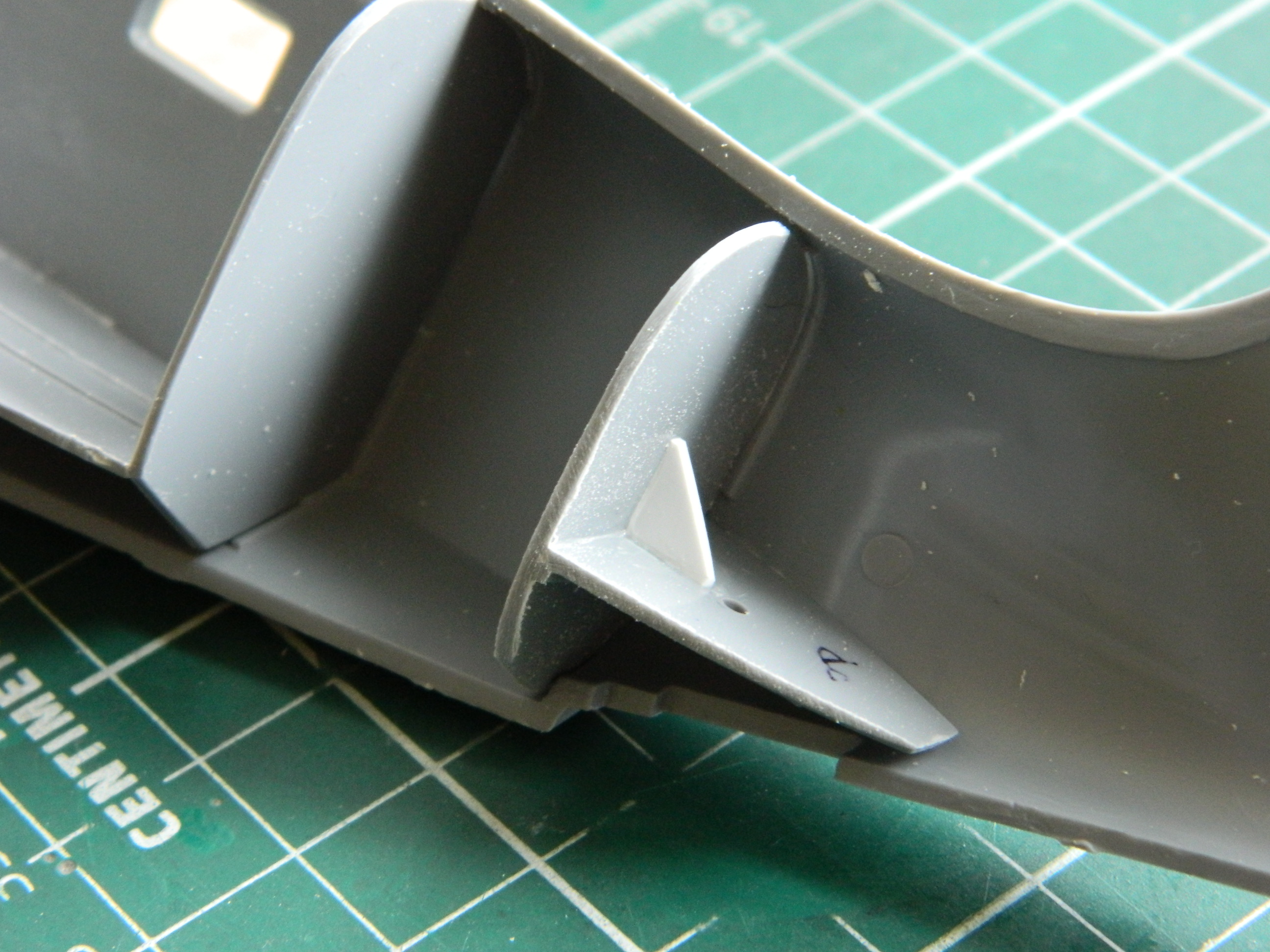
Attempting to dry-fit the other fuselage half led me to my next episode of fun. The other half wasn’t even close. It took several days of “fun” to find all the areas of the bulkheads that were keeping the halves from meeting and trim things down so that I can, in fact, attach the other half of the fuselage later. Five hours of sanding, fitting, filing, sanding, filing, fitting ensued. But it all now fits together.
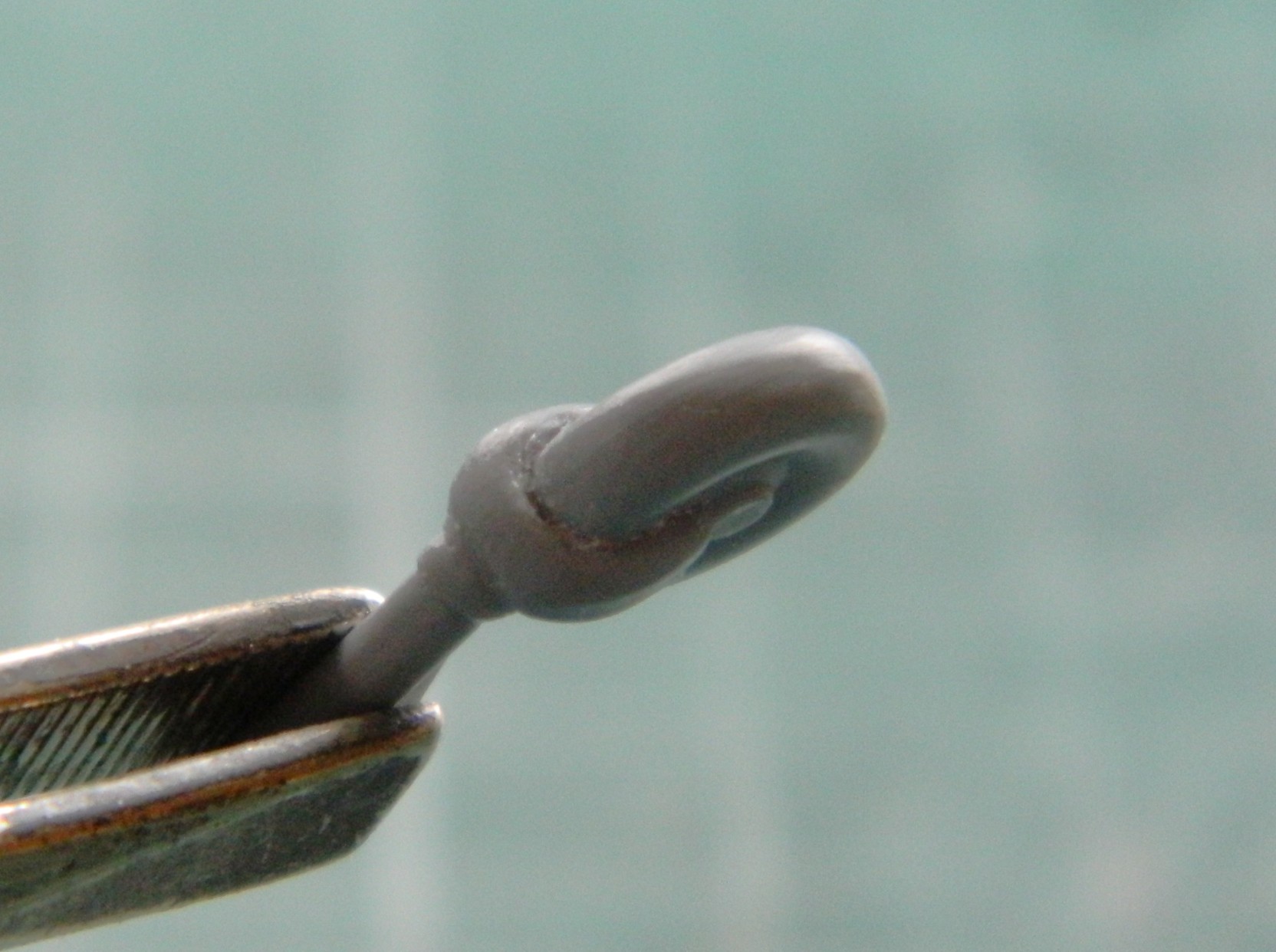
I decided to have more “fun”. I wish I’d remembered to take a “before” photo. The tail wheel is molded as one with the landing gear. Poorly. BADly. Miserably. I spent a couple of hours carefully creating the illusion (I hope…I won’t know until it’s painted) that the two are actually separate:
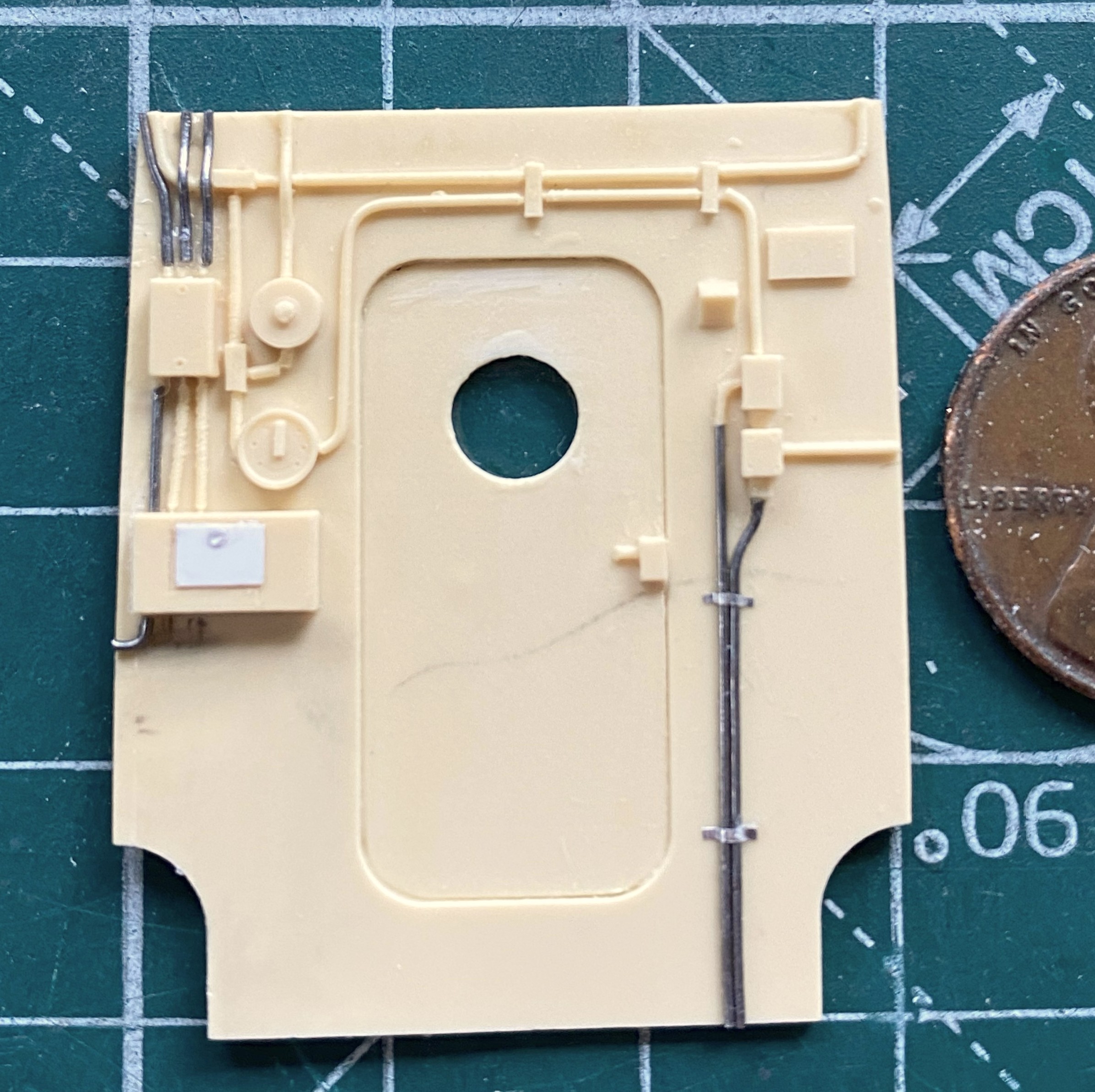
The rear bulkhead followed the cockpit side panels with their missing details so I fixed that using 0.015″ (.381mm) solder and standard kitchen aluminum foil as retaining straps…because True Details is obviously fine with putting in details that just end somewhere. Also, note the box with the added-on opening. That’s how they molded it. But to get to fit with their own damned parts into the cockpit, the lower left corner had to be modified. I also added 0.010″ (.254mm) clear to the porthole in the hatch:
Notice how the left edge of the partition doesn’t seem quite square? It’s not an illusion or camera artifact. It’s. Not. Square. Another bridge to cross relatively soon.
I got to the next step in my traditional manner. Painting is what’s now driving this bus. Before I can marry the fuselage halves, it must be painted. I prefer pre-shading to post-shading. So before I can shoot any color, I need to throw down the shaded areas. Tamiya XF-1 Flat Black:
I’ve read three different build reviews. Most of my gripes with this build involve things I was forewarned of, though I am surprised at how badly things fit, I wasn’t unaware that FIT SUCKS. Of the three build reviews, only one mentioned the landing gear. The builder called it “finicky.” Talk about understating a situation!!
I checked the instructions and references to make sure that the landing gear supports were going to the intended side (because the Tigercat build showed me that knowing right from left is still not my forte), and tried to dry-fit them. Without hyperbole (which I really, really want to indulge in), as molded they can’t fit. I tried everything I could think of (or even suspect) to get these parts to fit. They don’t. Then I did something that saved at least 3mm of stomach lining. I checked the landing gear doors for fit. You know, the part of the aircraft that would fit to fill the openings to the landing gear bays. What I found was wrong…wrong, wrong, wrong. I’ll show you the photos first.
This is what things looked like at the start:
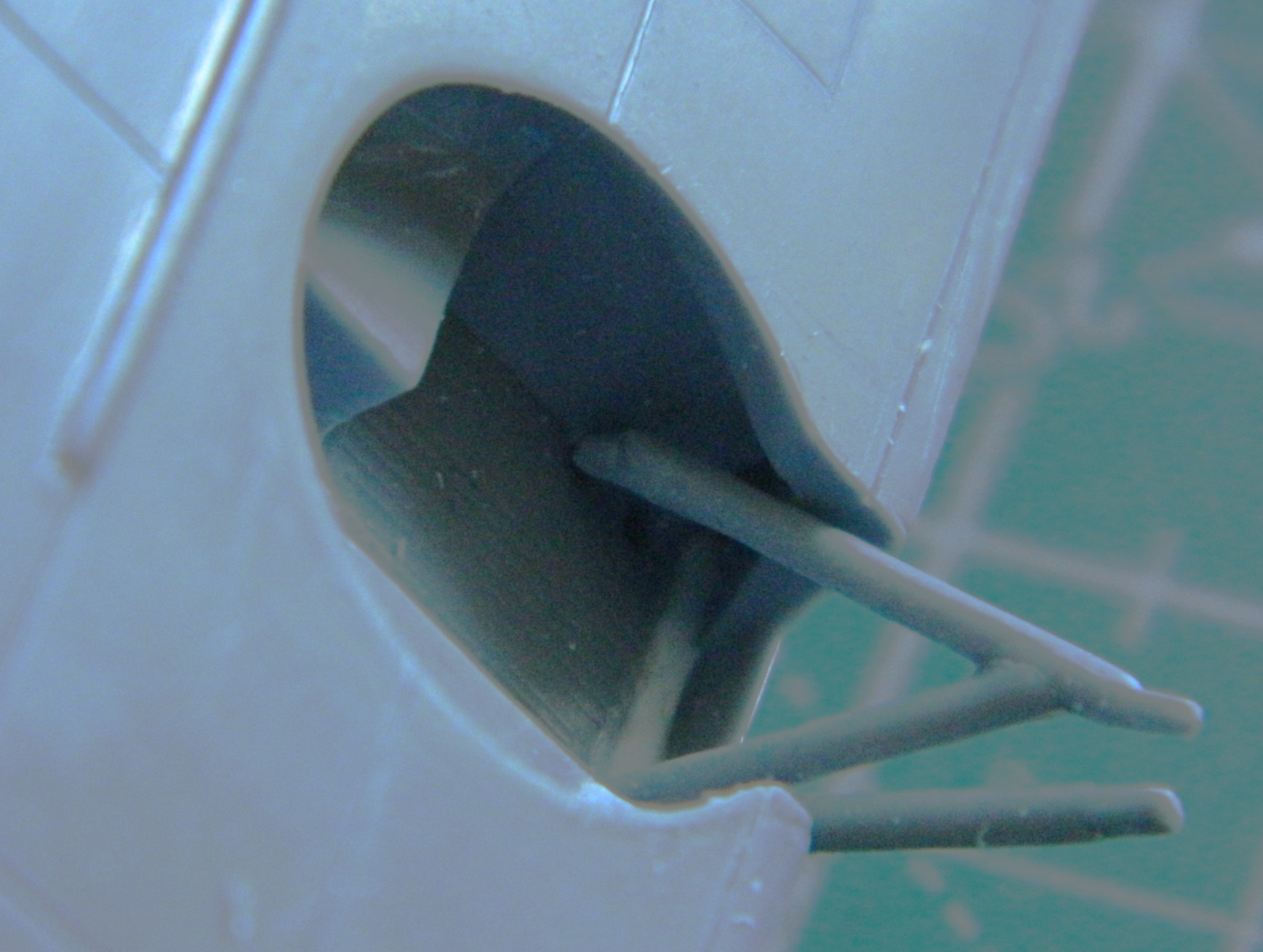
Note the uppermost strut. It’s in contact with the plastic of the fuselage but not one of the very few molded-in attachment points (of the entire kit) where the struts touch the inner landing gear bay. Doesn’t fit. Then I cut away the part from the sprue that would close the side and bottoms of the landing gear bay and compared it to the opening the kit provided for it:

Pencil didn’t last long enough and even the sharpest marker was too thick, so I used a scriber to outline the limits of the hole I had to cut:
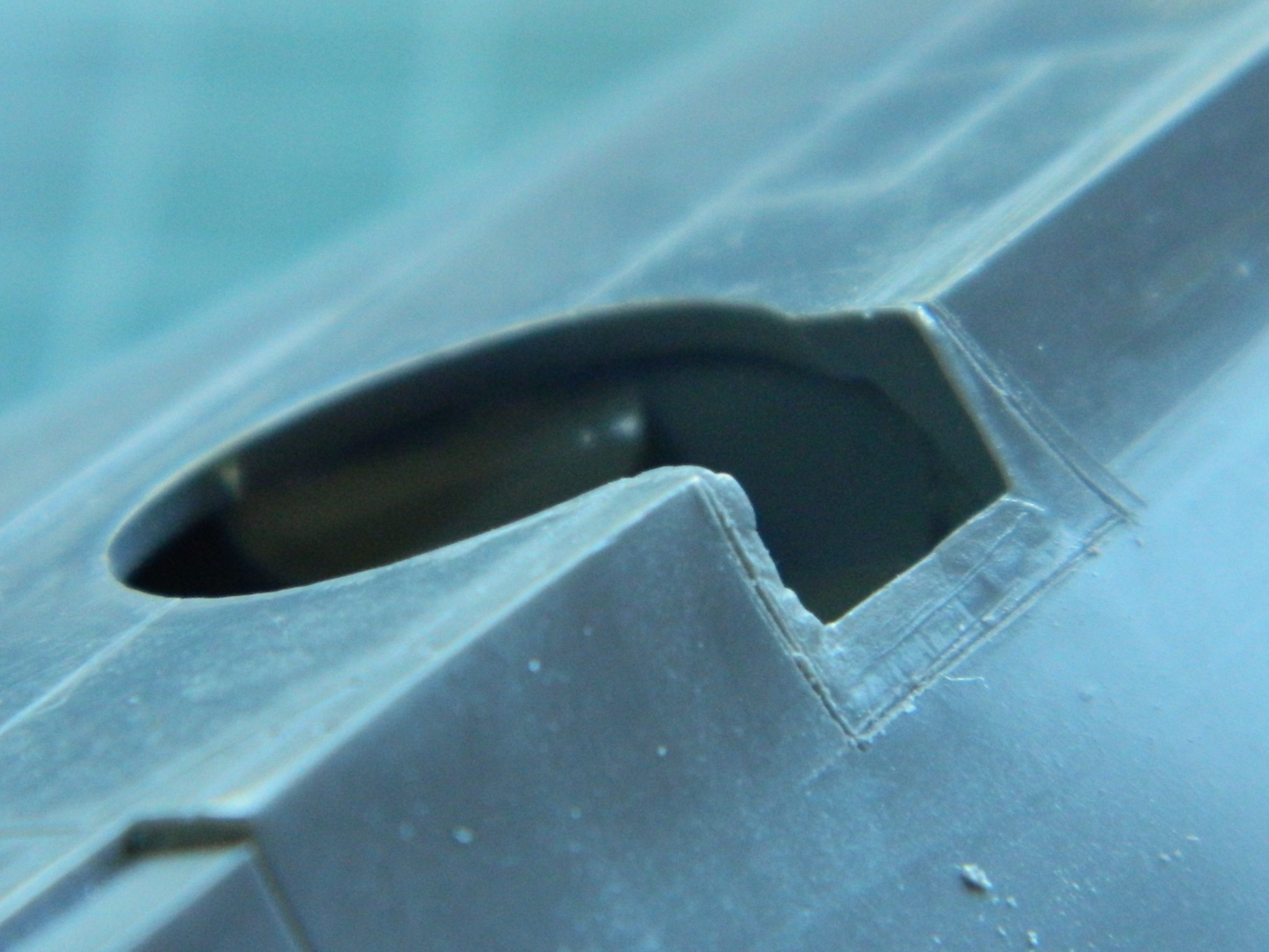
See those faint outlines of the fuselage on the bottom (which is in the above photo)? SOMEbody knew that that should have been cut away from the die, just not the guy (or gal because incompetence isn’t gender related) who cut the die.
So I did their job for them (which, really, is for me):
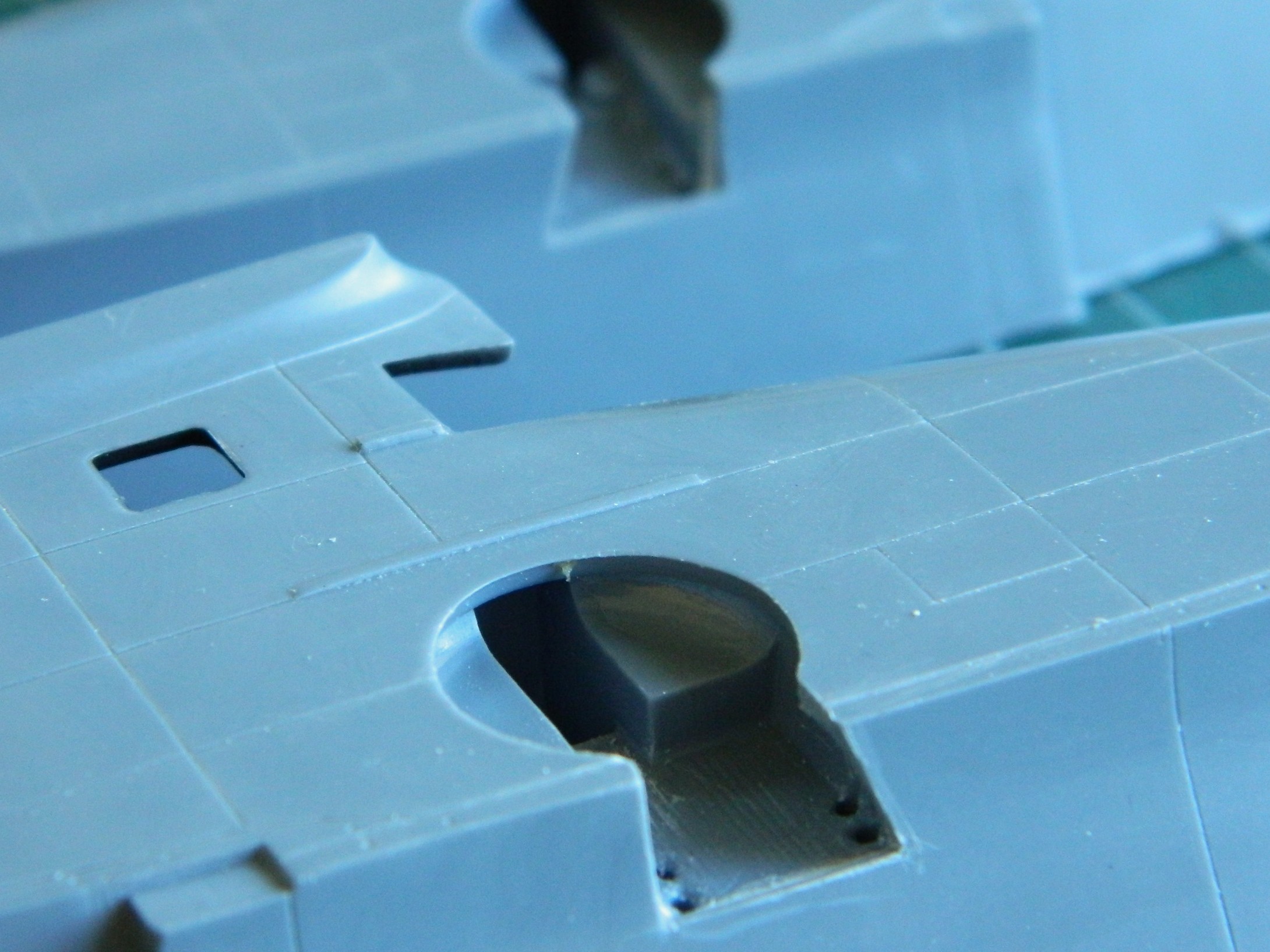
Not only do the parts fit now, in the bottom photo you can now see the attachment points…and the struts fit!
Now the landing gear doors look too thick (because they are too thick). The parts are so small that I knew trying to thin them out to a less out-of-scale state would reclaim those 3mm of stomach lining. I decided to scratchbuild them using 0.010″ (.254mm) scrap (yes…the part I’m making is held in place by double-sided tape):
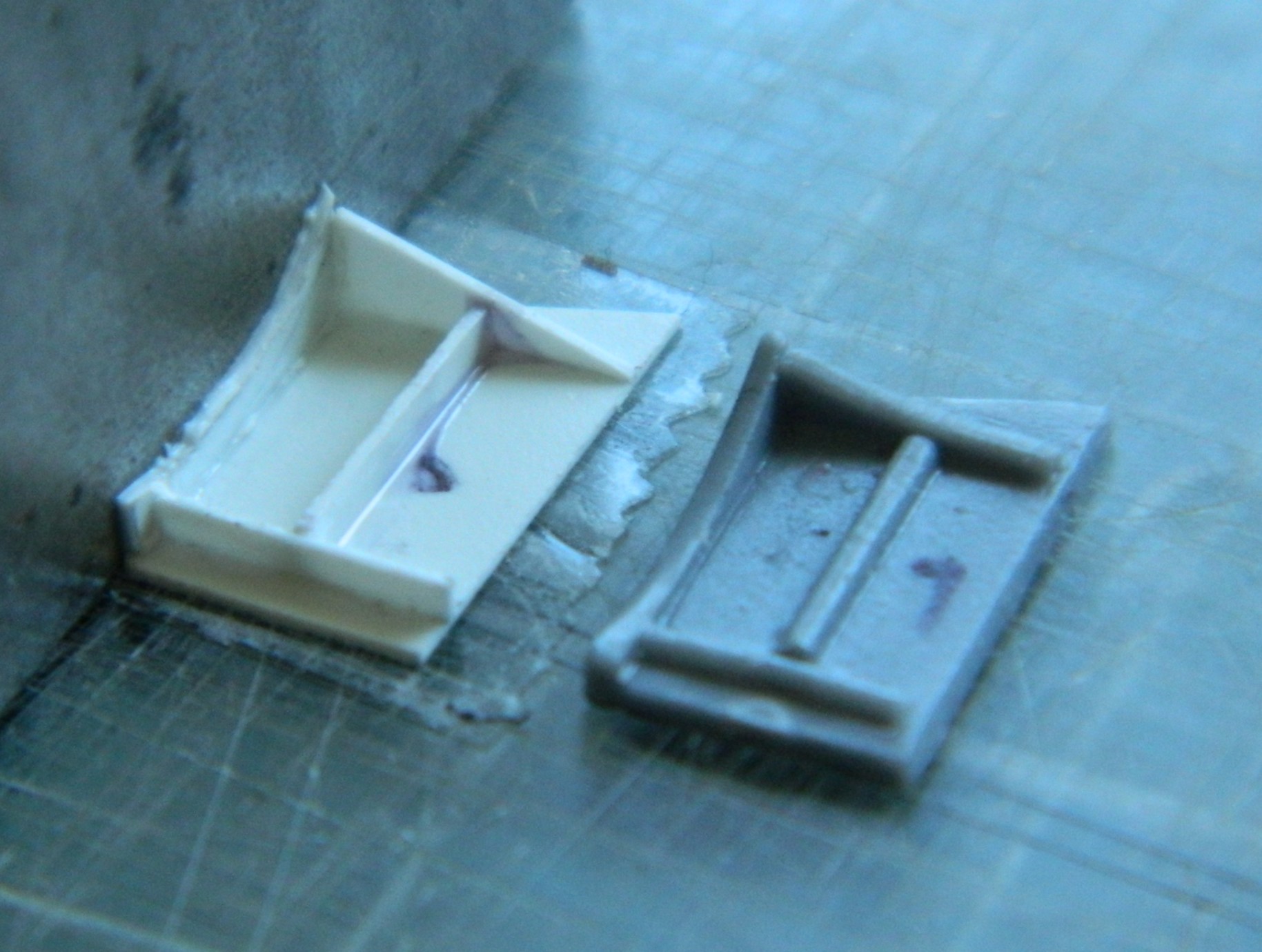
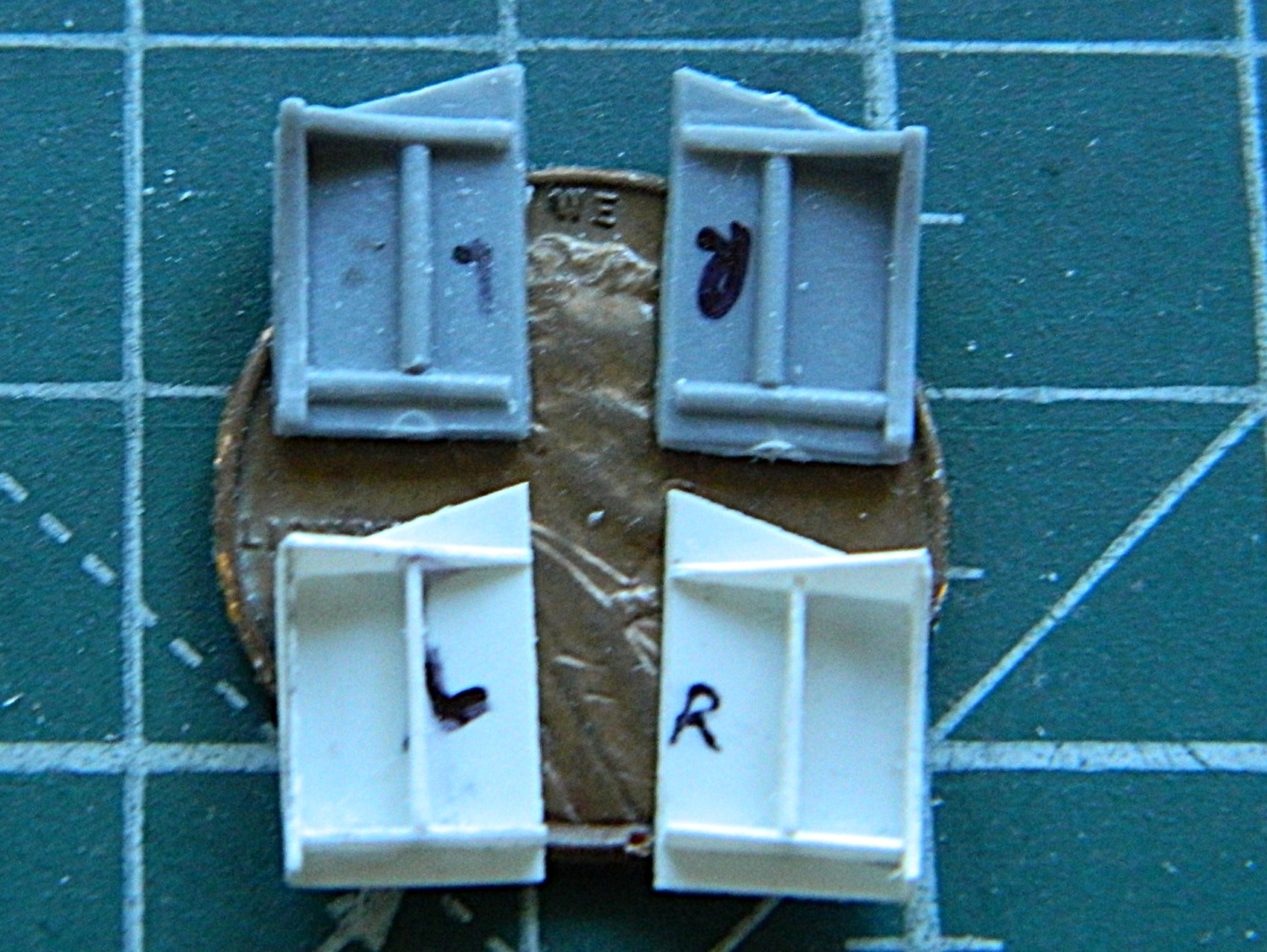
Next step in marrying fuselage halves is to get the instrument panel to fit. That’s going to be a chore. In order to get it to fit, I have to attach it (where it can be attached, anyway) to a fuselage half to begin filling the gap. But before I can do that, I have to paint it now while it’s easy to get at. I tacked a bamboo skewer to its back and applied the base coat of Tamiya X-18 Semi-Gloss Black:
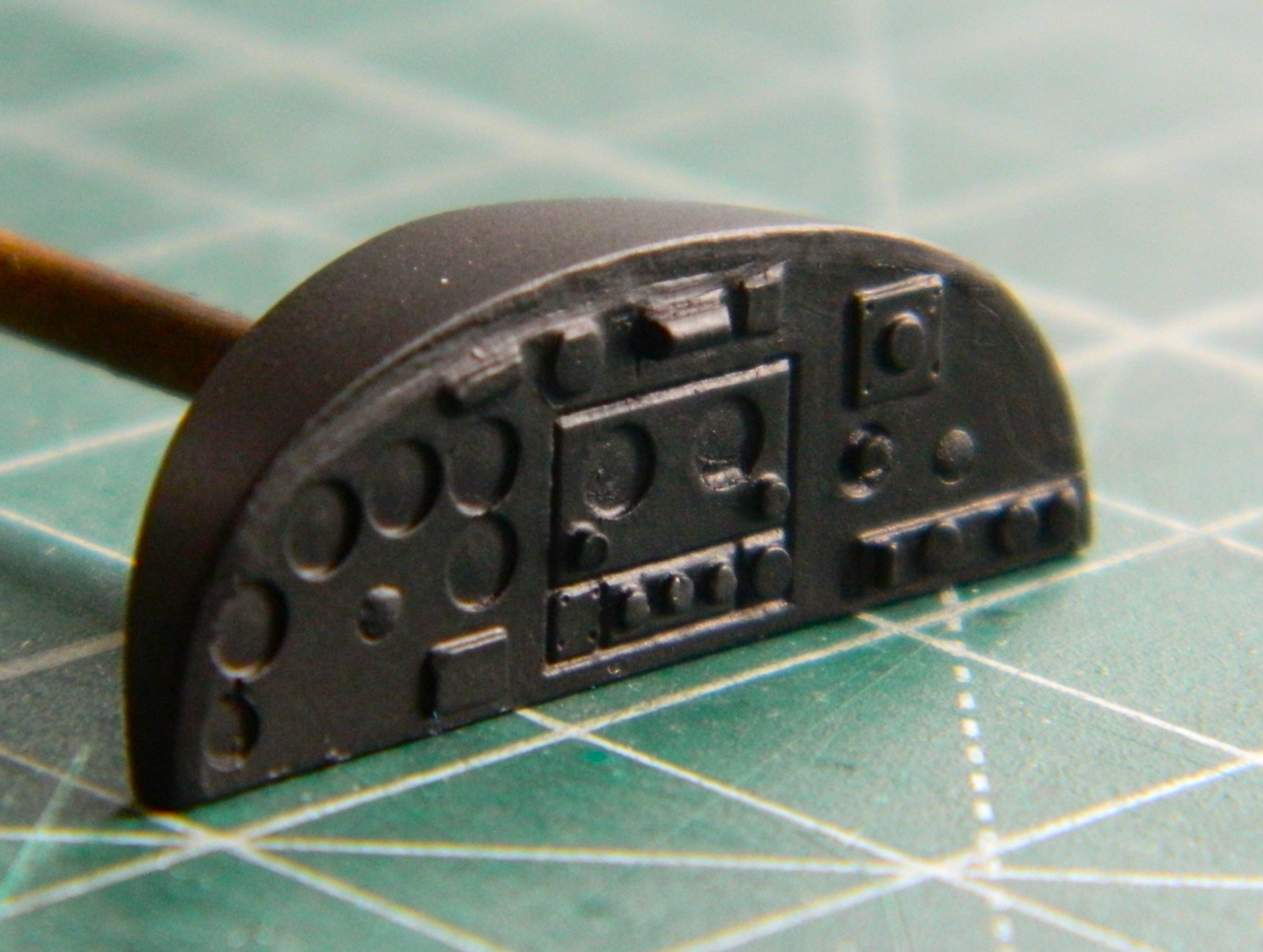
There’s a chance that the uppermost gauges will be visible so next month will also entail me adding either transfers or decals of instrument faces to them…but before that, I think I need to paint what parts/assemblies I have under black with chromate green.
 Scale Modeling Mania