If you’ve been to this website before and checked out my building process, I’m confident you’ve noticed that I build subassemblies and once there aren’t any that I can build, I start putting them together (though there are those tasks that have to wait until later…think “small bits that want to snap off during normal handling”). In general, I’m usually surprised that once I get to the install-subassemblies stage, “suddenly” the build is done. It’s much like being an overnight success. There is rarely any sort of “suddenly” to the successful. There are usually years of perseverance, varied and continual emotional stress, and luck that support the “success” part. It’s not “suddenly” for the person who succeeds, and I think the same thing is true about my being surprised that it’s all coming together seemingly quickly. With my builds taking MONTHS to complete (or longer), “seemingly quickly” doesn’t seem very quick from where I’m sitting.
This month was much like that.
I ended last month’s post with cleaning up the empennage. So I started this month attaching the empennage. My. Goodness. It was very fiddly and easier to get incorrect than it was to get it correct:

It’s at this point that I state that the elevator bits were an utter ass-pain. They have a dihedral and the kit offers absolutely zero help in getting them aligned. After the above was glued on, I glued the other one on immediately, intending on using the mutability/movability property of freshly glued parts. What enabled me to get it done as well as I did (I hope) was using the support struts to achieve whatever degree of accuracy I managed to attain (they weren’t glued on at this point). This end of the strut goes here and the other end of the strut goes there. I hadn’t cleaned up the struts at this point, they were just used as jigs to at least get within sight of this thing called “accuracy”.
While the glued parts were sitting for the glue to set completely (more on that in a bit), I decided to pull another trigger and glue the wing on:
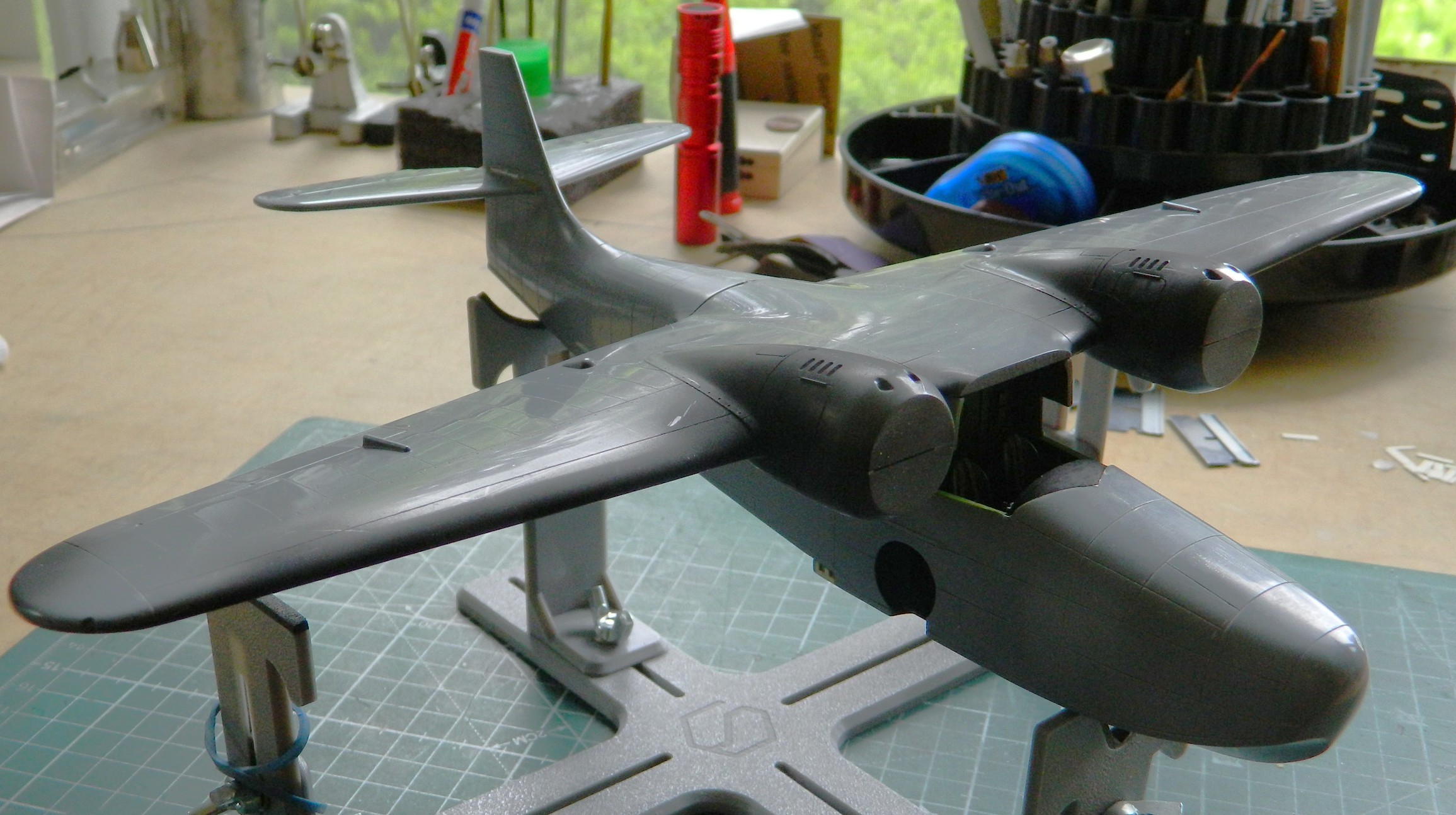

If you look at where the trailing edge of the wing crosses the top of the fuselage, you will see a gap. Since this gap is directly on top of the model and consequently easily seen, I decided that rather than putty the gap I would stuff it with scrap styrene (of various sizes):
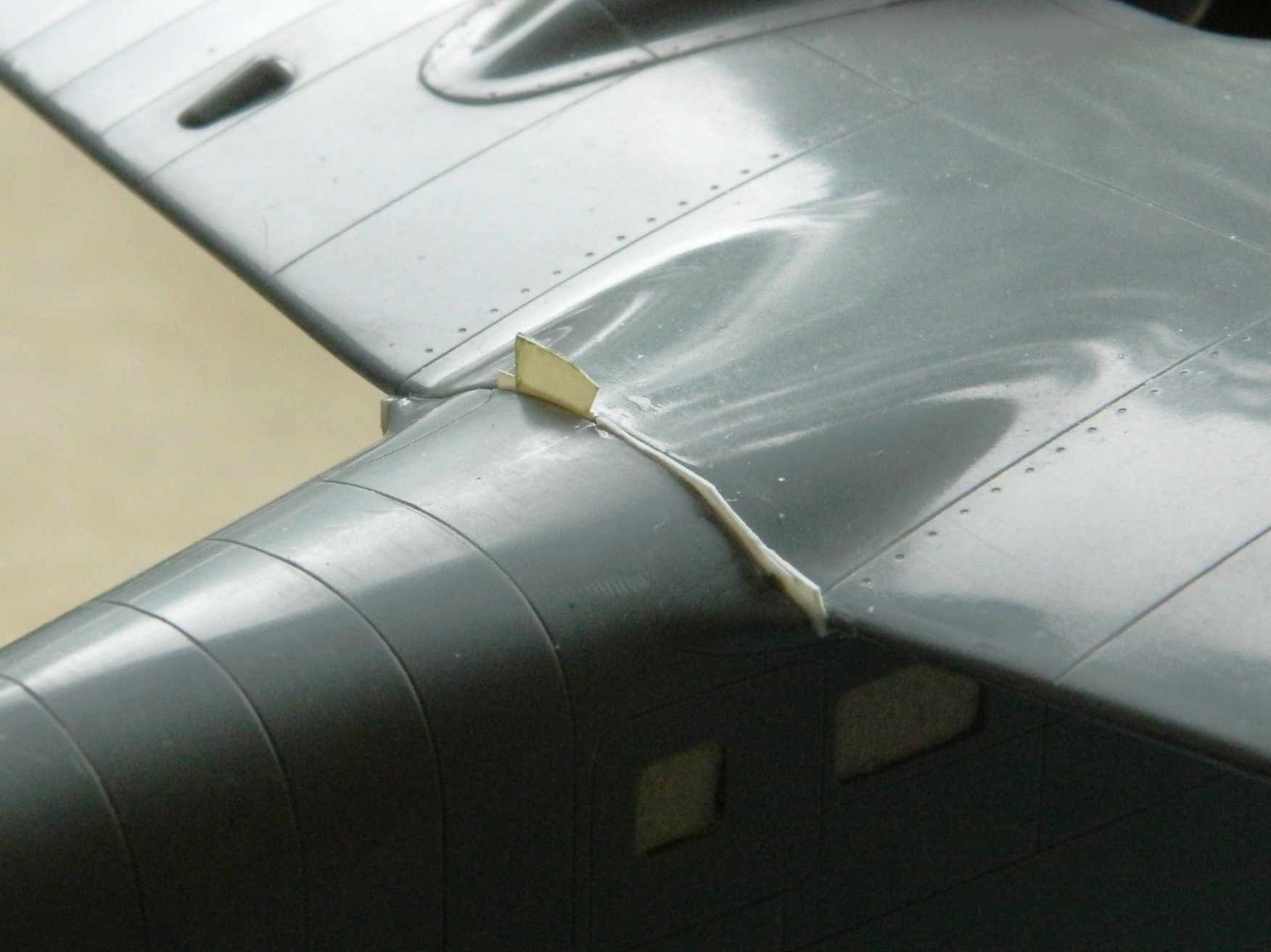
Even though I had to squeeze the fuselage sides together in order for the wing to fit into place, there were still gaps at the wing-roots. More scrap styrene stuffed in to fill those gaps:

3M Acrylic Putty was laid down over all of these gaps and set aside to dry.
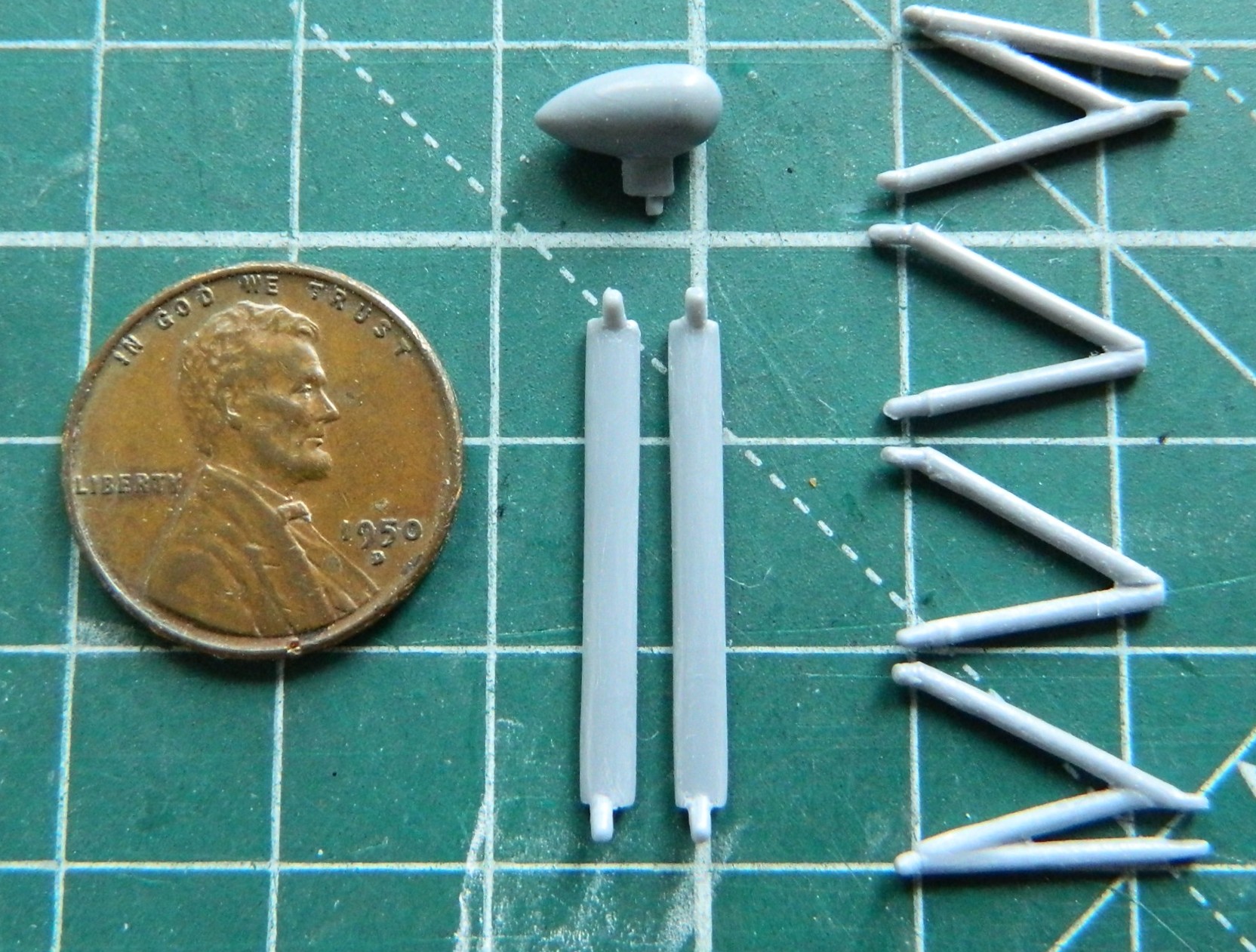
I was sort of dreading working on the landing gear. I think that whoever cut the dies for these parts did it from memory because they’re wrong. The main struts generally are also the main shock absorbers and as such have a certain look and, in the real kites, a definite purpose…and on this kit they’re just wrong. My initial thought (rare as those are) was to just scratchbuild the struts and move on. But once I had the part in my hand and my readers on, I realized that if I just could reduced the diameter of one section of the strut, that would suffice. No…it’s not 100% accurate. Yes…it does end up within the 90%-95% goal I’ve set for myself. In the next photo, the upper strut is a virgin (complete with parting lines). I used one strut as my trial, figuring that if I totally bitch it up, I can revert to my initial plan and “just” scratchbuild it. My goal, however, was to clean the part up well enough so that I could use the top of the struts (to the right in the lower photo) in my lathe if I managed to get the struts centered in the lathe chuck well enough then I’d be able to turn down the area I needed to. The blue arrow in the lower strut shows you where I managed that:
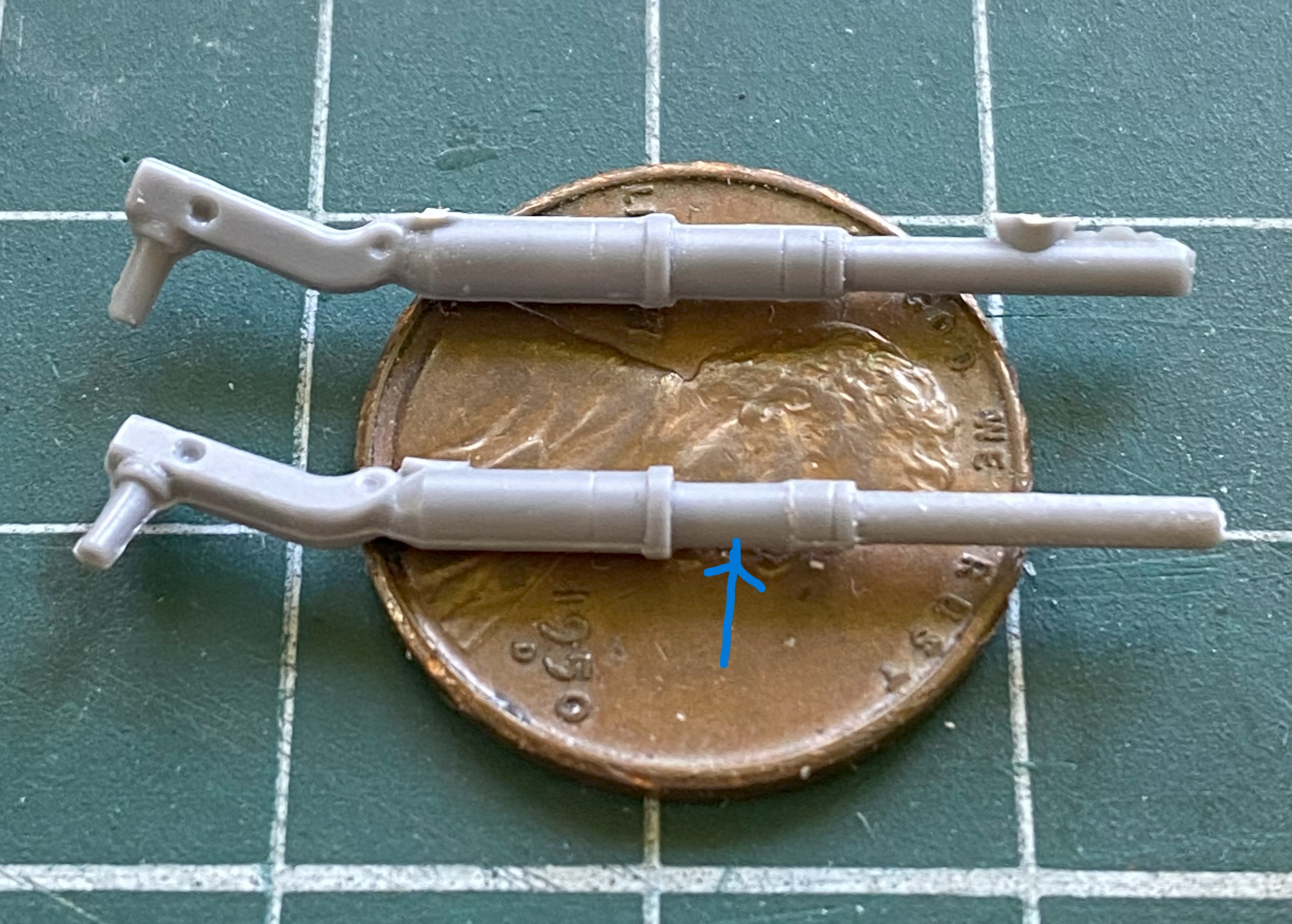
That machined area will be painted steel as it’s the section that compresses downward into the lower portion of the strut. I managed to get them both done without having to scratchbuild.
We’re at the “more in a bit” part. There was so little surface areas that could meet when I attached the empennage that, probably not surprisingly, during handling, one broke off:
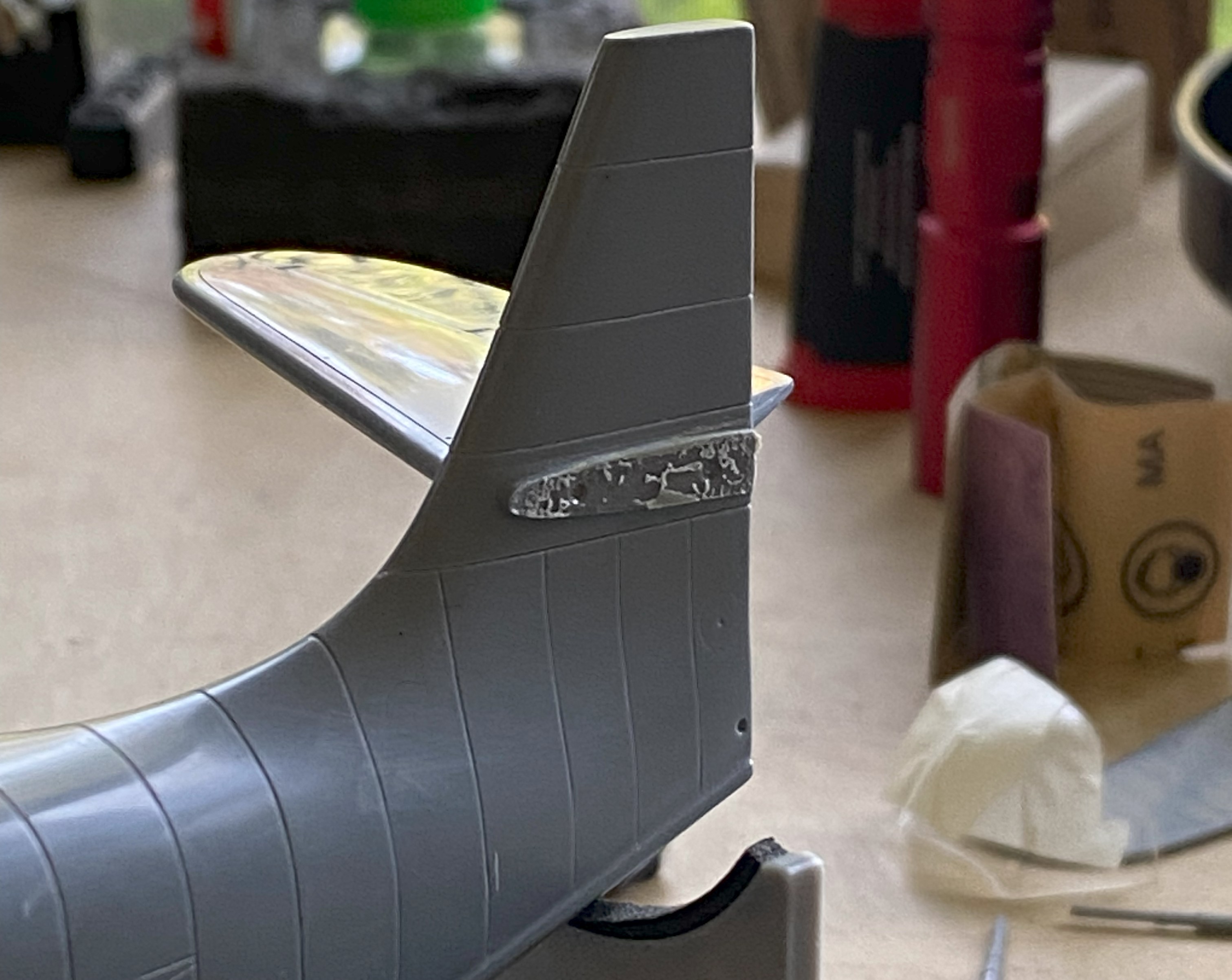
Normally I used Tamiya Extra Thin to get these bits to stay attached. When I saw how poor the mating surfaces fit, I instead dropped back to an old standard, Tamiya Cement (white label, white cap), hoping that that would work in a poor-fit situation. The photo above is more proof that perfection continues to elude me. So that was reattached:

Back on the path, I spent A LOT of time blending the roots of the empennage to the fuselage, as well as bringing down the added styrene on top of the wing:
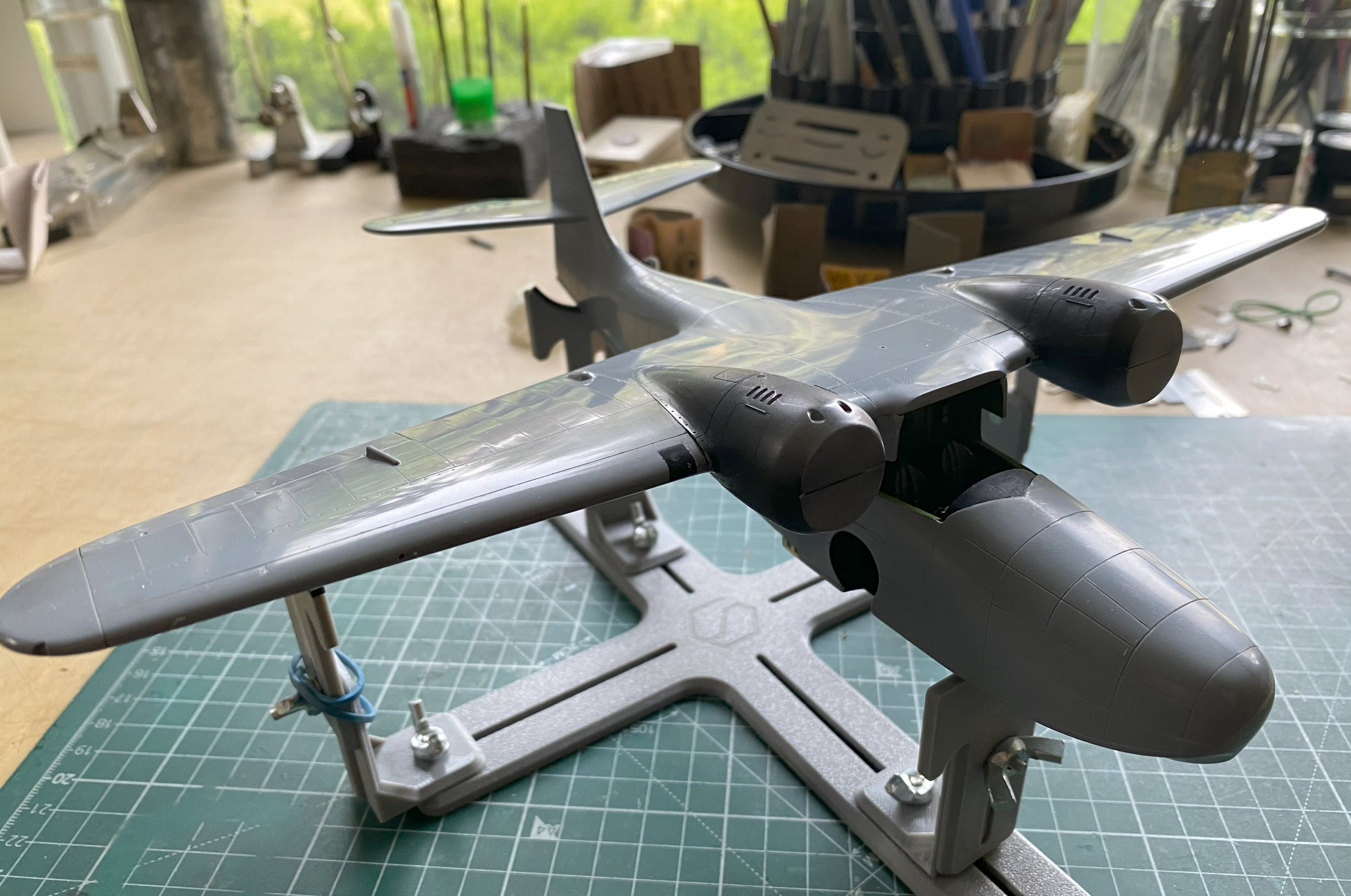

While I still had the wing on my mind, I decided which template I’ll use to cut the masks for the wing-mounted landing lights:
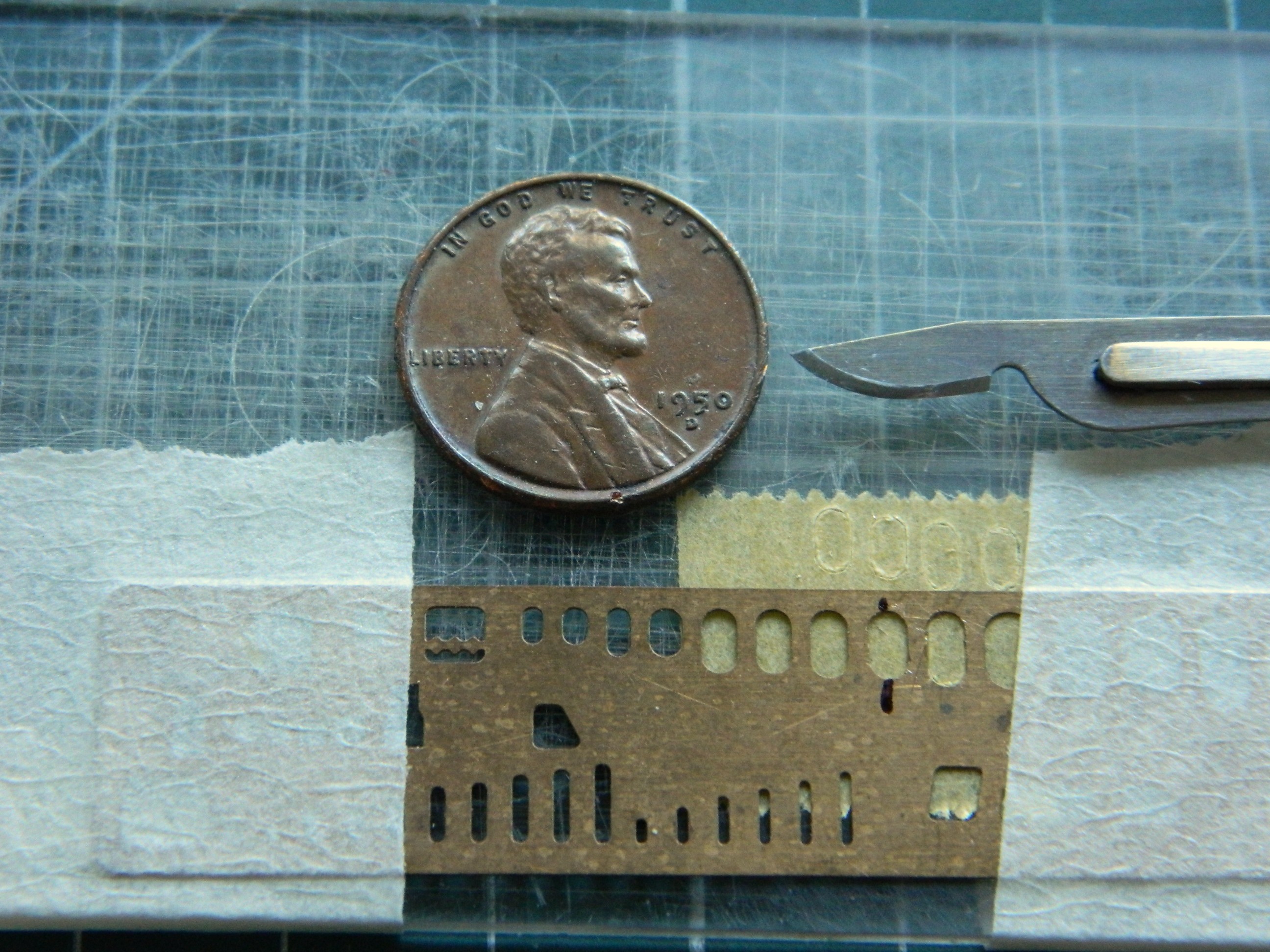
Which was then set aside because there’s a lot of work to do before the airbrush becomes the tool I need.
Having disappointed myself with how the paint job came out on the F7F-3 Tigercat, this time I decided that I would polish the surfaces to see if that resulted in something more satisfactory (as well as adding the rudder):


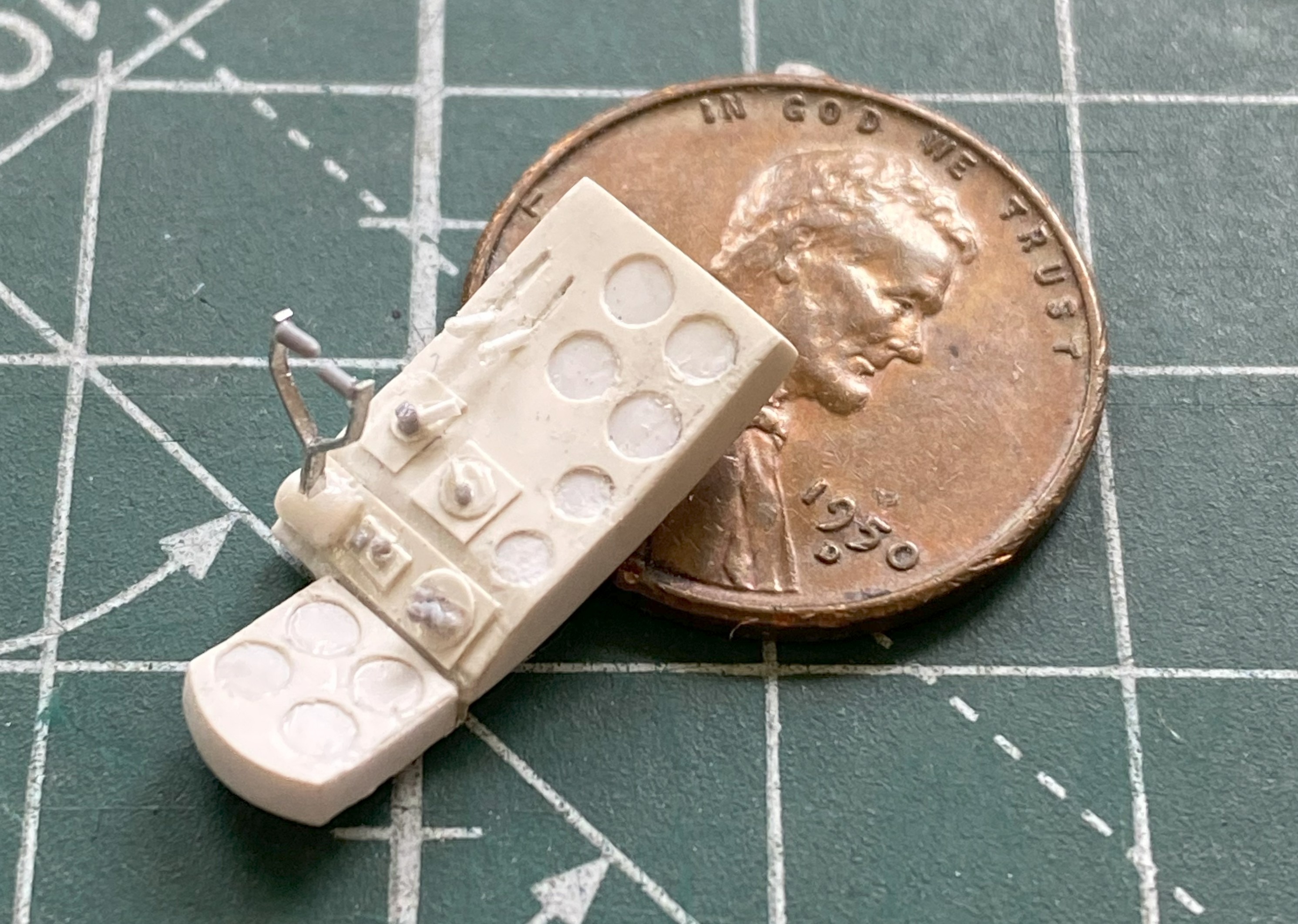
As I closed in on attaching the clear parts (normally I would call this “the canopy”, but most of it isn’t the “canopy” at all but structure of the fuselage over the cockpit. Hanging (okay, not hanging but attached) from the roof of the cockpit is a console with gauges, switches, and throttles. No way around it, I’ve got to build all that. And since I’m SO bad at matching interior curves (bad enough that comparing my…ahem…”skill” at scribing to matching interior curves makes my skill at scribing look decent), I decided that I would take advantage of the fact that the clear parts were molded in halves. I don’t have to match the interior curves, I can just trace them. Much inside the cockpit will never be seen. However, the throttle levers are quite visible, and if one turns the model just so, the face of the overhead can also be seen…so I have to build all that:
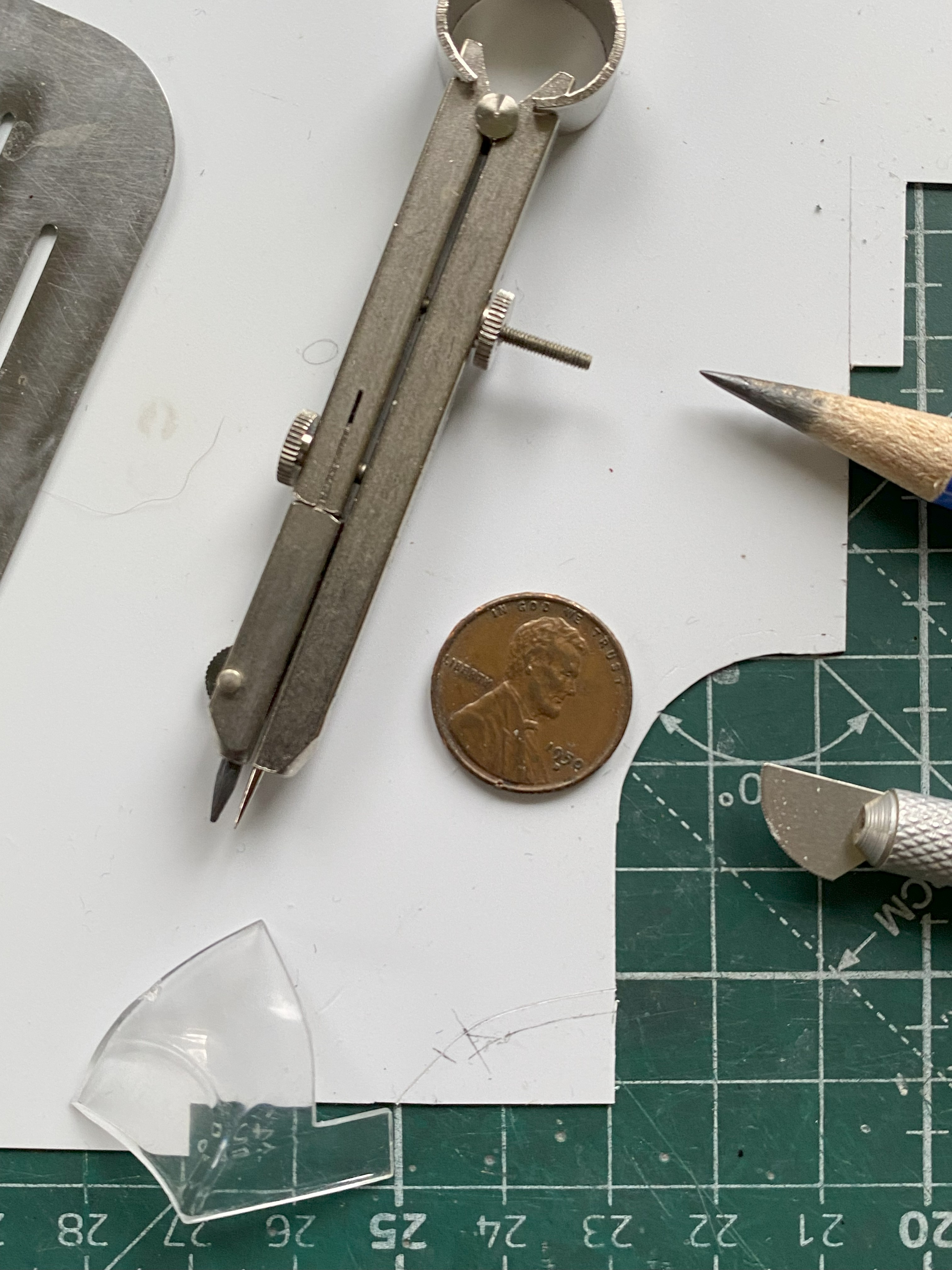
Having decided how wide I wanted the overhead, I used 0.020″ (.508mm) to fashion the sides and then 0.040″ (1.016mm) scrap as both ends:
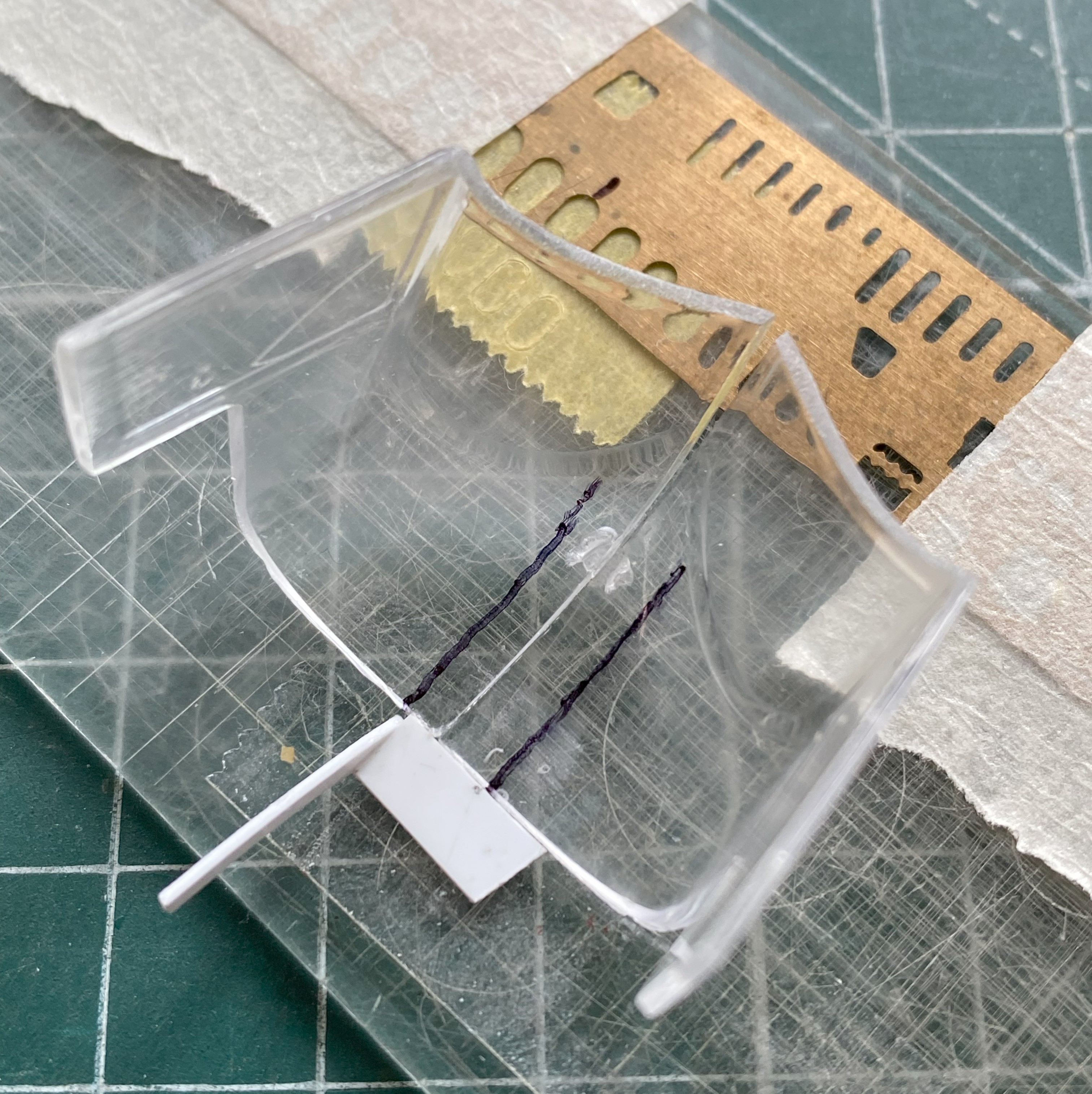

While checking fit and keeping an eye on what needs to go on and into that overhead, I realized that maybe all those details would fit on an actual overhead console, there’s no way that the initial width of my construct would. I fixed that by adding 0.060″ (1.524mm) to both sides and added the face of the overhead with a piece of 1.010″ (.254mm) styrene:


After trimming everything to fit, I used a punch and die set to knock out the gauge locations on a bit of 0.005″ (.127mm) fascia:

Once I’d laid out the gauge locations, I glued the fascia on and added bits ‘n’ bobs to start filling in the details:


Yeah…a bit sloppy. What needed to be cleaned up was attended to.
While the glue was curing, I cleaned up landing gear arms, empennage struts, and the ADF (I think) antenna:
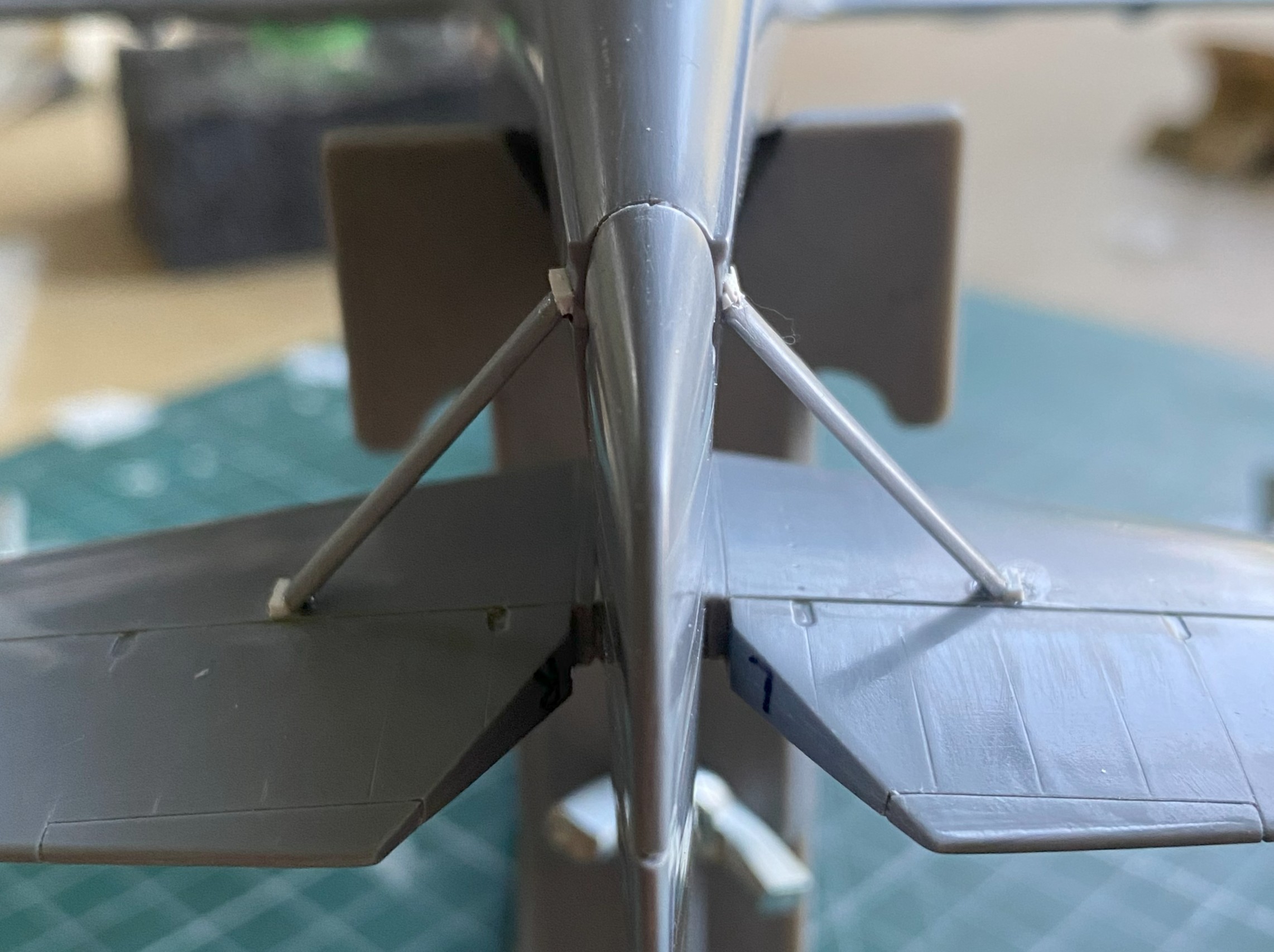
With the empennage struts all cured, this is the fit of them (note what the blue arrow is pointing at if you want a notion as to how ALL these parts so far have “fit”):

Of course that required filling, and though putty would be easier (all terms are relative), I didn’t know how it would hold up over time so instead of putty, I stuffed little bits of scrap styrene in to build up structure that later on I could trim to actually fit:

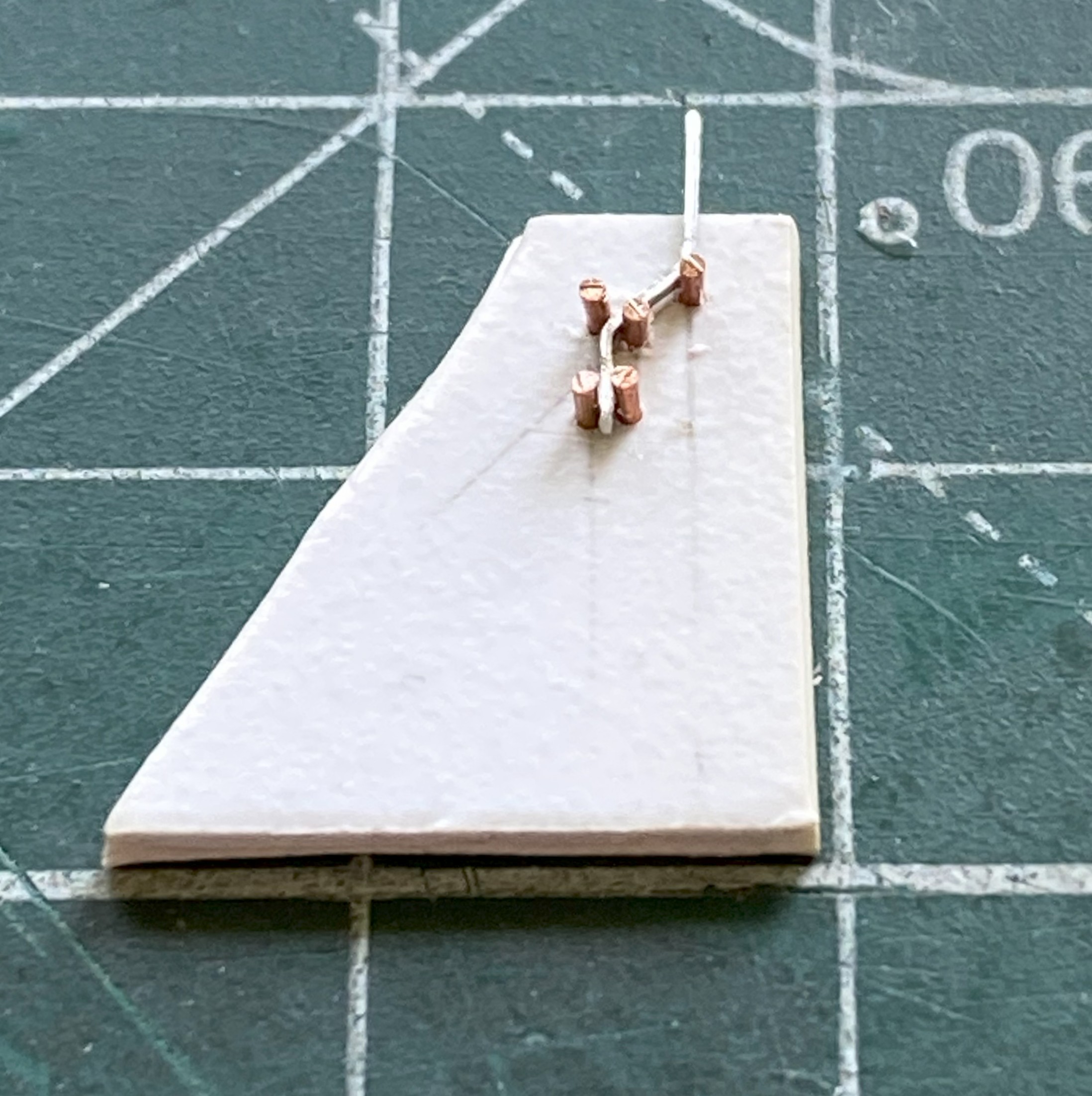
With the glue cured on the overhead console, I had to make the throttle levers. The body of them are made from 0.010″ (.254mm) aluminum for structural reasons. My first step was to lay out the angles on a scrap hunk of 0.040″ (1.016mm) styrene, drilled where the bends needed to be, and stuck 18awg wire into the holes:


Then a couple of tiny bits of stretched sprue for the grips:
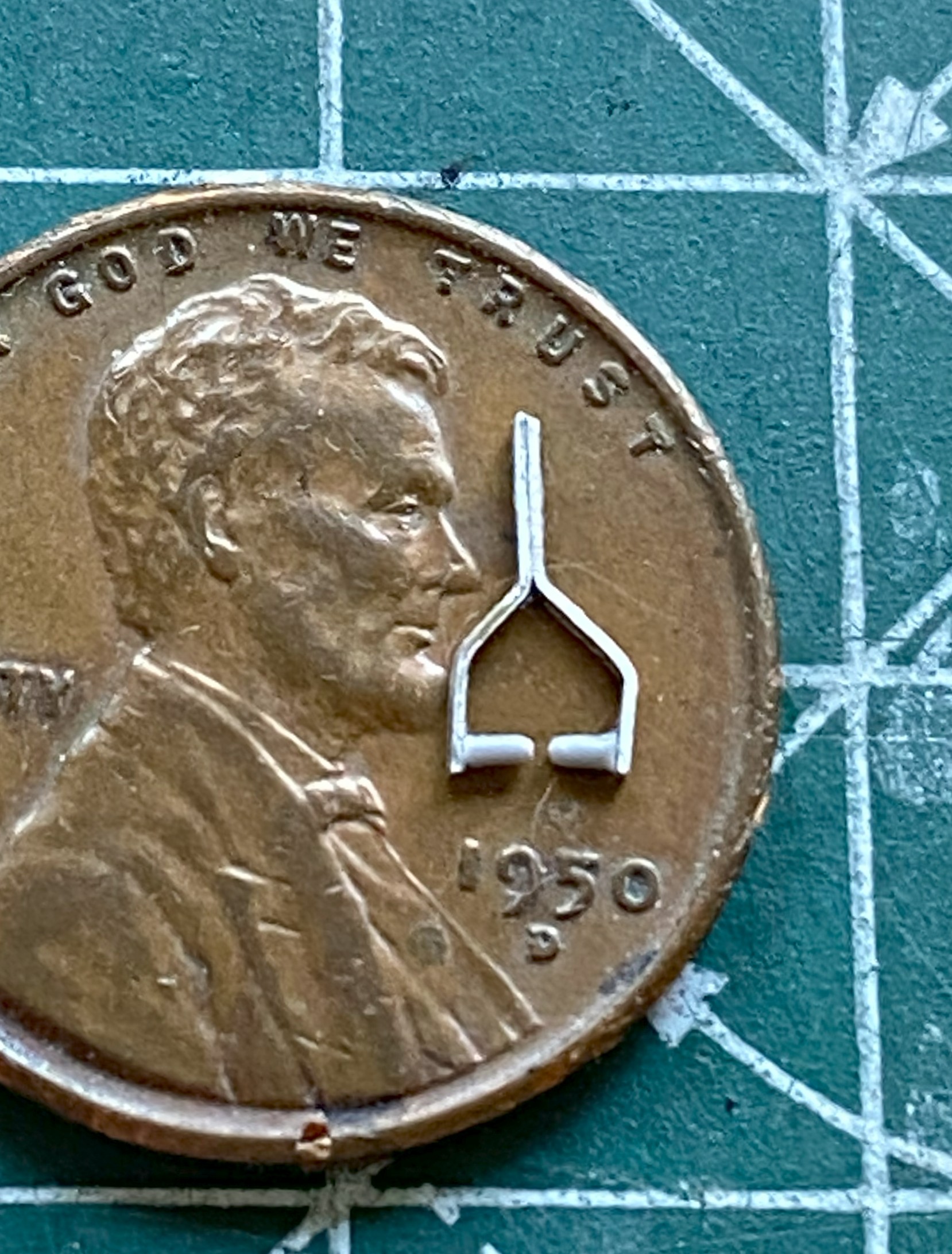
Those were glued to the overhead as were a couple of other levers (UV-setting resin…great for making those infinitesimal knobs on the ends):
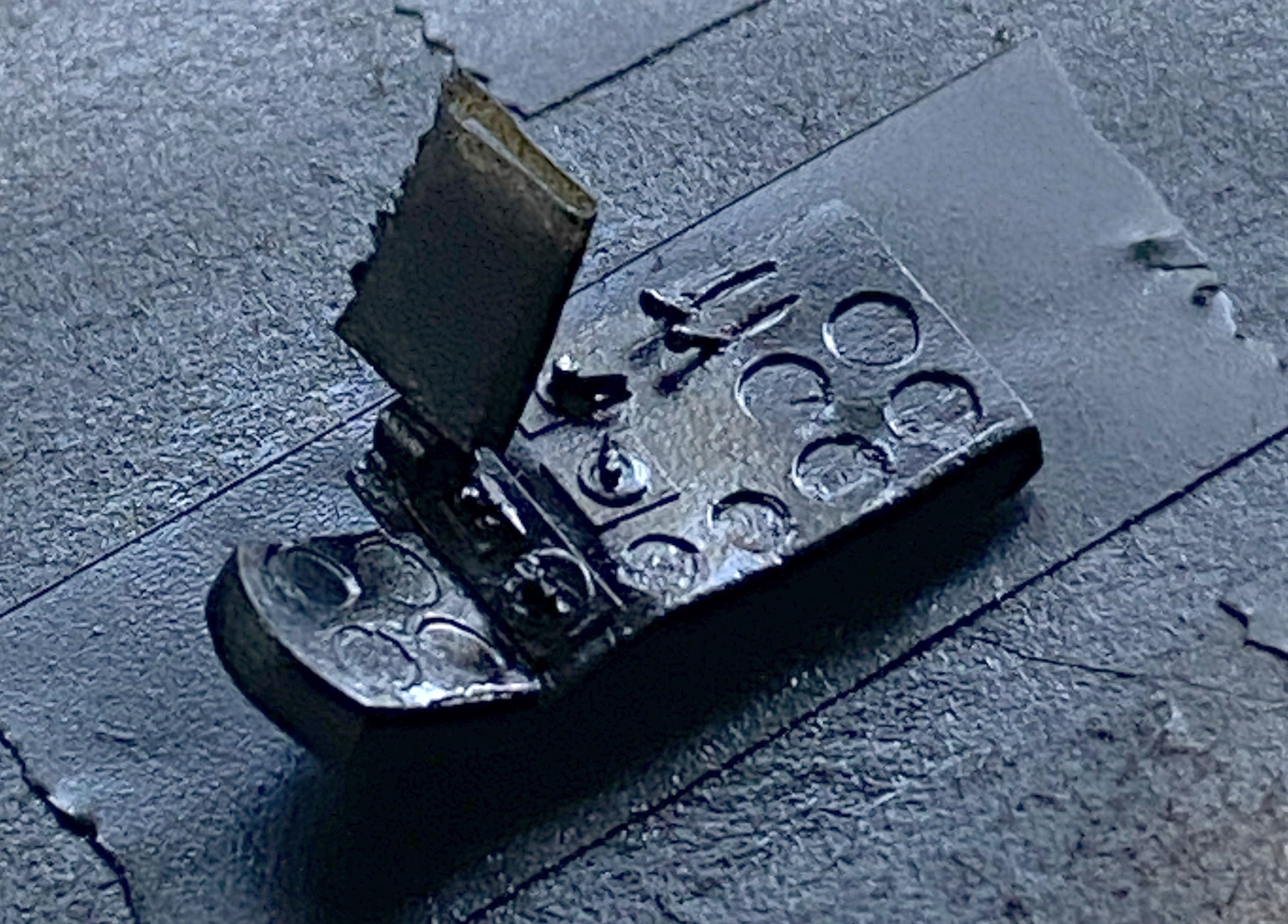
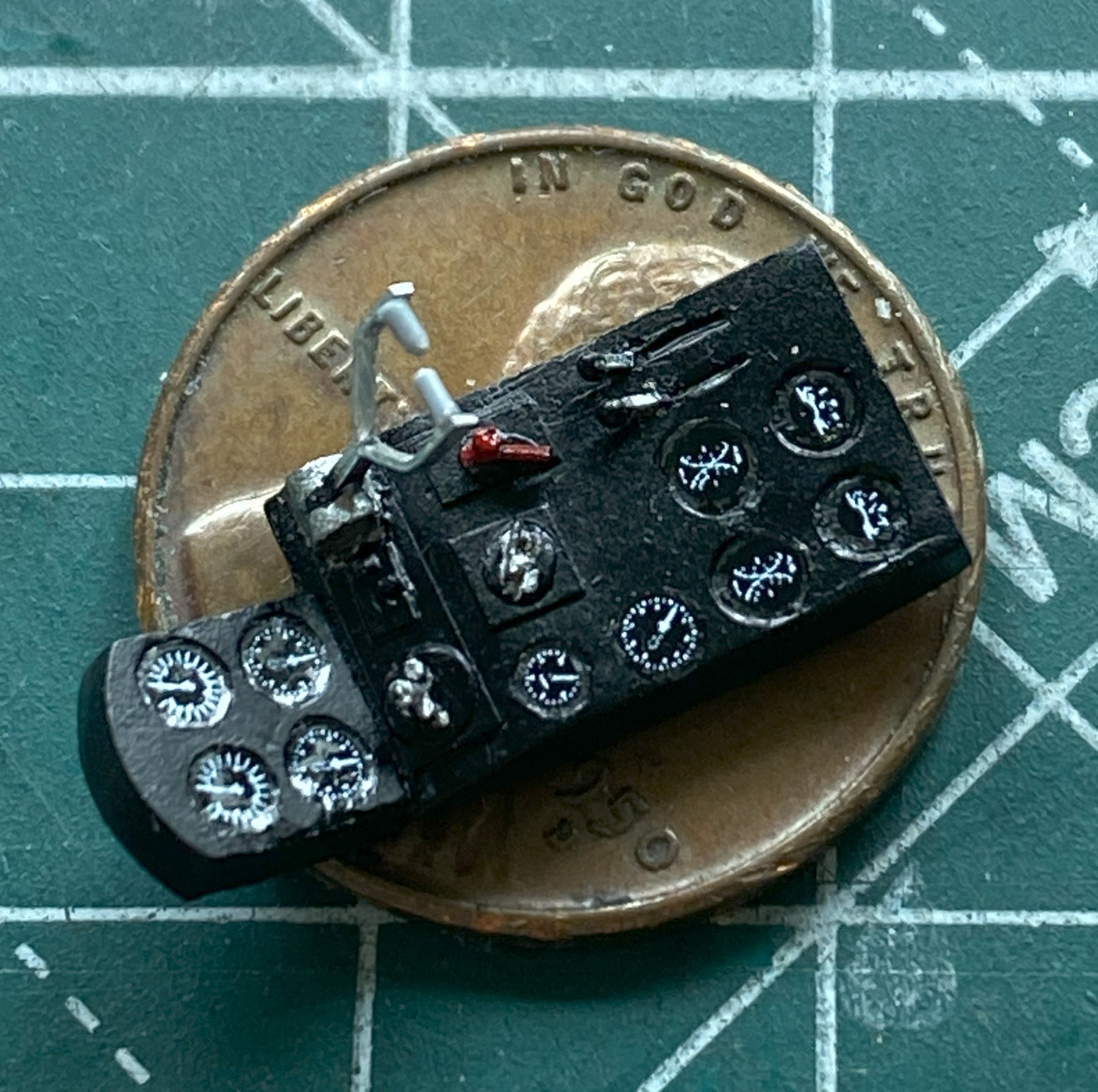
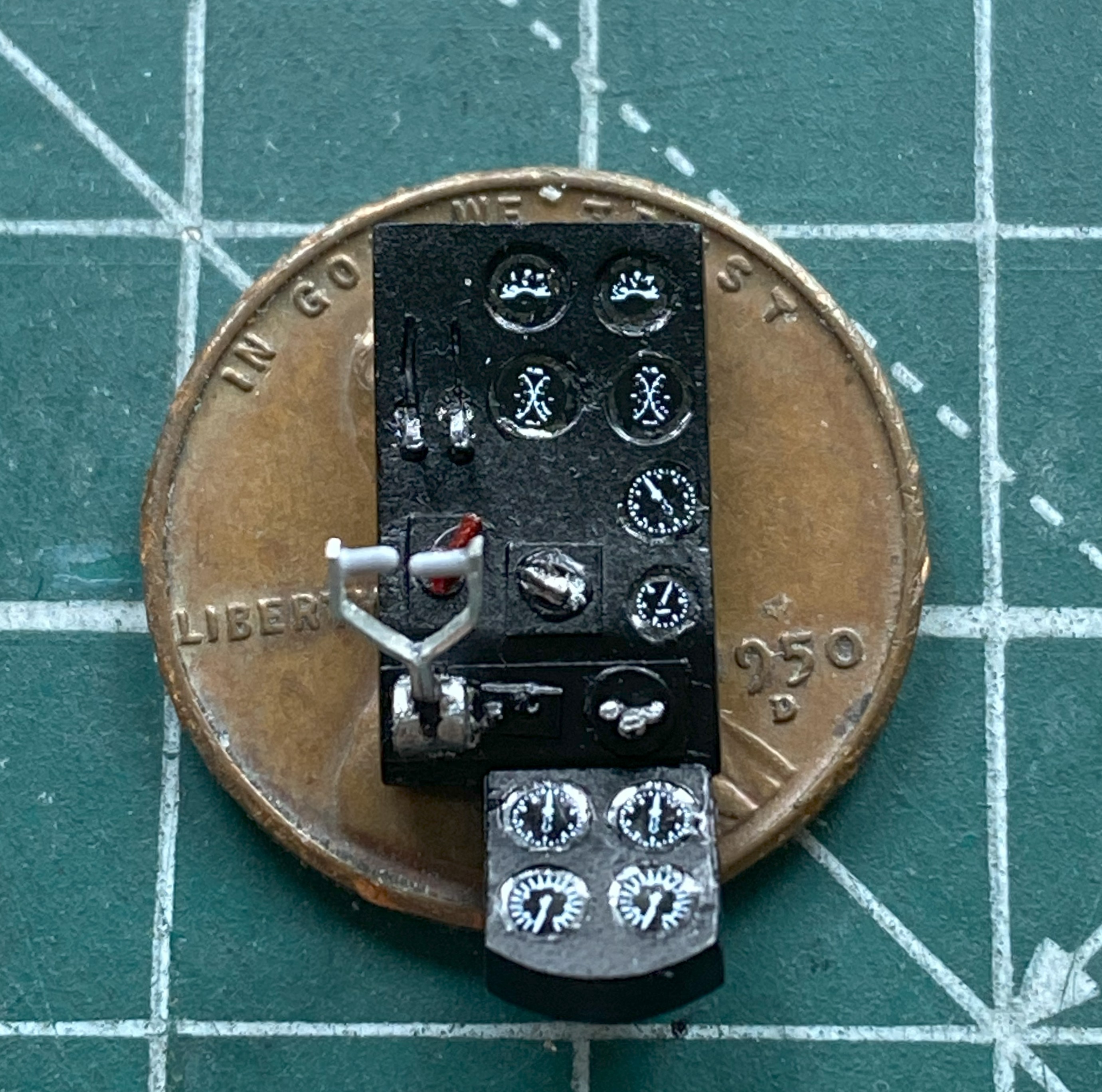
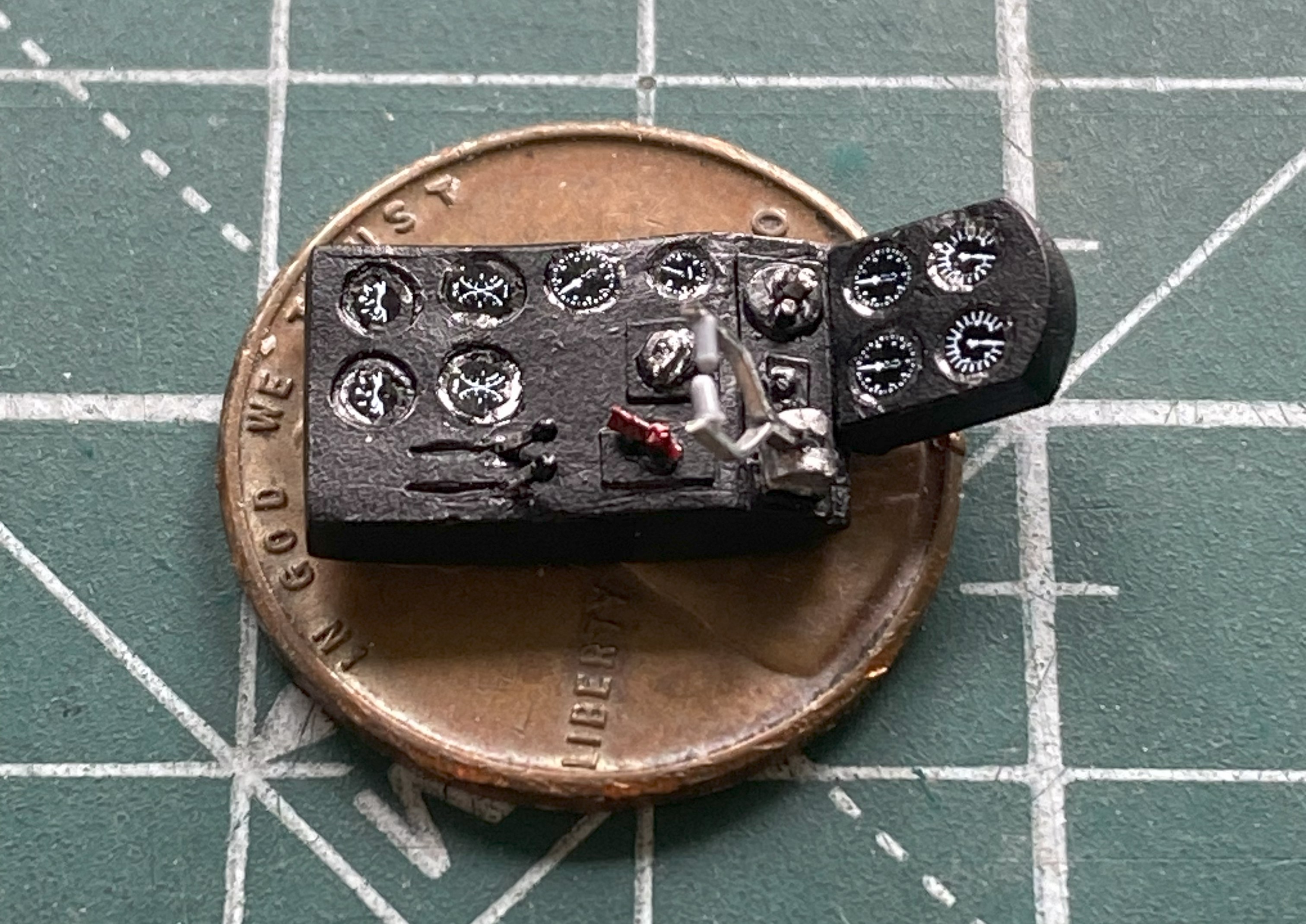
Time to paint it. The overall color is Tamiya X-18 Semi Gloss. Details were brought out by using red and silver paint on some of the switches and levers and Airscale “Instrument Dials, Generic WWII USAAF, item #AS48 USA”:
I don’t know if the dies were sloppily cut or if they’re old. Either way, at the windscreen area where the clear panel meets what will be opaque after painting, there is a radius. A soft corner. I didn’t want that. I know how to fix that with opaque plastic, but doing it that way will totally screw up the areas that need to be clear. I already had 1200 and 2000 grit sandpaper, but I didn’t think that would be enough to return the windscreens to unscratched clear. I went online and picked up 3000, 5000, and 8000 grit to fix this. The panel on the left has been sharpened but not sanded, the panel on the right is as-cast:
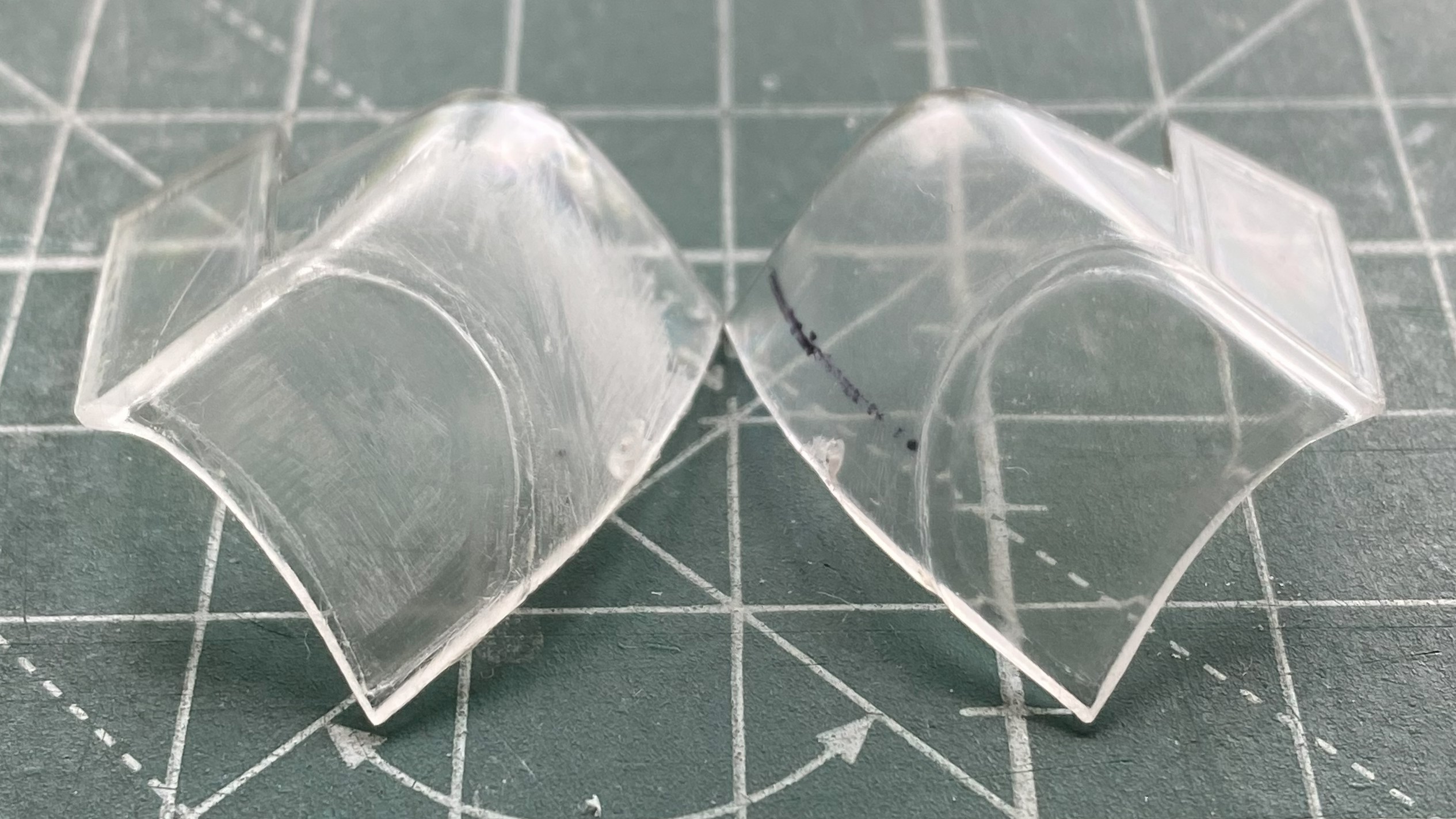
After doing left and right sides and then removing scratches with this progression: 320 grit, 400 grit, 600 grit, 1200 grit, 2000 grit, 3000 grit, 5000 grit, I polished with Novus #2 plastic polish. I was pleased with how clear and blemish-free that left the plastic:

Part of why this clear part fits SO poorly is because of the “wings” on either side. These are actually sliding panels that allow the side windows to slide open rearward. In order to fit this to the fuselage, those have to come off. I intend on making replacements for them (the prototype for which is at the bottom of the photo and covered in masking tape to minimize scratching):

With the overhead console done and the sliding windows removed, it was time to join the two clear parts. When I started that, I didn’t glue the entire join. I figured that since everything else fits so wonderfully (I sure hope you know that’s sarcasm), I wanted to leave enough room where the clear part attaches to the canopy just in case the fit was off (I know that it looks like the join has been completely glues…which it was…and then I realized that I was probably going to need to adjust the fit so I spread the two apart down to the post between the two windscreens before the glue could set up):

I am certainly glad that I made that allowance! The strip of plastic inserted at the rear of the clear piece(s) is 0.040″ (1.016mm) wide. Subsequent work showed me that I could have done with 0.020″ (.508mm) more:
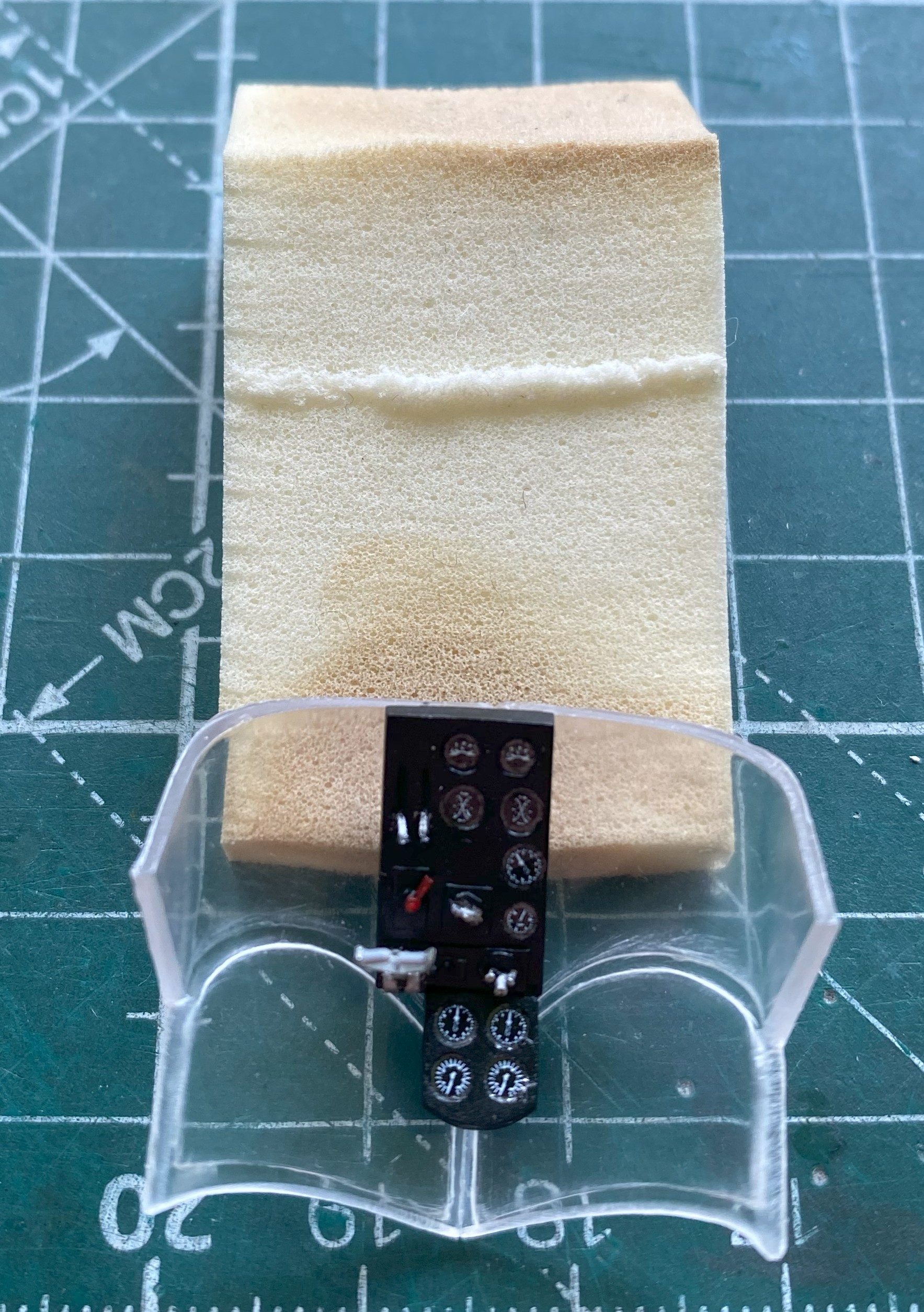
I filled in the gap and sanded it down on both sides before I permanently attached the overhead console (the foam wedge is there to prop the clear part in the most supportive angle while the glue cure):
While I was yanking and cranking on the fit of the clear part, I heard an odd “click”. Investigation showed that I had pushed one of the passenger’s windows inside the fuselage:
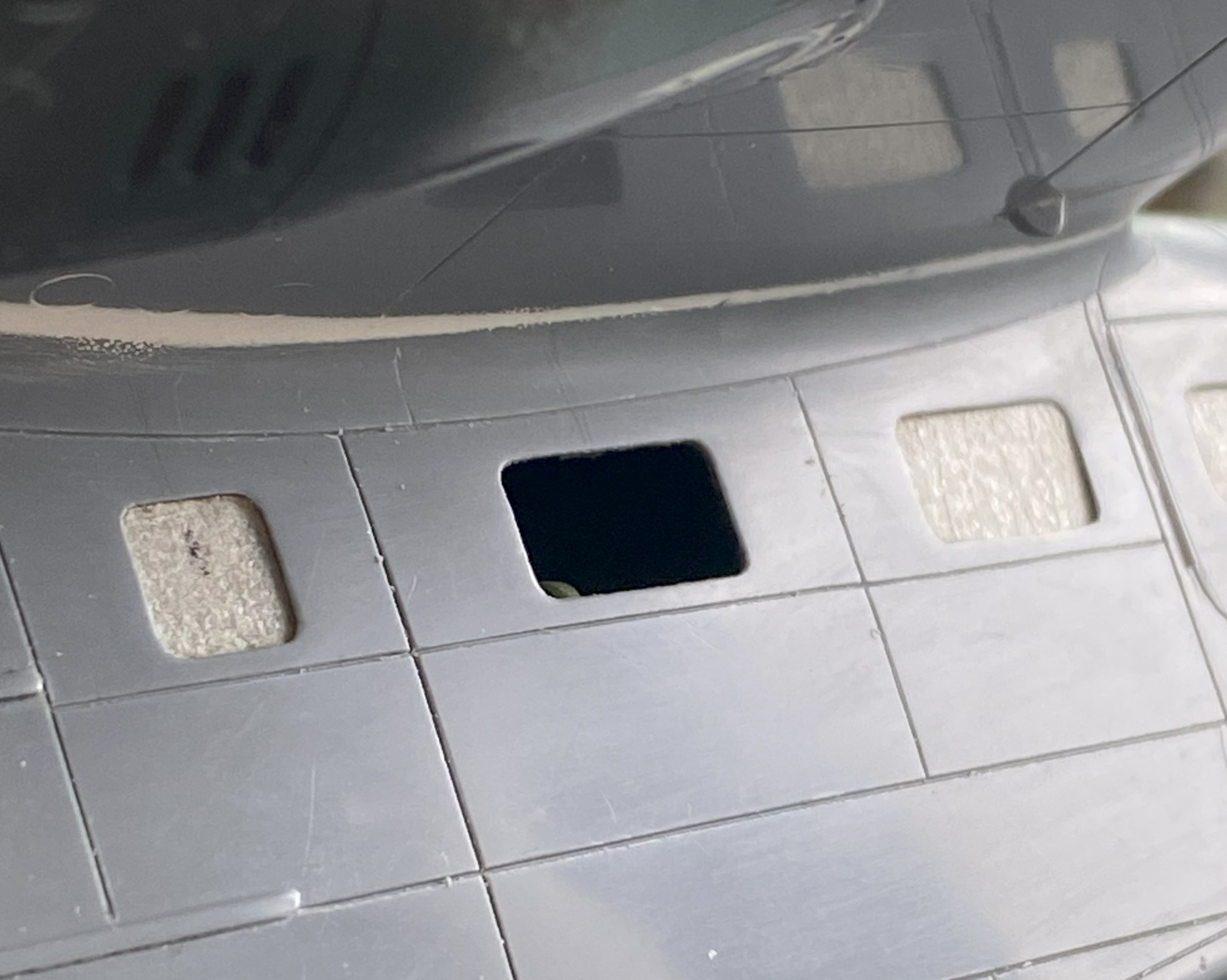
This window can only be installed from the inside. ::face palm::
After much deliberation (read that as kicking, screaming, and threatening Dire Consequences), I decided that cutting out the section of the window between the panel lines would let me get at it to fix it:
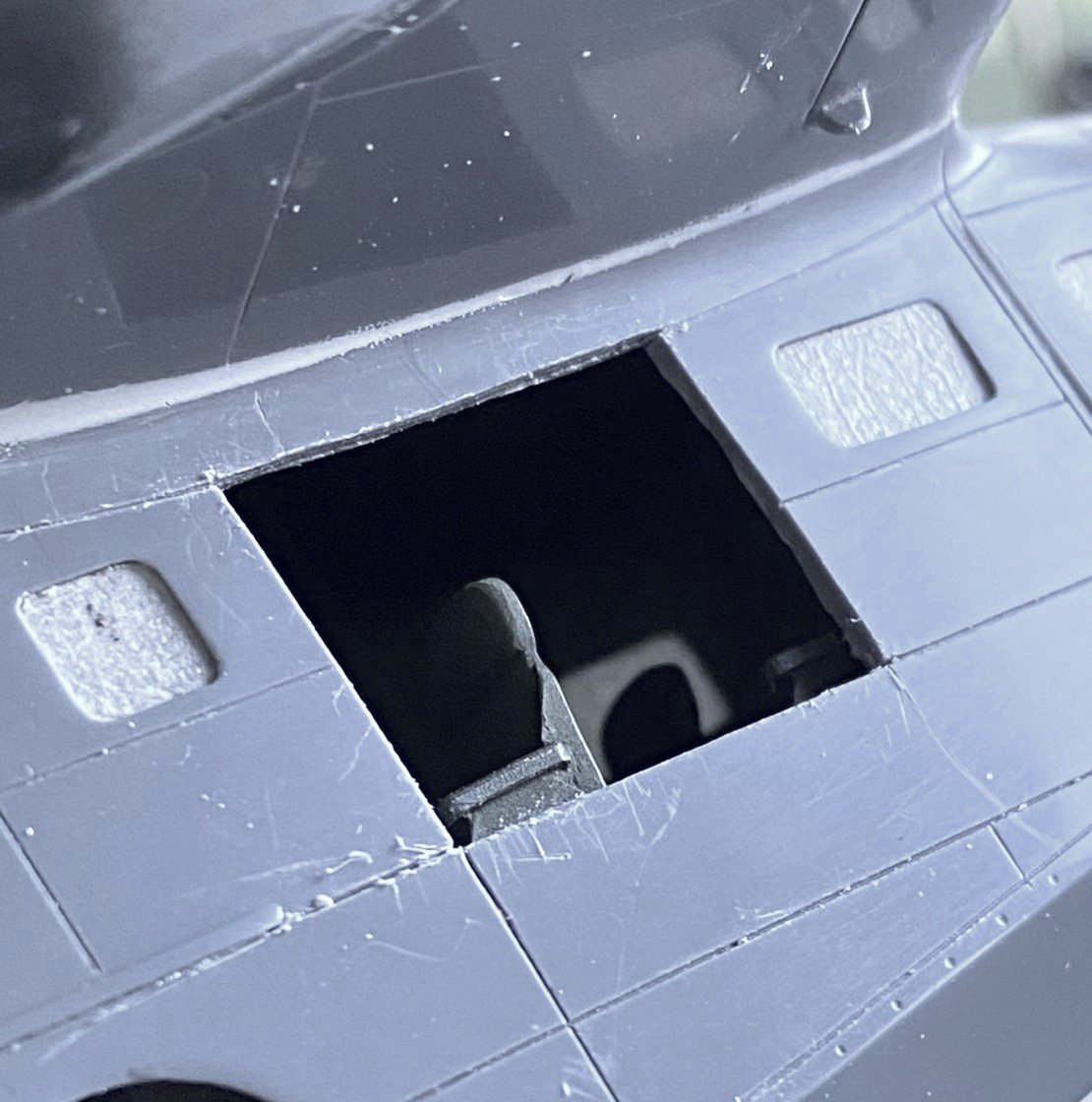
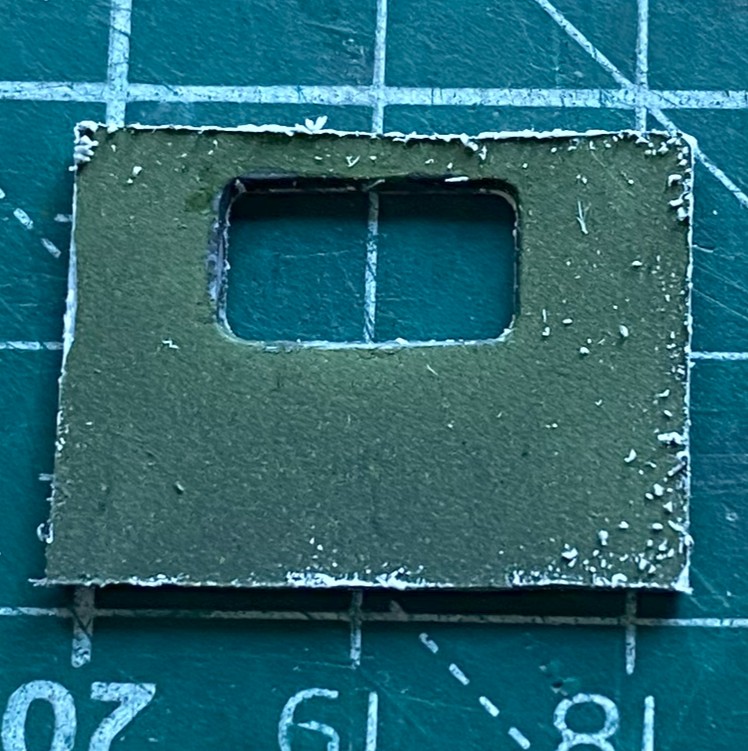
I thought that I’d be able to get the window that popped out (or in) but I rattled that thing like it was a rattle can of rare paint that I hadn’t touched in a couple of years. Nope…not coming out. Okay, easy fix. Get another piece of clear…so I did:


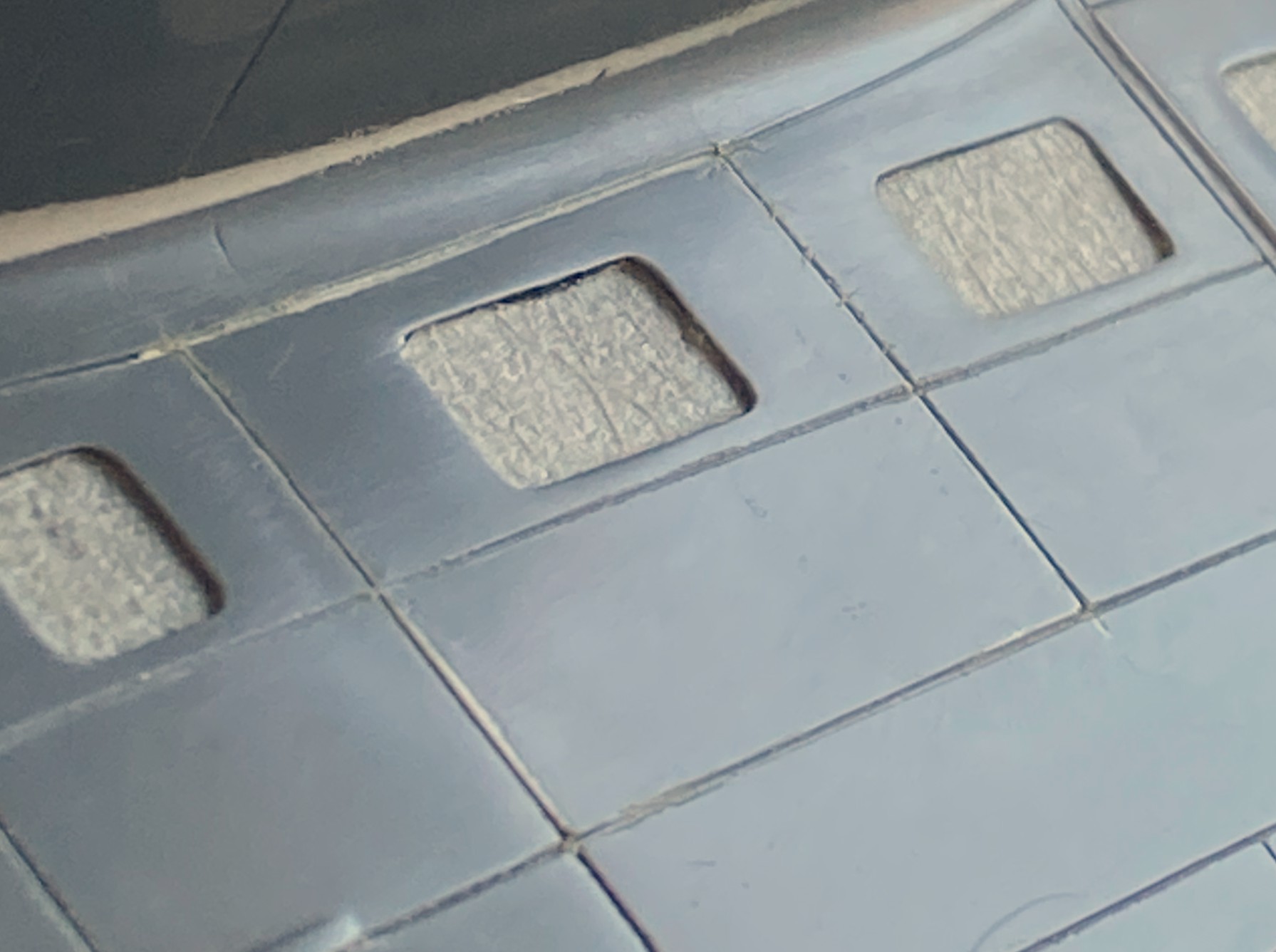
Self-inflicted injuries are still injuries…only without anyone else to blame for it. Moving on.
With that delightful sidetrack, I got the clear part glued on. Note where the blue arrow is pointing. That’s the closest I could get it, mostly. Yes…I could have diddled it into a better fit, but the V shape of the windscreens has to match the V shape where it joins the fuselage. Fixing the poor fit on the sides was the easiest path:

I used UV-setting resin to build up the places I needed to so that the edges matched up:
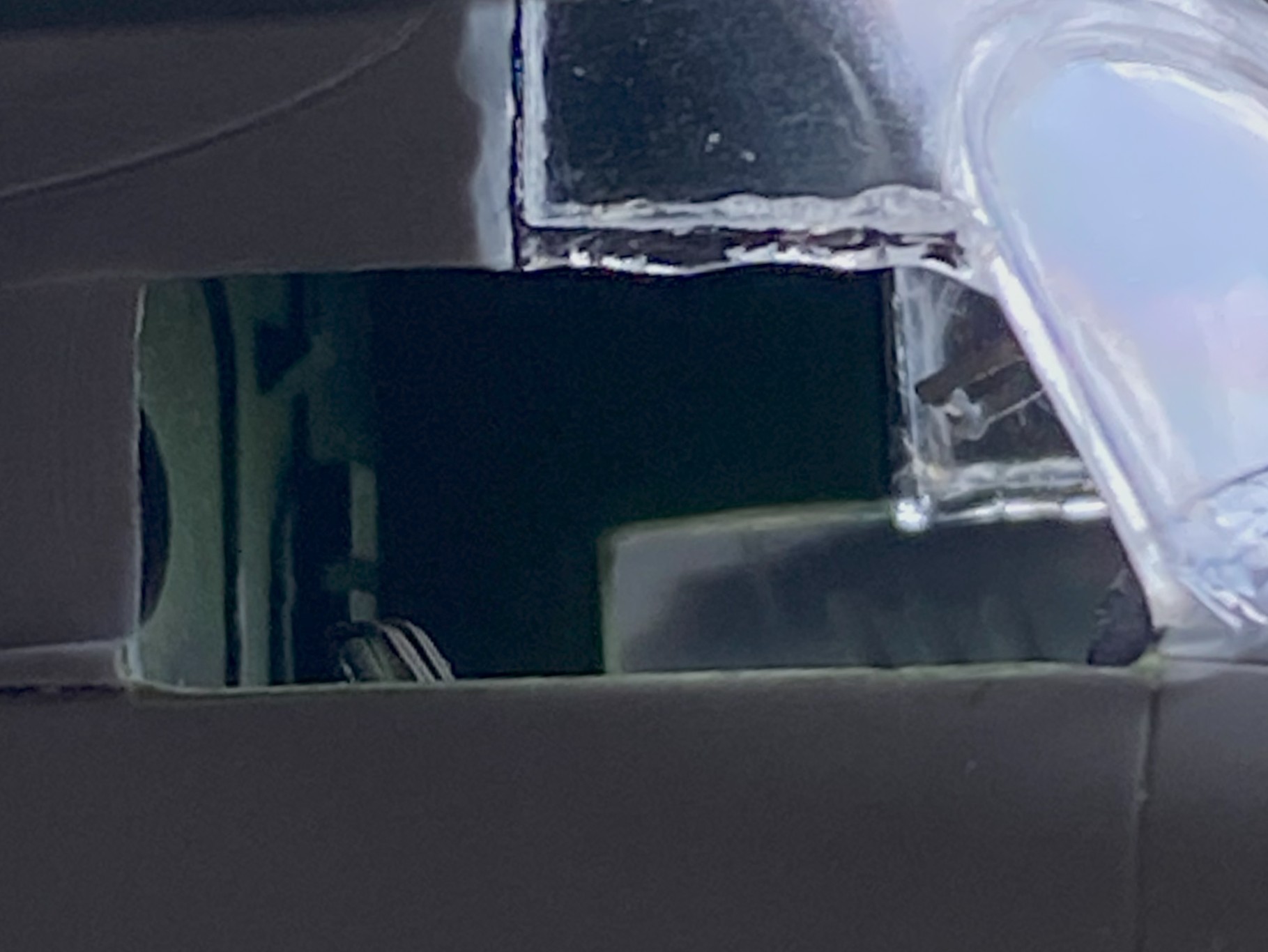
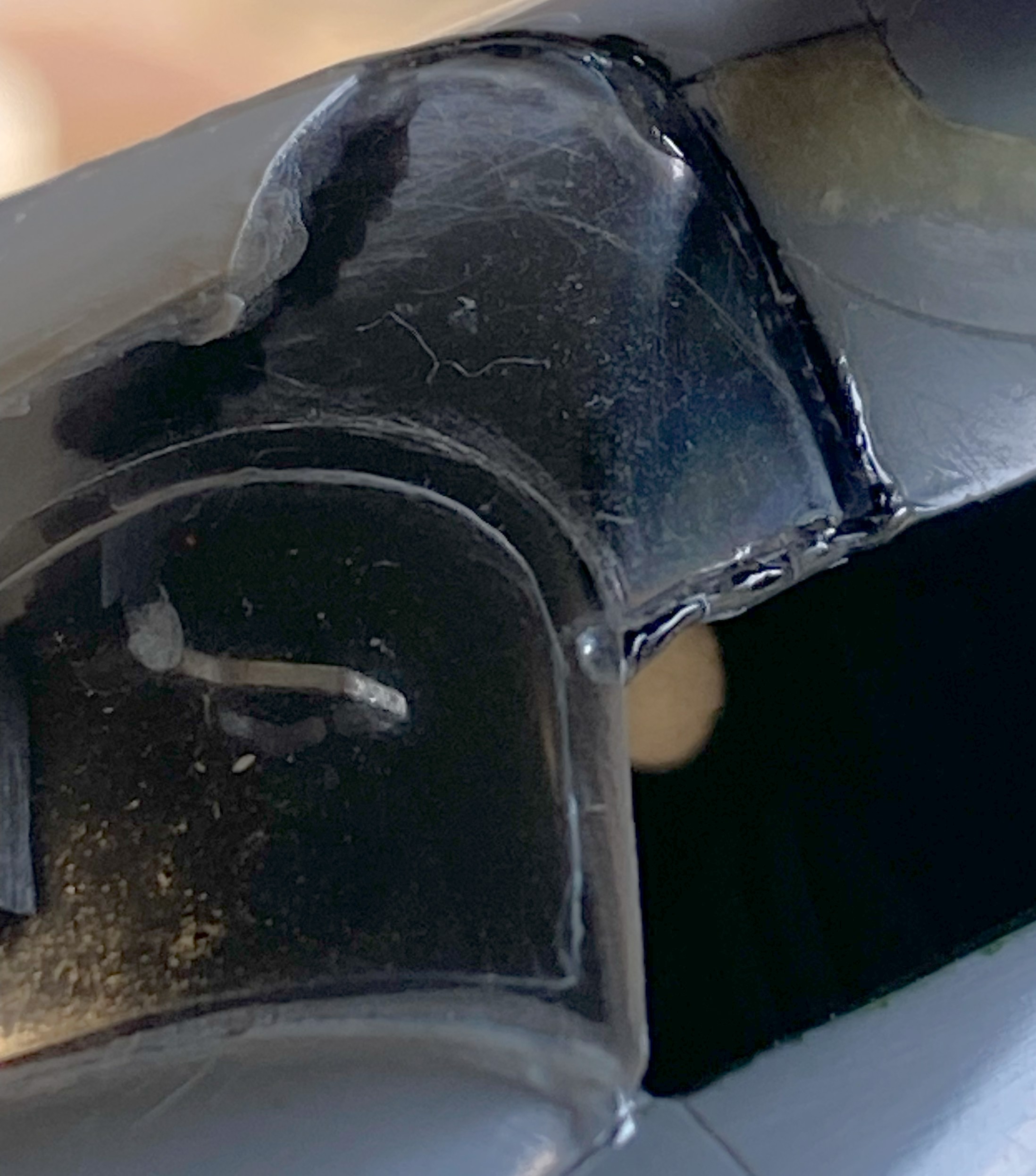
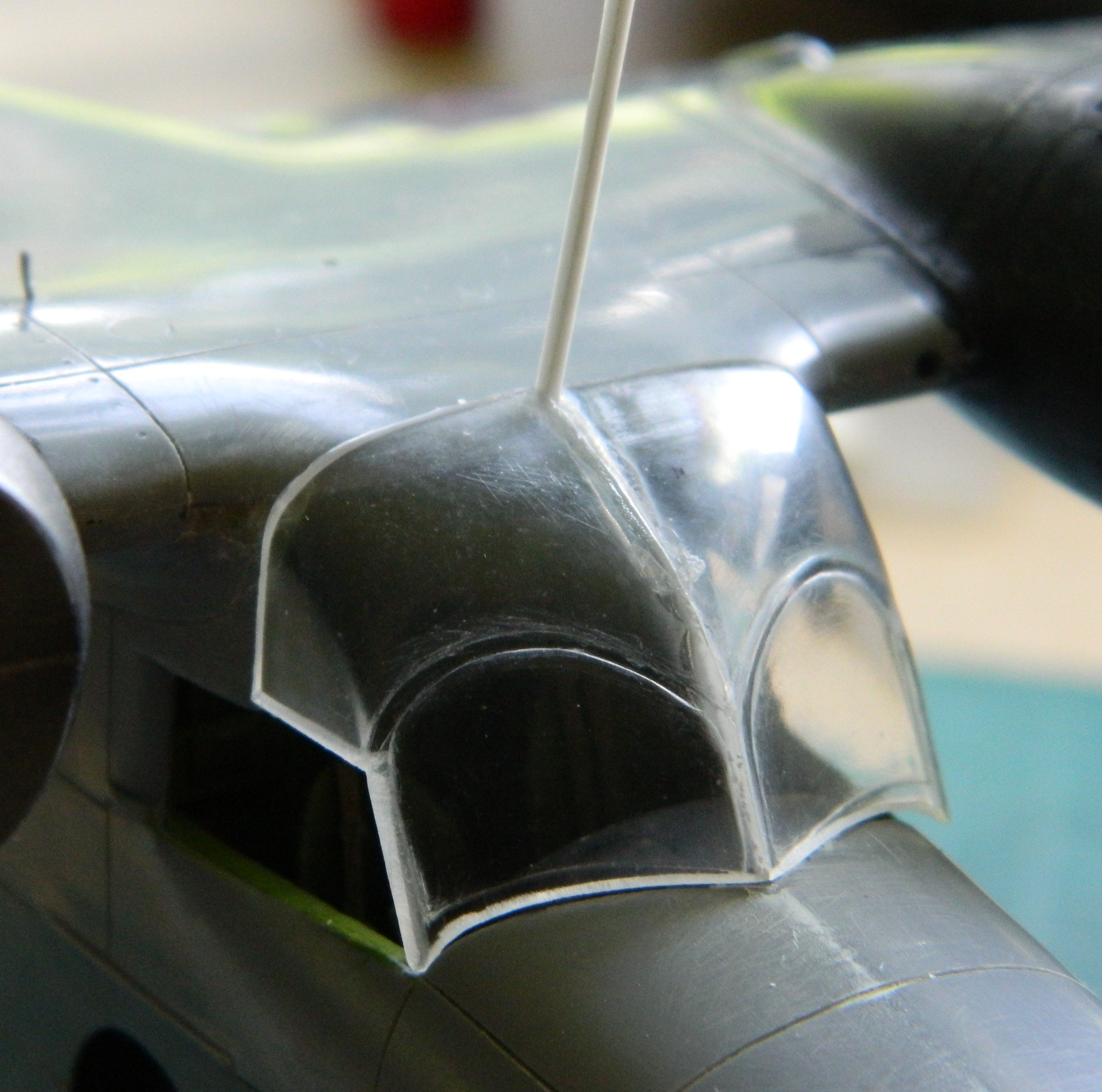
As you’ve probably noticed, I also added a couple on panels of 0.005″ (.127mm) scrap to build up areas to meet the fuselage and wing. Sanding would have removed too much and altered the correct curve at the top. I also added more UV-setting resin to the top join to fill gaps and give me a firm surface to scribe a panel line into:

I also used UV-setting resin to attach the V at the front of the windscreens to the fuselage:

The additional UV-setting resin fixed the problem nicely:


Whew…and it gives me the look I wanted:

Now that painting this is driving the build, I started going over the surface to see what I’d missed. Little things like scribing the underside of the wing root. Dymo label tape is my go-to when I have to scribe a long, straight, scribe (and even then I can screw it up):
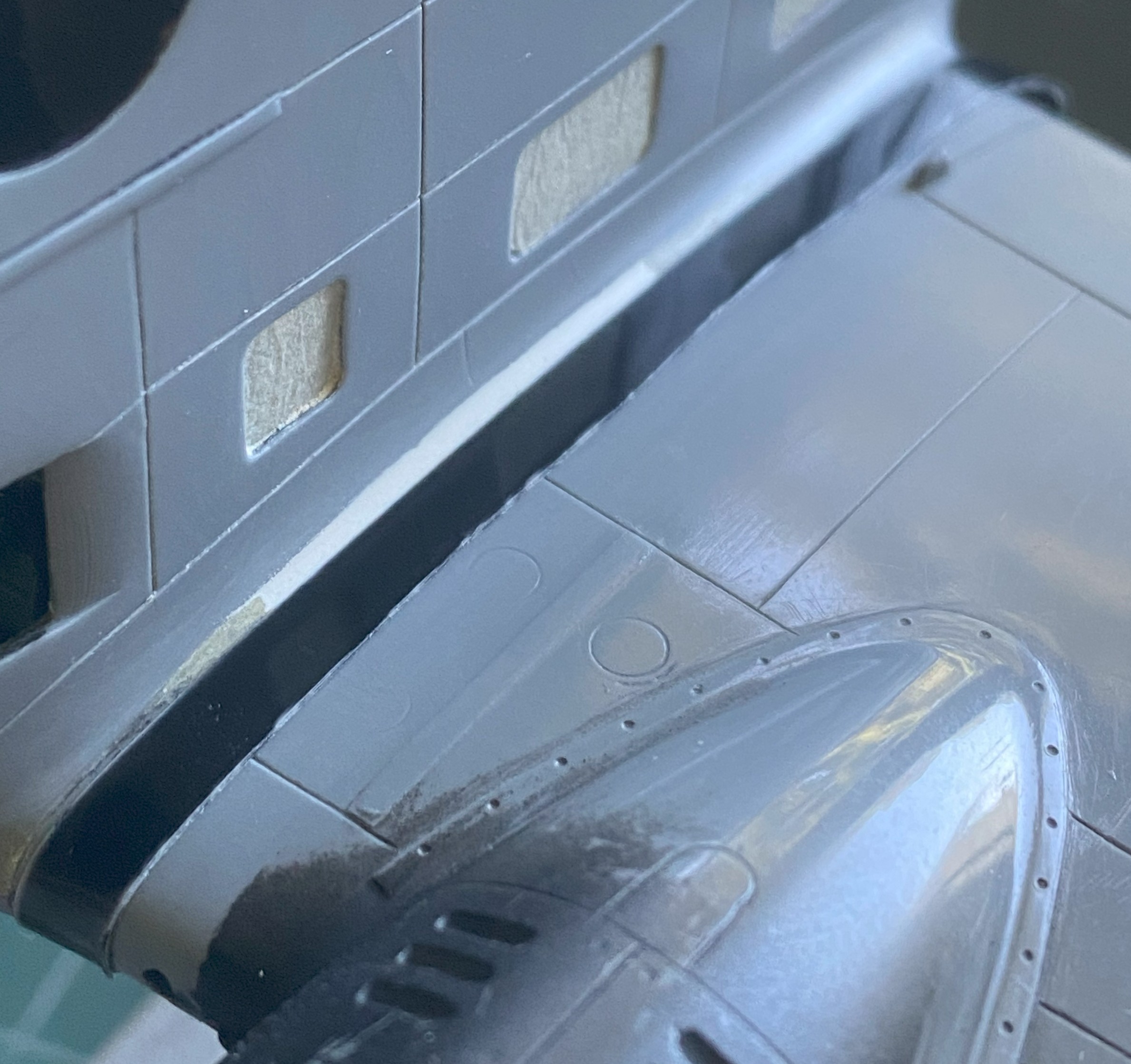
The kit provided no pitot tube (thankfully!) so I made one using 18awg wire and built up the fin that this one had using drops of UV-setting resin, curing it, adding more drops, curing that, until I had enough mass to shape correctly:

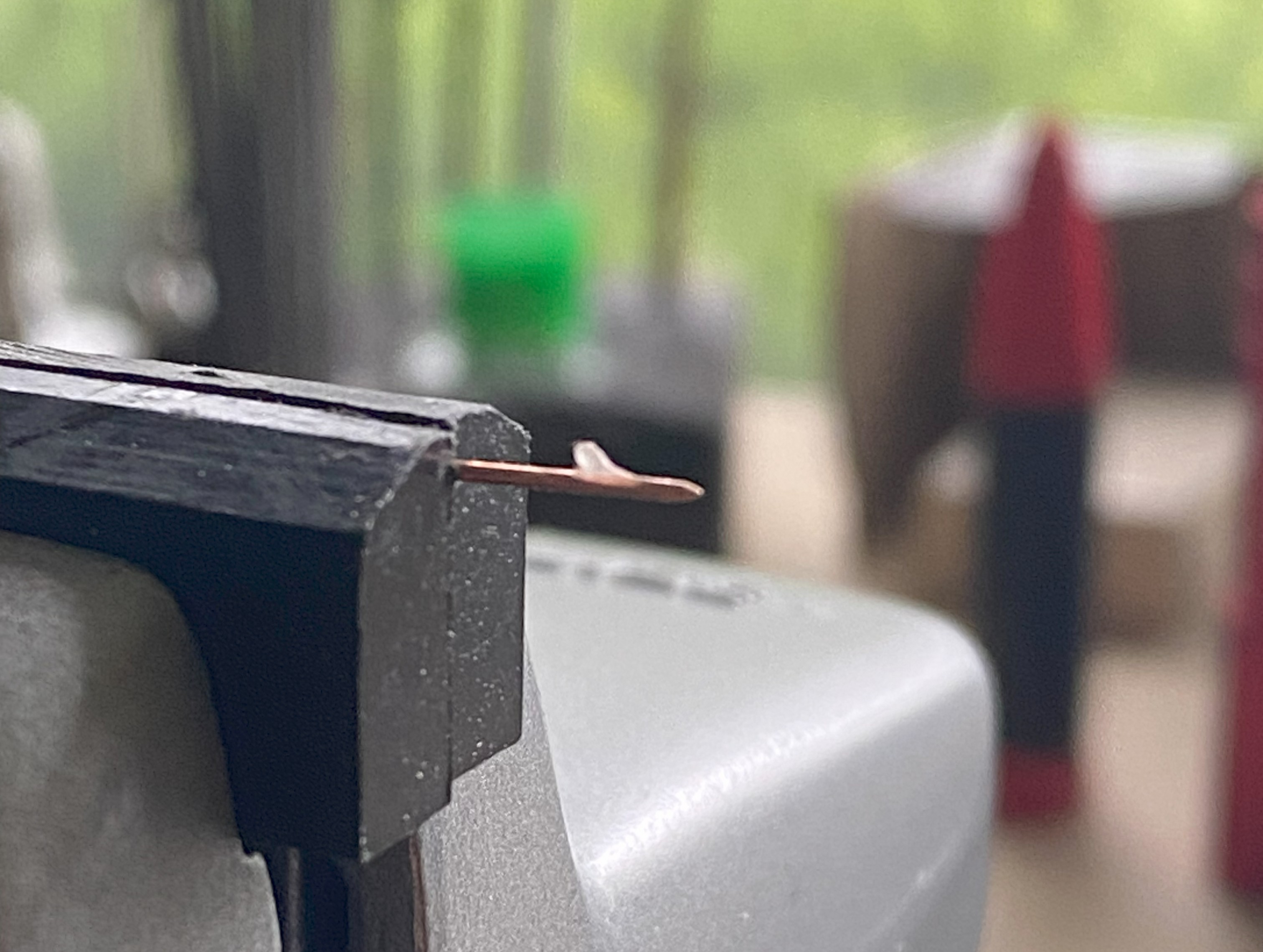
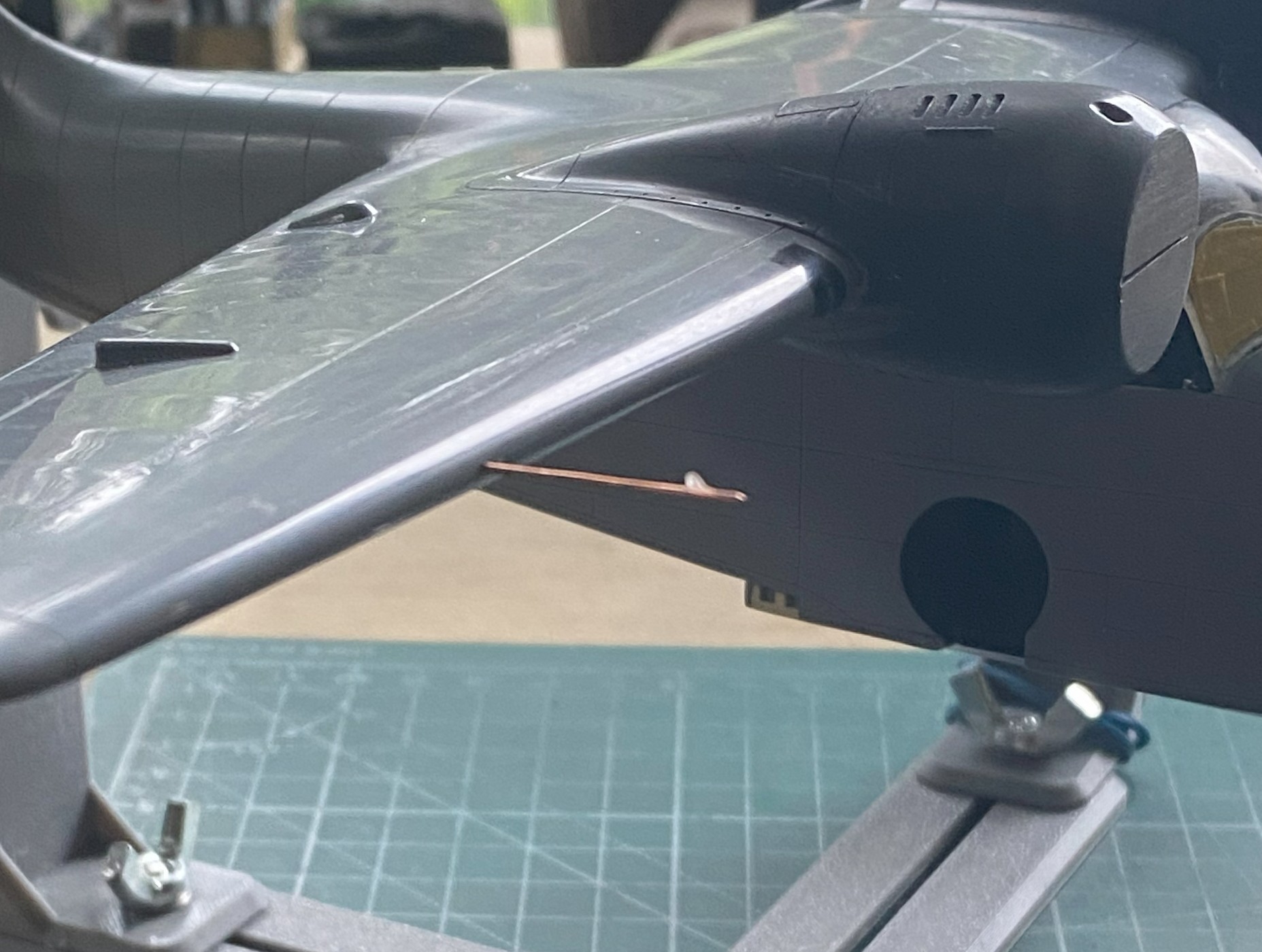
The pitot tube is removable so that I don’t have to make another one later on.
The Goose had a splash shield fitted around the nose and down the sides to the landing gear. This part was far too thick so I thinned it out, and it fit about as well as nothing else has fitted, resulting in me having to snap a section to allow curves to match and sides to extend backward:
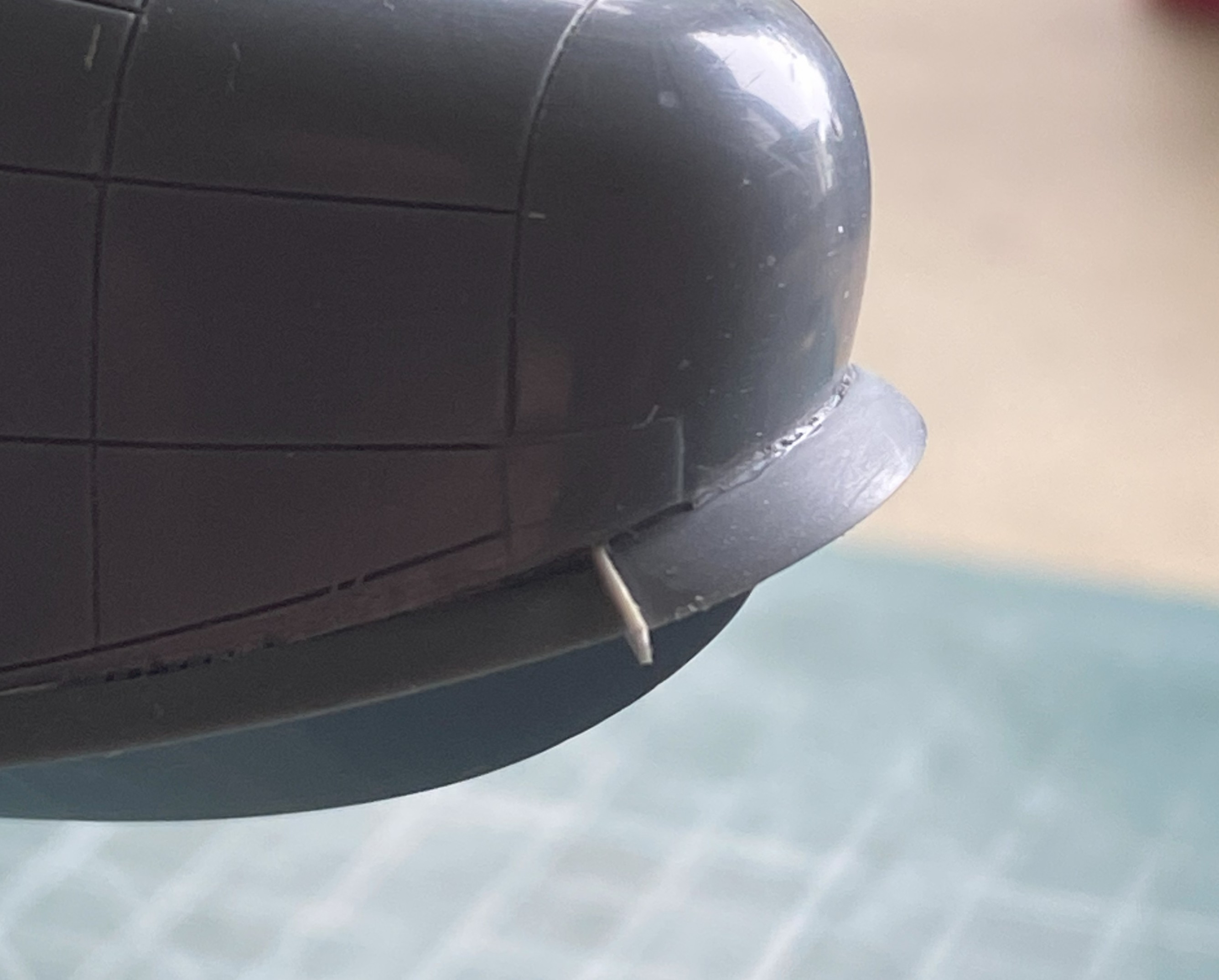
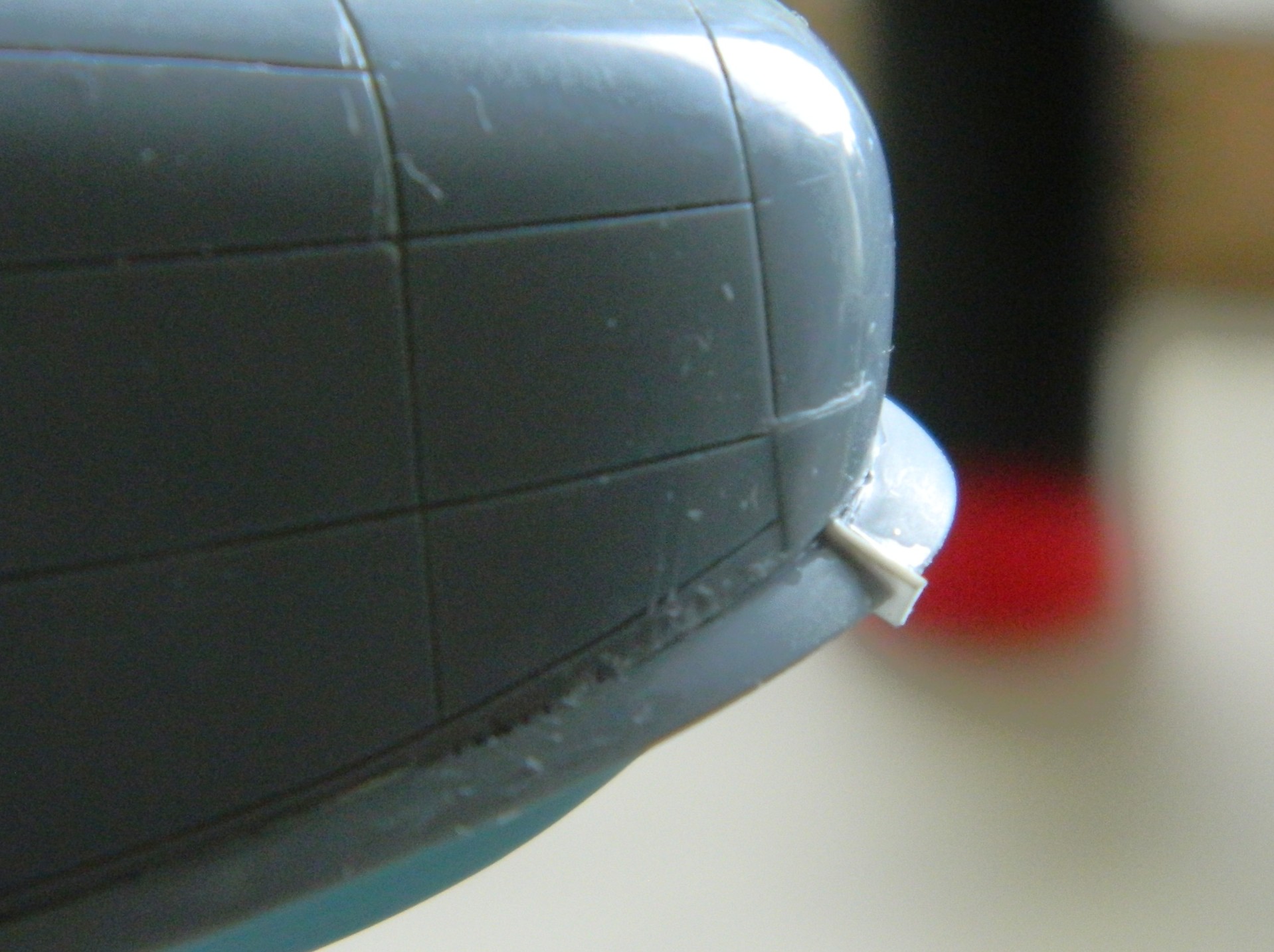
While that glue was curing, I started going over the entire surface again, noting new scratches and the sort for near future attention(s), and then I dropped the whole sodding thing. Few things are so bad that things cannot get worse. This time, I dodged major reconstruction. This is the only damage that happened; the splash shield got dinged:
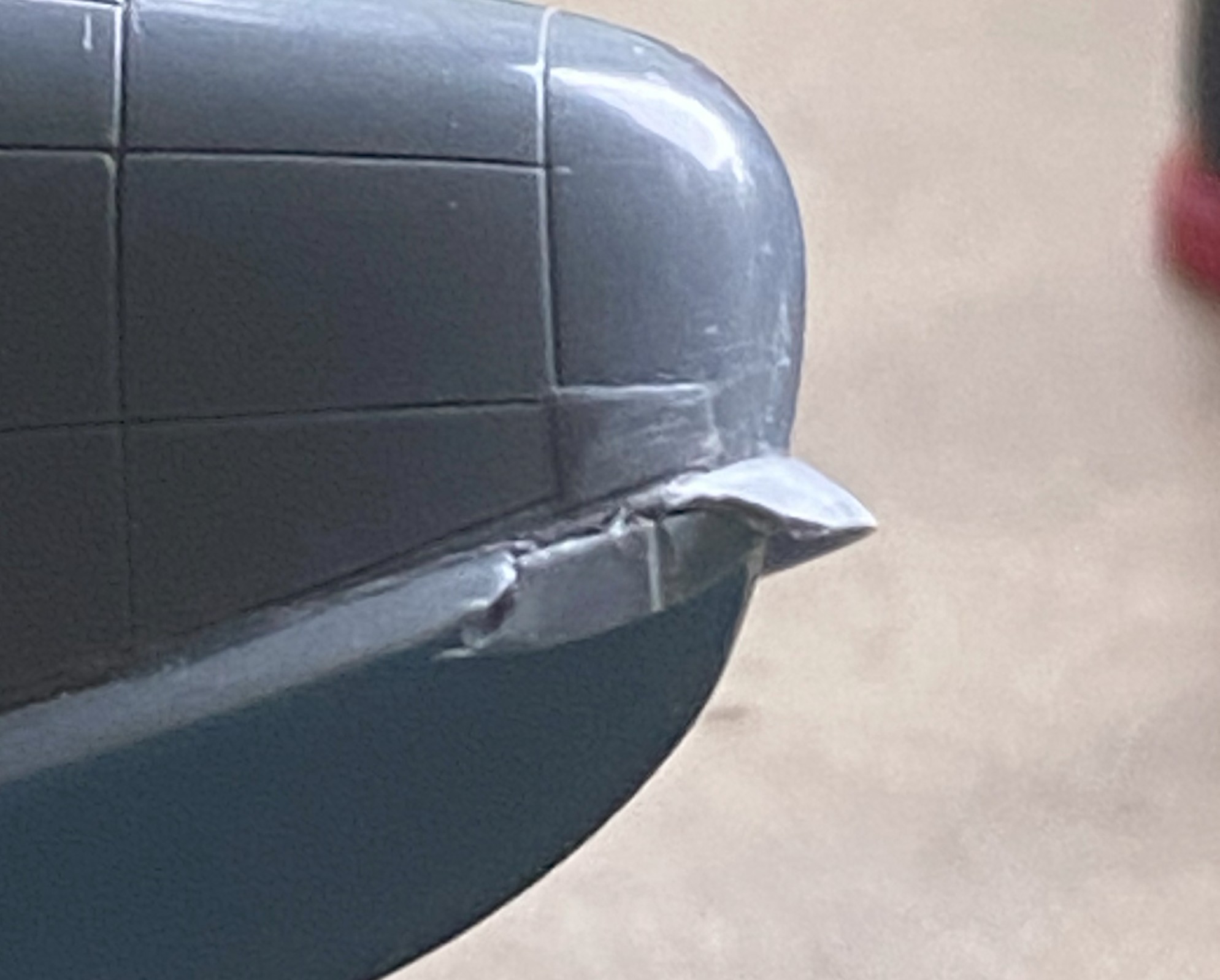
Fine, I’ll fix that too:

I started building the sliding windows for the cockpit. I was doing okay until, once again, I dropped one…and then stepped on it because a simple fix cannot be relied upon repeating itself. Thankfully, these are really simple parts and fixing them won’t present insurmountable obstacles:
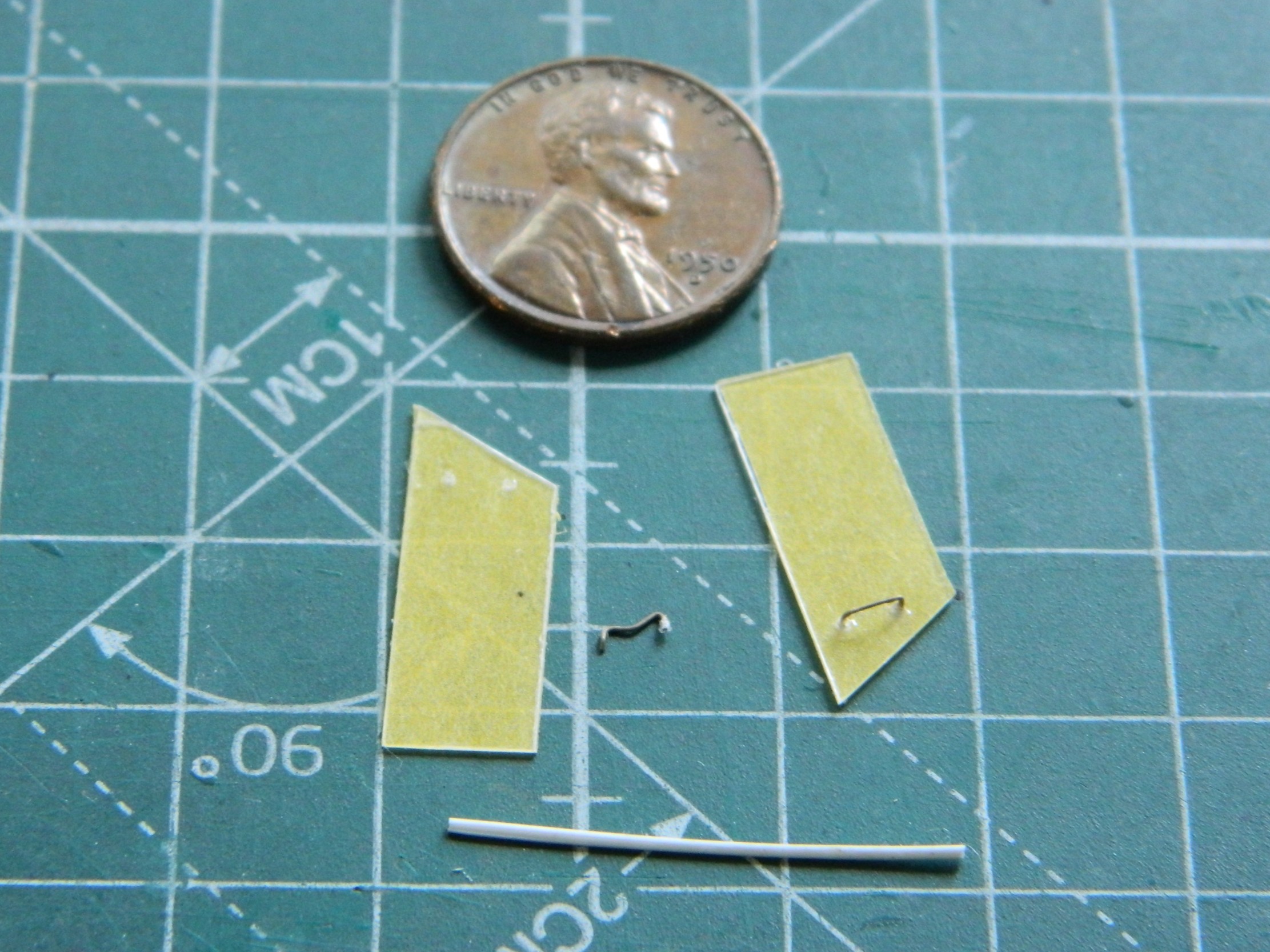
But that’s for next month.
 Scale Modeling Mania